Two days after my husband and I moved to Sunnyside Gardens, Queens, in 2008, an old German man whom I will call Otto introduced himself. He was dressed in shorts, knee-highs, and sandals, his hair gray and thinning. “Hello,” he said as I sat on my stoop drinking beer. “I live in the house with the flowers.”
Everybody has flowers in their front yard in Sunnyside Gardens, but Otto’s flower arrangements stand out: His garden’s neat choreography rivals that of a North Korean mass performance. Trying to reach the ultimate perfection, Otto, in his mid-70s, is always sweeping, digging, raking, pruning, and polishing things. On hot summer nights he sits on his stoop listening to German folk music on an old cassette recorder, while his Puerto Rican wife, whom I’ll call Maria, watches baseball games in the living room.
Otto never misses an opportunity to tell me how much he aches for Germany. Born and raised in the western state of Nordrhein-Westfalen during the Third Reich, Otto immigrated to the United States in the 1950s because his company relocated. He thought he’d eventually go back, but he met Maria and the couple married. In 1982, they bought a house in Queens.
Our block is perhaps the most diverse one in the world. I am a Protestant born and raised in Germany; my husband is Catholic, from Mexico. We met in 2004, in New York City, and married in 2006. Our neighbors are from Pakistan, India, Great Britain, Peru, Ecuador, Australia, China, Turkey, and Ireland. We are white, pink, beige, brown, and black. Our neighbors are Protestants, Jews, Catholics, atheists, agnostics, and Muslims. Most recently, an Orthodox rabbi with his wife and four children moved from Israel to a house on our block to take the pulpit at the Young Israel of Sunnyside congregation, which had been without a rabbi for several years. The synagogue celebrated his arrival with a little parade down our block. Neighbors of all shades and creeds sat on their stoops in the sun; some took pictures and waved at the float that carried the rabbi’s neatly dressed children. In Sunnyside Gardens my husband and I felt at home for the first time in decades. It seemed like a safe and welcoming place.
Aside from our nationality, Otto and I have little in common. We both married Latinos, as he once noted, but in addition to an age gap of nearly four decades, we have different tastes in music, clothes, literature, and garden decor. Until recently, Otto left German tabloid magazines on my front porch for me to read, and not wanting to hurt his feelings, I never told him that they went right into the recycling bin. But despite our differences, when Otto asked me to check in on Maria while he traveled to Germany for a trip, I agreed. This may be his last trip home, he said.
Taking care of Maria was far more demanding than I had imagined. I was supposed to drop by once a day and make sure that Maria hadn’t suddenly fallen ill or down the stairs.
“My head is spinning,” she told me on the first morning. “It feels like I have one head on top of the other.” I looked at Maria’s head. I saw nothing wrong. I offered to take her to the doctor, but Maria waved off my offer. “I’ve felt like this for years,” she said.
The next day Maria complained about back pain. “Damn Otto!” she said. “He screwed up my back.” When I asked what happened, she said, “He had a heart attack and fell on top of me.”
Each day Maria complained about something else. She hated hospitals because of the black nurses, and Jews because her sister was married to an allegedly lazy one. She hated the envelope I bought for the “Home Sweet Home” calendar she wanted to send to her sister (presumably the one who married the “lazy Jew”). Maria also hated the milk and the potatoes her Puerto Rican neighbor got her. She even hated Sunnyside. (“Too many trees,” she said.) I was sure that Maria hated me too.
The last few days of Otto’s absence, Maria played possum. I rang the bell but no one opened. Just to make sure everything was OK, I walked past her house at night to check whether the lights came on. They did.
When Otto returned from his vacation, he stopped by my house. “I’m sorry about my wife,” he said. “I think she’s faking it.” There was no way of denying that something was wrong with Maria, so I didn’t.
But what was wrong with Otto that he would be married to Maria? He didn’t strike me as a hater. He, too, had mentioned his lazy Jewish brother-in-law, but added apologetically, “You know there are good Jews and bad Jews.” At least he’s trying to make a distinction, I thought. I decided to let it slide.
***
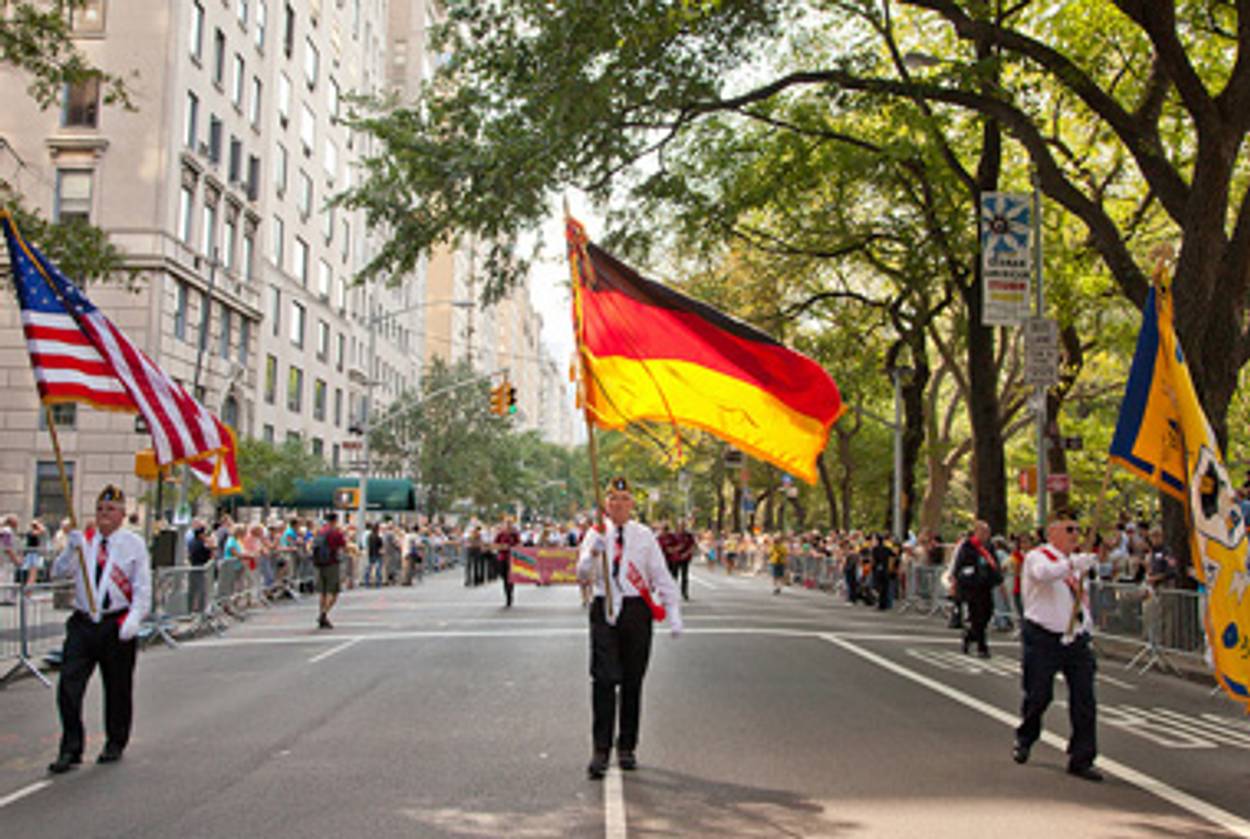
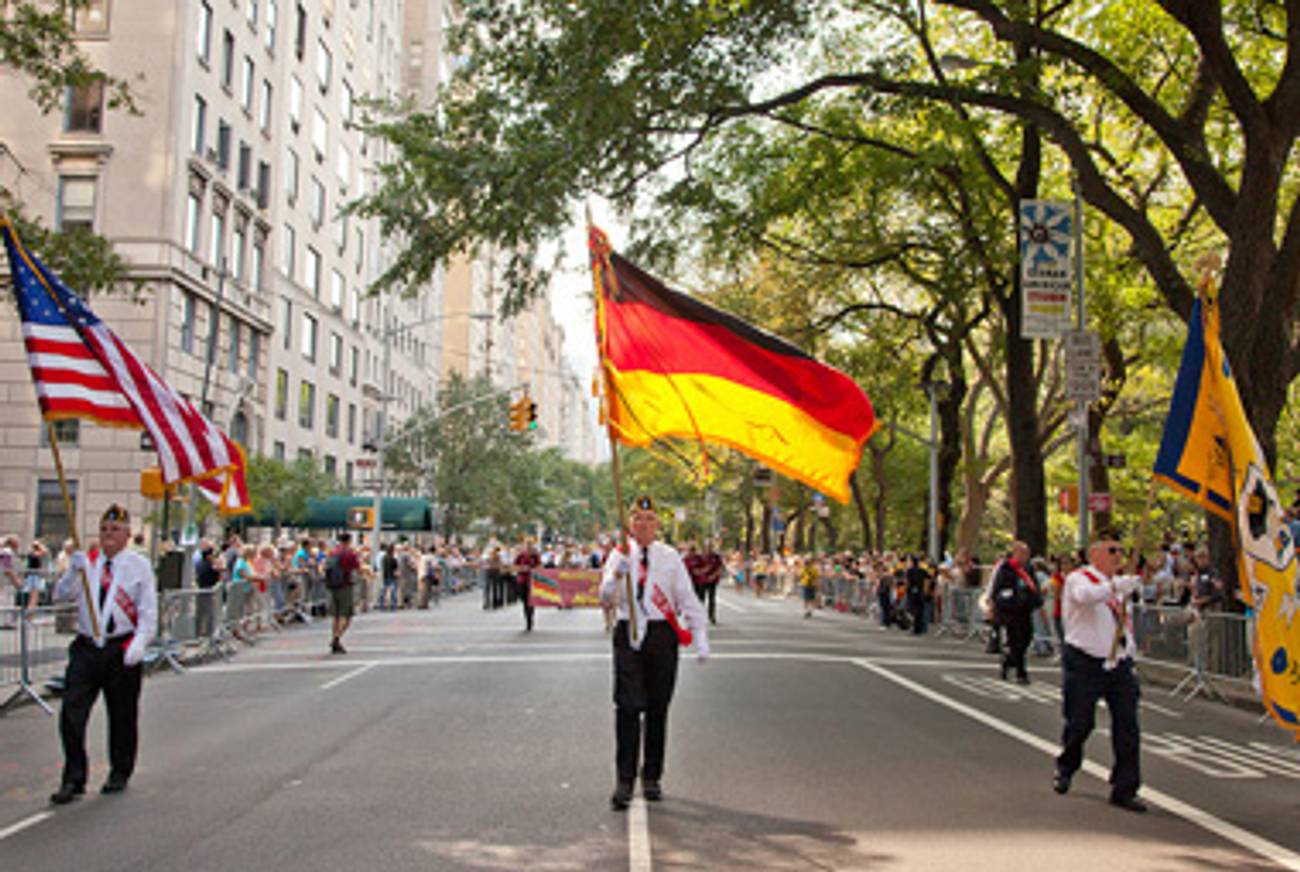
The Upper East Side of Manhattan hosts a big German parade each summer, the Steuben Parade. In my 10 years here I had never gone. Last summer when Otto asked me if I wanted to join him and a German friend, I agreed. My mom had recently sent me her old, custom-made dirndl dress, and the prospect of wearing it in public made me giddy. It was 90 degrees and incredibly humid. My short hair stuck up in all directions.
I schlepped myself to the subway, a hybrid of Snow White and Nina Hagen. The dark blue skirt and its baby blue apron dragged on the ground. The dirndl’s dark red corset was so tight that my otherwise small chest pushed out over the top. Otto and his friend were in awe. Such a nice dress! And just for the parade!
Maybe I subconsciously tried to compensate for their praise by moving away from them once we got to the parade and spending most of my time talking to a black NYPD cop who was leisurely leaning against a Fifth Avenue lamp post. Officer Charlie told me that of all the parades in New York, he liked the German one the best. The Germans, he said, always start and end on time. Germans don’t litter, scream, fight, get drunk, or take off their clothes. There has never been any trouble at the German parade.
“You must be proud to be German today,” Charlie said. My level of discomfort began to rise. Then Dr. Ruth Westheimer, sex therapist and the Grand Marshal of last year’s parade, rode by on her float. For the briefest moment I felt a tiny bit proud to be German. I tried to explain to Charlie that Germans often have a difficult time with national pride—unless, of course, the parade organizers choose a C-list celebrity as their grand marshal. National pride has fueled too much horror. Charlie nodded, and I didn’t know whether he understood me or whether my speech about national pride was drowned out by the inappropriately named MC Digga, “Philadelphia’s Best German Rapper.”
From early childhood, my generation of Germans was trained to be unpatriotic. In first or second grade my class was led to our village’s Jewish cemetery and told about the horrors of Nazi Germany. After the visit we had to take a test. We were to draw and explain Jewish gravestone symbols. I failed the test because my Star of David had too many points. We never sang the national anthem; as far as I know, a pledge of allegiance doesn’t exist. I didn’t meet a Jew until I visited New York when I was 26. I assumed he must have hated me for being German.
In the distance I could see Otto and his friend waving their German paper flags vigorously. Otto had even bought a flag for me. I was reminded of my grandmother’s stories about the Nuremberg rallies. When asked about the Third Reich, she said, “It was the best time of my life.” She would recall the times when she rode to the rallies on the back of a horse-drawn cart. “We had so much fun,” she used to say.
My paternal grandmother was born and raised in Baiersdorf, a small Bavarian town 15 miles from Nuremberg. I grew up there too. She alternatively insisted that Baiersdorf never had any Jewish residents and that the Jews had left long before she was born. In fact, Baiersdorf has a big Jewish cemetery, and until Kristallnacht in 1938, when the Nazis ransacked Jewish homes, businesses, and synagogues, Baiersdorf also had a mikvah and a synagogue.
As a child in the 1980s, I watched my mother, the daughter of self-proclaimed socialists, argue with my grandmother, her mother-in-law. When I was old enough to fight, I would participate. Eventually we stopped talking about the Third Reich. Partially because I felt I wasn’t an authority on the Holocaust, on what people knew and what they were in denial of, and partially because it is hard to question a shrunken, wrinkled 95-year-old woman who had long lost the ability to go to the bathroom by herself about the best time of her life. But still, her bigotry would often find its way into our conversation. Only now it was the Turks who were bad and should go back to where they came from. Again, we would fight. The fight usually ended with her saying, “I have to discuss this with my people. They’ll understand.”
I never knew who her people were, yet they concerned me. Apparently, there were more bigots, the only difference was that they weren’t as outspoken. Who, I wondered, were her people? The question continued to haunt me even as I made a new life 4,000 miles away. Surely, I thought, they aren’t in Sunnyside, Queens.
On her deathbed, three years ago, her voice and mind twisted by yet another stroke, my grandmother said to my father, “You know what we need now? A horse and carriage, then we could go home.” It seemed to me that in her last hours she was reminded of the best times of her life and the horse-drawn carriage on which she rode home from the Nuremberg rallies.
In the cab Otto had a sad expression on his face. The parade, one of the highlights of his year, had come to its end. I suffered, too. The thick, tight fabric of my dirndl was now soaked with sweat. The dirndl, a symbol of home—or Heimat—encased me like a casket.
“If it wasn’t for Maria,” Otto said. “I’d be on a plane home by tonight.”
“You must really love your wife,” I said.
“Love? Ha-ha!” Otto laughed. He elbowed his friend in the ribs.
Another season, another parade. It is virtually impossible to escape parades in New York City. If there is one that represents my values, it is “St. Pat’s for All” parade in Queens. It takes place each spring and starts on the block where Otto, Maria, my husband, and I live. “St. Pat’s for All” was the first Irish parade in New York City to welcome everyone who wishes to celebrate Irish culture, most notably the gay groups forbidden to take part in the Manhattan St. Patrick’s Day parade. “We err on the side of hospitality,” its organizers announce on their website.
After a group of African-American schoolchildren from the Bronx performed Irish dances in the pouring rain, Sunnyside’s openly gay councilman, Jimmy Van Bramer, affirmed the parade’s motto, adding that Sunnyside is a place where everybody is welcome. Soon Otto appeared. As the Queens Lesbian and Gay Committee passed us, Otto began to boo emphatically. He turned to me and said, “I thought the gays were only in the Village!” Then he continued to boo.
I wanted to say something, but didn’t know where to start. Since my grandmother had died I hadn’t had this kind of conversation. I knew from his comments about his brother-in-law that Otto wasn’t the most open-minded of people, but I had categorized him as a Mitläufer—the German term for the many Nazis who were party members out of convenience—rather than a Rädelsführer, or ringleader.
I felt sick and went home. For the next three days I fretted over how to deal with Otto’s reaction. While my mother would have probably just screamed something at Otto, it certainly wouldn’t have changed his opinion. A few weeks before, I had gotten into a discussion with a complete stranger in the subway about the proposed Islamic center in downtown Manhattan, which he vehemently opposed. In a calm conversation that lasted from Grand Central to Sunnyside I spoke about America’s concept of “freedom of religion.” This seemed to resonate with him. “Maybe you are right,” he said as we parted.
I decided to write Otto a letter—in German, of course. It began with an expression of my hurt feelings. “My husband and I moved to Sunnyside because we thought that here people of all cultures, religions, nationalities, sexual orientations, and skin colors were welcome,” I wrote. “This is the 21st century. Many of my friends are gay, our councilmember is gay, you are married to a Puerto Rican.” And remembering his earlier comments about his Jewish brother-in-law, I wrote, “I thought we had learned our lesson from the Third Reich. I expected more from you.”
Writing the letter put me at ease temporarily, but on my way to Otto’s house I felt sick to my stomach again.
Until I rang Otto’s doorbell, I didn’t know what I would say other than that he had hurt my feelings. The door opened, and Otto, dressed in shorts and knee-highs, asked me to come in, while Maria hovered in the background.
“I would prefer not to,” I said. “You know, last Sunday at the parade? It hurt my feelings when you booed.”
“At the Mexicans?” Otto interrupted me.
“At the Mexicans?” I repeated, perplexed. “You booed at the Mexicans, too?”
Otto nodded. “That’s OK,” he said.
Nothing is OK, I thought.
In one breath I released my little speech about the way I felt when I heard him boo at the gay-parade participants. “Many of my friends are gay and they would feel terrible if they were booed at. I felt terrible.”
“That’s OK. That’s OK,” Otto said again. He tried to shut the door into my face.
“Hold on,” I said. “I also wrote you a letter.” I slipped it to him as he closed the door.
Later, I thought about how it took another parade for me to respond to Otto’s bigotry. To me, parades can reveal how closely pride and hatred are related. The celebration of one group has the potential to fuel discrimination of another—be it Jews, gays, or Mexicans.
The St. Patrick’s Day Parade reaffirmed how happy I was to live in a mixed neighborhood. This is my home. While I still feel a little uncomfortable every time I walk past Otto’s house—as I have to every day—I feel better now that I have responded to his bigotry. I owed it to all those who were not my grandmother’s people.
Sabine Heinlein, a recipient of fellowships from New York Foundation for the Arts, the MacDowell Colony, and Yaddo, lives in New York City.