Family Reunion
A Brooklyn writer, great-great-grandson of a revered Hasidic rebbe, travels to Hungary to see if he feels a connection to his iconic ancestor
December 09, 2011
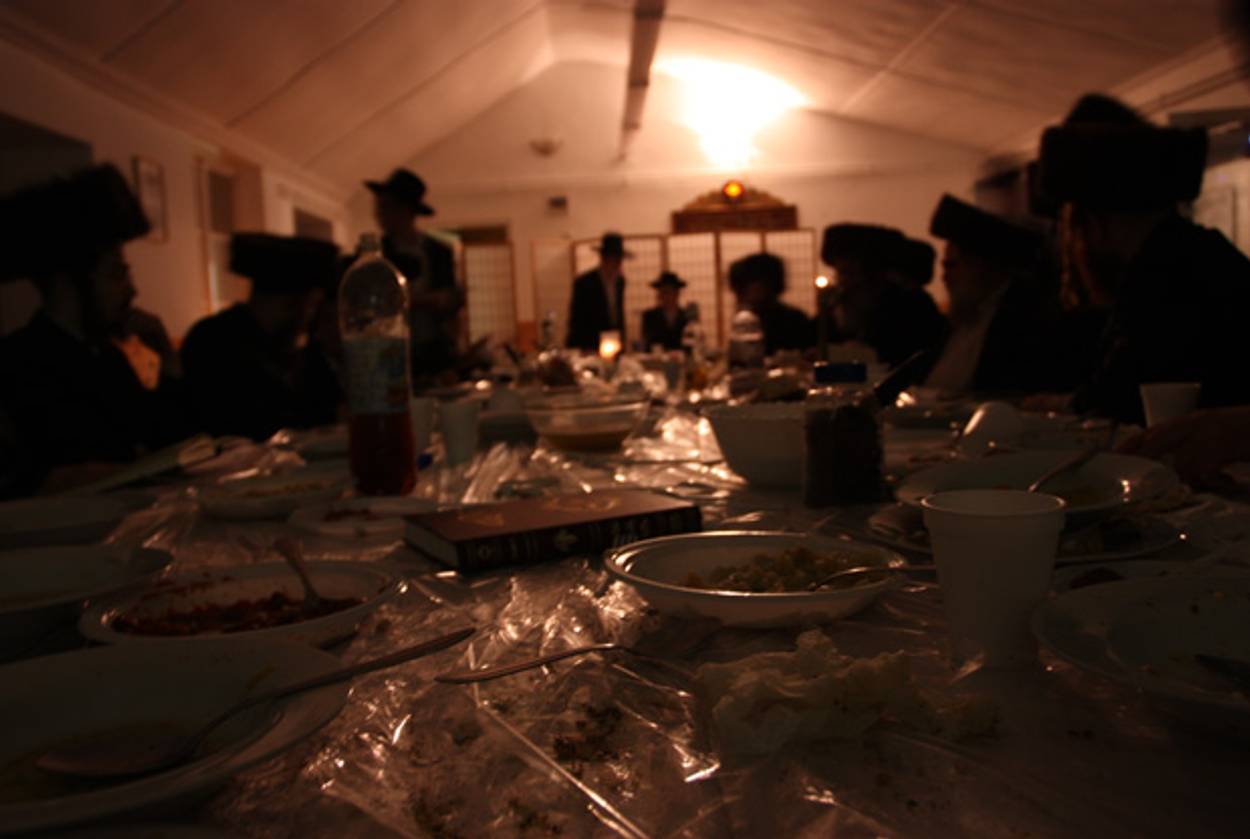
Dinner in Mako, Hungary.(Menachem Kaiser)
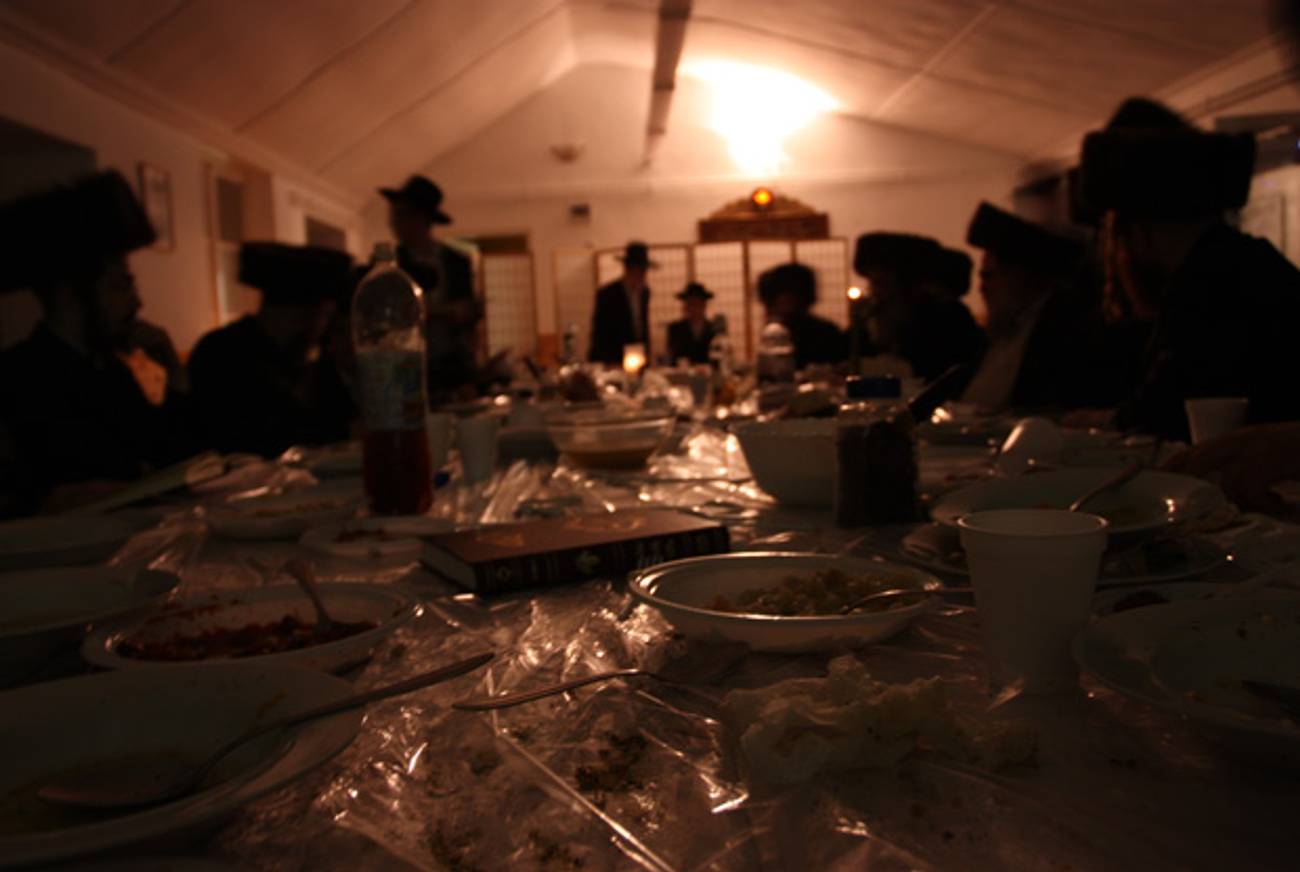
Last May I traveled, along with about 75 ultra-Orthodox, to Mako, Hungary, for the yahrzeit of my great-great-grandfather. Specifically, I’m referring to my mother’s father’s father’s father, Reb Moshe Vorhand, aka the Makove Rav (usually pronounced roov), a minor-league but well-respected Hasidic rebbe, who died in 1943.
It’s difficult to say exactly why I went. While I’m proud of the lineage, it’s mostly a harmless point of family trivia. I find even my immediate family’s mainstream brand of Orthodoxy foreign to me, never mind my extended family’s extreme observance. But my mother, who is always (but lovingly) on my religious case, has recently begun to invoke the Makove Rav in remarking upon my relative non-observance. (She went to the yahrzeit the year before I did and returned inspired.) I am, she tells me, letting him down. These exhortations are hard to take seriously. Who is this rabbi, and why should I care? Does it matter that I’m his descendant? When my mother offered to pay for a trip to Hungary, I agreed to go, if only to understand what I’m supposed to feel guilty about. This would be spiritually invested voyeurism.
Mako is in Hungary’s southeast corner, close to the Romanian border. It’s known, if at all, for its onions—some of the most arable land in the country is here—and as the birthplace of Joseph Pulitzer. Size-wise, it’s somewhere between a shtetl and a village: small enough that Reb Mechel, my cousin and the closest thing the yahrzeit weekend had to a host, didn’t feel the need to give directions or an address beyond “Mako.” I arrived on a Friday from Budapest, via a train and two buses, and stood clueless in the town square until I spotted a Hasid, whom I followed.
Only a block away, just past the refurbished synagogue, was an off-white, no-nonsense-looking building. Hasidim were scattered about, walking in little circles, talking on cell phones and smoking in the small parking lot, where a banner overhead referred to my forebear, in Yiddish, as “a great tzaddik … the miracle-worker of his generation.” This building was where everybody stayed—a Hasidic hostel. About 10 years ago, Reb Mechel had bought and thoroughly renovated a former egg factory so it could comfortably accommodate those making the annual pilgrimage to Mako. The building included two industrial kosher kitchens; a few dozen guestrooms, each with a bathroom offering a negel vasser kit (for ritual washing); a large main dining room, as well as a smaller women’s one; and at least one mikveh.
The men who arrived for the weekend (and a handful of their accompanying wives) were from all over—Austria, Israel, England, Belgium, New York, Los Angeles, Toronto—so the lingua franca was Yiddish. For me that meant halting conversation; the little Yiddish I know was learned in a college classroom, from a non-Jew. My pronunciation is hopeless. Many of the other attendees were related to me, though I couldn’t keep straight exactly how, and everybody I met wanted to know what I was doing there. I’d quickly mention my connection to the Makove Rav—aside from Reb Mechel, who’s a generation closer and has no mothers in the way of his connection to him, I had the most direct line, which garnered me instant credibility, even celebrity. People called me “der zun!” or “der ainekel!” (the son! or the grandson!) and when they did I suddenly felt very underdressed. At least I’d had the foresight to bring a white shirt.
***
The yahrzeit proper, when we were to visit the gravesite, was on Sunday, so Shabbat should have been a gentle spiritual warm-up.
Except that the current and very much living Makove Rav was also in Mako. Background, quickly: When my great-great-grandfather died in 1943, the vacant rebbe position went to his son-in-law, because his son could not travel from Nitra, in modern-day Slovakia, to Mako to take up the post. The current rebbe is that son-in-law’s son—my first cousin twice-removed, if I calculate correctly—and he lives in Kiryat Ata, Israel, near Haifa, and has hundreds of followers in his congregation there. This rebbe set the tone for the entire weekend. Our meals, in particular, were rebbe-dictated. We sang when he sang, we ate when he ate (and took a piece of his leftovers), and we hushed (or shushed others) when he held forth. He spoke in a low, mumbly Yiddish; the second his mouth opened, he was surrounded by a huddled mass, heads angled and ears cocked, competing to hear him.
The Hasid to my left, who seemed much too young to have the five children he claimed, whispered that this rebbe doesn’t sleep. He only micronaps occasionally, and he owns no bed.
Toward the end of the Friday night meal, the rebbe, in shirtsleeves and woolen tzitzit, poured two beers and motioned that I take one. He raised his cup and, after briefly inquiring about my life, delivered a 10-minute blessing. This was awkward. He spoke to me, and only me, the only guy in the room not in uniform, about repentance and renewal, about the constant opportunity to start fresh, to not be weighed down by sin. He told me that my ancestors are ready and willing to help me redeem myself. I didn’t catch everything he said, but I got the general drift.
I nodded and blushed, and wanted to down my beer. Afterward, Reb Mechel came up behind me and put his shtreimel on my head. “Next year, it’s mandatory,” he said. “And this hair up here”—he mussed my crown—“belongs on your face.”
Eventually, the rebbe left, and things relaxed. One Hasid passed around solvent-grade schnapps. I asked for stories of the (original) Rav, of which there are many, almost all implausible, like how he assured the Mako community that they would survive the war. (Or, as a less-audacious variant has it, that they’d be OK as long as he was alive.) And how the cars holding Makovians got detached from an Auschwitz-bound train. Twice. How the more progressive members of the community sought to build near the graveyard, inevitably desecrating graves, and went ahead and broke ground despite the rebbe’s warning, only to then die within the year. I understand these as myths, not stories; in their retellings, these ever more fantastical legends overtake and obscure the personality they’re meant to valorize. They transform a real, multifaceted person into a one-dimensional miracle-worker, which makes it that much harder to gain any realistic understanding of who my great-great-grandfather was. But for the Hasids I met in Mako, the stories may be less important than the story-telling. Maybe this is how they ascribe greatness to their rebbe. And maybe that is how I’m supposed to know my great-great-grandfather—as someone about whom people tell miracle stories.
On Sunday morning, we headed to the gravesite, in a cemetery outside the city that was difficult to get to, even in the Jeep we had hired for the day. Its inaccessibility is a preservative—there were no signs of destruction. The Rav’s grave, along with that of his wife, is in a humble mausoleum. Weak daylight snuck in through the windows, barely supplementing the dozens of candles clustered on top of the tomb. A few people were reading the Rebbe’s writings (collected, edited, and published posthumously by Reb Mechel). The current rebbe was writing names on slips of paper—names of those who required prayers for healing or livelihood or some other blessing—that he would then place on top the tomb. There was an ongoing, unorganized effort to recite the Tehillim, the Psalms. I hadn’t brought a prayerbook of my own and know maybe one psalm by heart, which I started repeating. Then I stood idly for a while, feeling conspicuous and useless, until an old woman approached me. I don’t know who she was, but she knew my name. She carried a yellowed Tehillim, full of loose and uneven pages that looked like they might crack. She opened the book and showed me what was inscribed: “From the library of Moshe Vorhand.”
I prayed from my great-great-grandfather’s Psalms, and for a brief moment I felt what everyone else had been feeling the entire time. For a brief moment I understood—even if I can’t fully articulate—why veneration traverses generations, why family is something to take pride in, why it matters that my great-great grandfather was a rebbe.
Menachem Kaiser is a Helen Zell Fellow at the University of Michigan, as well as a Wexner Graduate Fellow.
Menachem Kaiser is a Helen Zell Fellow at the University of Michigan, as well as a Wexner Graduate Fellow.