Monomaniacal
The newest George Lucas production, Red Tails, forces a Star Wars nerd to come to terms with a troubling philosophy
January 24, 2012

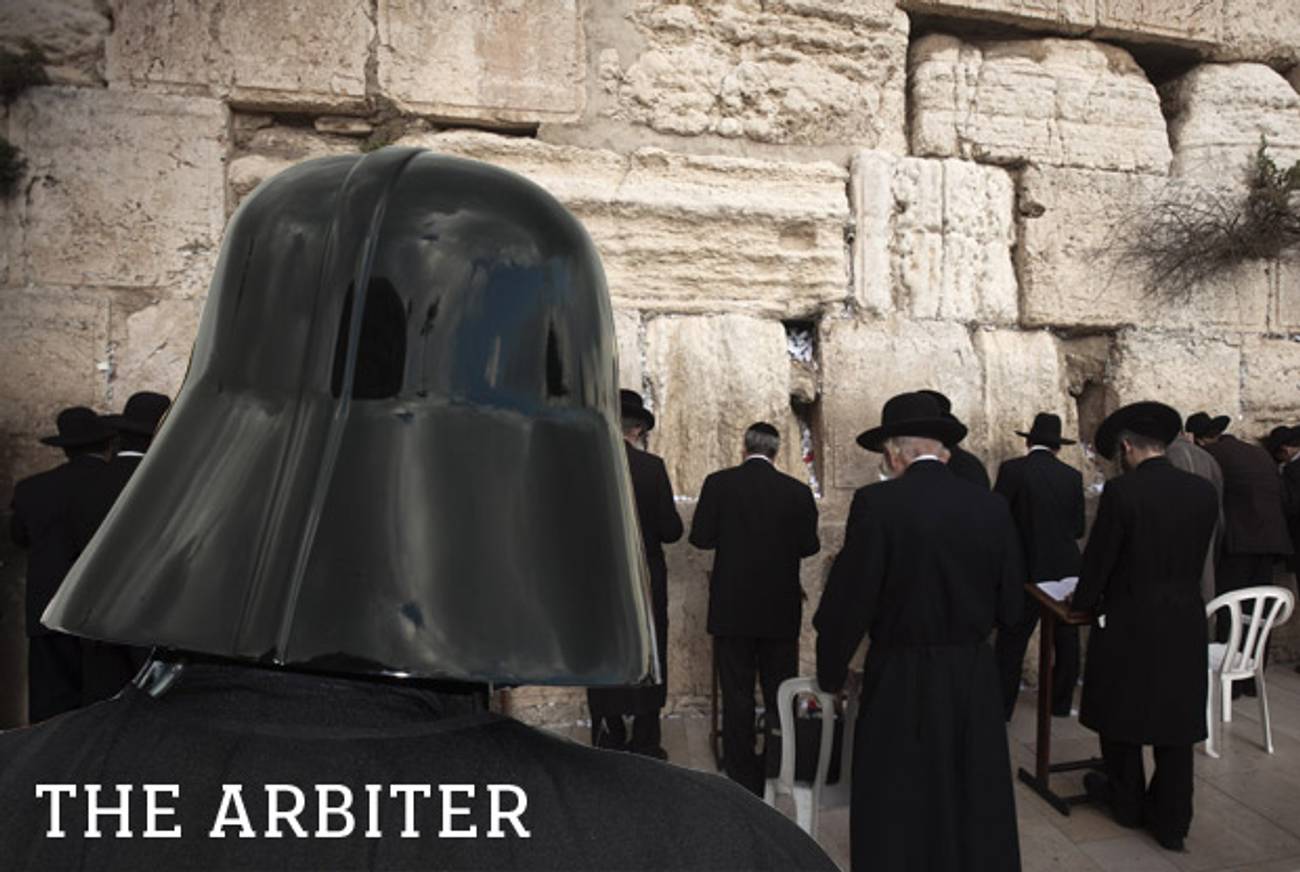
(Collage Tablet Magazine; original photos Menahem Kahana/AFP/Getty Images and Mojoey/Flickr.)
Of the 20 or so T-shirts I own, about half make some reference to Jedis, midi-chlorians, or lightsabers. In 1999, on the day Episode I: The Phantom Menace was released, I bought tickets to three consecutive screenings and sat giddily through them all, Jar Jar be damned. When my dear friends had their beautiful baby boy late last year, I was thrilled to buy him a Boba Fett alarm clock desk lamp, the best gift I could imagine. I bought another one for myself.
If you’ve understood most of the references in the paragraph above, you, sadly, belong to the same wretched class of emotionally precarious quasi-adults in whose minds and hearts Star Wars occupies the realms others furnish with accomplishing life goals or forming meaningful relationships. Which is why the next line hurts: George Lucas has ruined our lives.
I don’t mean that in the obvious way, like the sorry stares my friends and I sometimes get from well-balanced, emotionally available adults when they overhear us discussing issues like the politics of Wookie society or why all spaceships seem to always have their engines on in full thrust yet none ever seem to accelerate. What I mean is that those of us reared on Star Wars too easily subscribe to its creator’s facile mythology that sees all religions as nothing more than particular facets of one grand universal myth and that has little use for cultural distinctions or theological depth. As his newly released production, the World War II film Red Tails, clearly shows, George Lucas’ world is a place where good forever battles evil on a landscape that is smooth and flat and unchanging. The same goes for his entire oeuvre.
***
Lucas, of course, made up little of what would become the organizing principles of his Star Wars universe. An eager student of mythologist and autodidact Joseph Campbell, he adapted the latter’s opus, The Hero With a Thousand Faces, to the world of spacecrafts and laser guns.
“I came to the conclusion after American Graffiti that what’s valuable for me is to set standards, not to show people the world the way it is,” Lucas said in one of his several interviews about Campbell. “So, that’s when I started doing more strenuous research on fairy tales, folklore, and mythology, and I started reading Joe’s books. … It was very eerie because in reading The Hero With a Thousand Faces I began to realize that my first draft of Star Wars was following classic motifs. … So, I modified my next draft according to what I’d been learning about classical motifs and made it a little bit more consistent.”
Or a lot more. The main idea Lucas borrowed from Campbell was that of the monomyth, or the universal structure Campbell argued explained every hero humanity has ever adored, from Jesus Christ to Luke Skywalker. They all followed the same pattern: “A hero ventures forth from the world of common day into a region of supernatural wonder: fabulous forces are there encountered and a decisive victory is won: the hero comes back from this mysterious adventure with the power to bestow boons on his fellow man.” The specifics change—one went to see John on the banks of the Jordan before facing down Pilate, the other visited Yoda in Dagobah before doing battle with Vader—but they don’t matter much. What matters is the string that unites us all, the ur-story we share and that is our common human foundation.
Lucas was better than most at reimagining this human story. By setting his retelling in a galaxy far, far away, and by following Campbell’s guidelines religiously, he created an embodiment of the monomyth that was so powerful it instantly became mythological itself. We impressionable children of the 1980s found in Luke and Han and Leia the sort of universal thrust that most religions seemed to lack. In synagogue, they spoke of a personal God who gave us laws and expected us to keep them. At the multiplex, there was the Force, strange and mysterious and mystical. It was never a hard choice. We all became Talmudists of the Jedi.
Which—and I realize that by writing this I’m forfeiting any future claims to nerdhood—was a terrible thing, intellectually and morally speaking. Campbell certainly had his dazzling strengths as an erudite and engaging scholar of comparative cultures, but his lack of understanding of faith and its machinations is astounding. In an 1985 interview he gave to In Context, a humanist journal, he called the Bible “the most over-advertised book in the world,” dismissed its claim to moral authority, and argued that the violence the Israelites visited on the peoples of Canaan precludes their scriptures from shining an ethical light unto the nations. Any religion, Campbell argued, is nothing more than an invitation to sectarianism and hate.
It’s a popular theme nowadays, one that the nouveau atheists often flaunt. But its core failure, and Campbell’s, is that it fails to see the crucial nuances that set one faith apart from the other. It is true, as Campbell observed, that both Abraham and Kut-o-yis, a legendary hero of Montana’s Blackfeet, experienced hardships as boys and went on to suffer exile before emerging as leaders of their nations. That one went on to become the father of monotheism seems to matter little. Campbell has no patience for the specificity of Abraham’s—or any hero’s—teachings; all he’s interested in are the broad patterns of shared stories.
The same goes for Lucas. His good guys are so good that their unique brand of righteousness hardly matters. Take, for example, the issue of the Force, the power Jedi knights possess to manipulate the physical world with their minds. Here’s the best explanation of how it works (Lucas later concocted other, less-convincing ones), delivered by Obi Wan-Kenobi: “It’s an energy field created by all living things. It surrounds us and penetrates us. It binds the galaxy together. … A Jedi can feel the force flowing through him.”
What do non-Jedi feel? And what are the Jedi to do with said power, other than vanquish the obviously evil masked menaces that knock about the galaxy enslaving all they meet? Lucas never says. He, like Campbell, is uninterested in such questions, which are precisely the questions religion is dedicated to addressing. Judaism, for example: With chosenness constantly on our minds, every Jew’s a Jedi, and our entire spiritual journey, as individuals and as a people, is dedicated to trying to figure out what responsibilities and privileges are affixed to those who believe themselves to have been singled out by God. It’s how we come by our concept of morality, and we’re beholden to it not because we think it applies to every single living human being—although a comparative analysis of the Ten Commandments supports the idea that many of its prohibitions recur across time and space—but because we believe in the validity and the might of our particular journey.
From faith stems nuance. From myth, generalities. And, sadly for us, the spirit of myth is winning: We revere Star Wars because to our minds—modern machines that equate religion with superstition and are willing to disregard imperfections in science but never in dogma—the movies represent transcendentalist humanism at its best, a perfect manifestation of that noxious label, “spiritual,” that people use to describe themselves when they’re too dull to believe in religion and too dim to understand science. This is why the Force has become the organizing metaphor of our time; there’s no better one for those who believe that if we only open our hearts and understand people are all the same and all good we’d be enlightened enough to lift rocks with a tilt of our heads.
Just how idiotic is this logic will become evident when we examine the controversy known in geekdom as the “Han Shot First” incident. In the original release of Episode IV: A New Hope, Han Solo is seated across a table from Greedo, a reptilian-looking bounty hunter who’d come to collect a debt Han owes to galactic mobster Jabba the Hutt. Greedo points his laser gun at Han, indicating his intention to shoot the dashing smuggler dead, but Han stealthily readies his own weapon under the table, blasting Greedo first and killing him. When the movie was re-released to theaters in 1997, Lucas had edited the scene. In the new version, Greedo shoots first, somehow missing the man seated about three feet away from him and absolving Han of any moral ambiguity. The fan community was outraged, but Lucas was adamant; he had to make sure, he explained, that kids believed Han had no other choice but to kill Greedo.
Call it monomythic morality: If you believe we’re all bound by structures of sameness, you’re bound to ignore what makes us different, which means that you’re eventually left seeing nothing but bold smears of black and white with no substantive shades anywhere in between. It’s fine, perhaps, when considering the origins of the clone wars, but not so much when the conflict on screen happens to be World War II—Red Tails, a movie about the Tuskegee Airmen financed and produced by Lucas, is another literal-minded study in black and white with a heavy-handed egalitarian message and an inevitable happy ending. The intricate roots of racism and its devastating effects on American society all vanish with a few easy, CGI-enhanced midair dog fights, and it takes a particularly curmudgeonly viewer, or an especially sober one, to recall that black Americans currently comprise 12.6 percent of America’s population and 39.4 percent of its inmates.
But Lucas is largely unburdened by details. He obeys Campbell’s mantra, “follow your bliss,” and presents us with a menagerie of uncomplicated heroes who had followed theirs, urging us to do the same.
We must refuse. Bliss is a terrible guide to follow. Unlike the rules set forth by organized religions, designed, however divergently or effectively, to shepherd the frail species to something approximating goodness, bliss is gauzy and fleeting. If we’re ever to become heroes, if we’re to undergo the sort of noble quests that Campbell and Lucas valorize, we should first find something grander, and more specific, to believe.
Liel Leibovitz is a senior writer for Tablet Magazine and a host of the Unorthodox podcast.
Liel Leibovitz is editor-at-large for Tablet Magazine and a host of its weekly culture podcast Unorthodox and daily Talmud podcast Take One. He is the editor of Zionism: The Tablet Guide.