Back to My Roots
After my grandparents came to America, they changed our name. Decades later, I changed it back—and rediscovered a lost history.
March 21, 2012
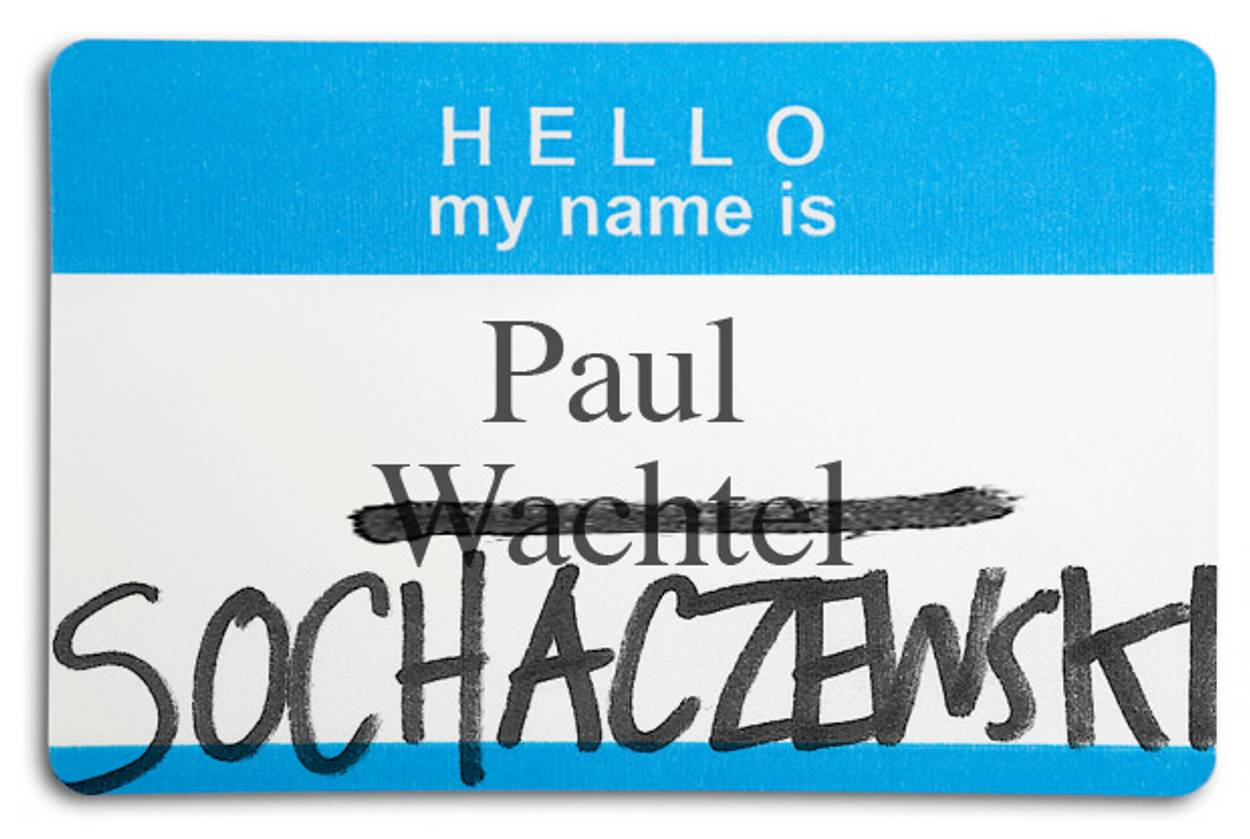
(Photoillustration Tablet Magazine; original photo iStockphoto.com)
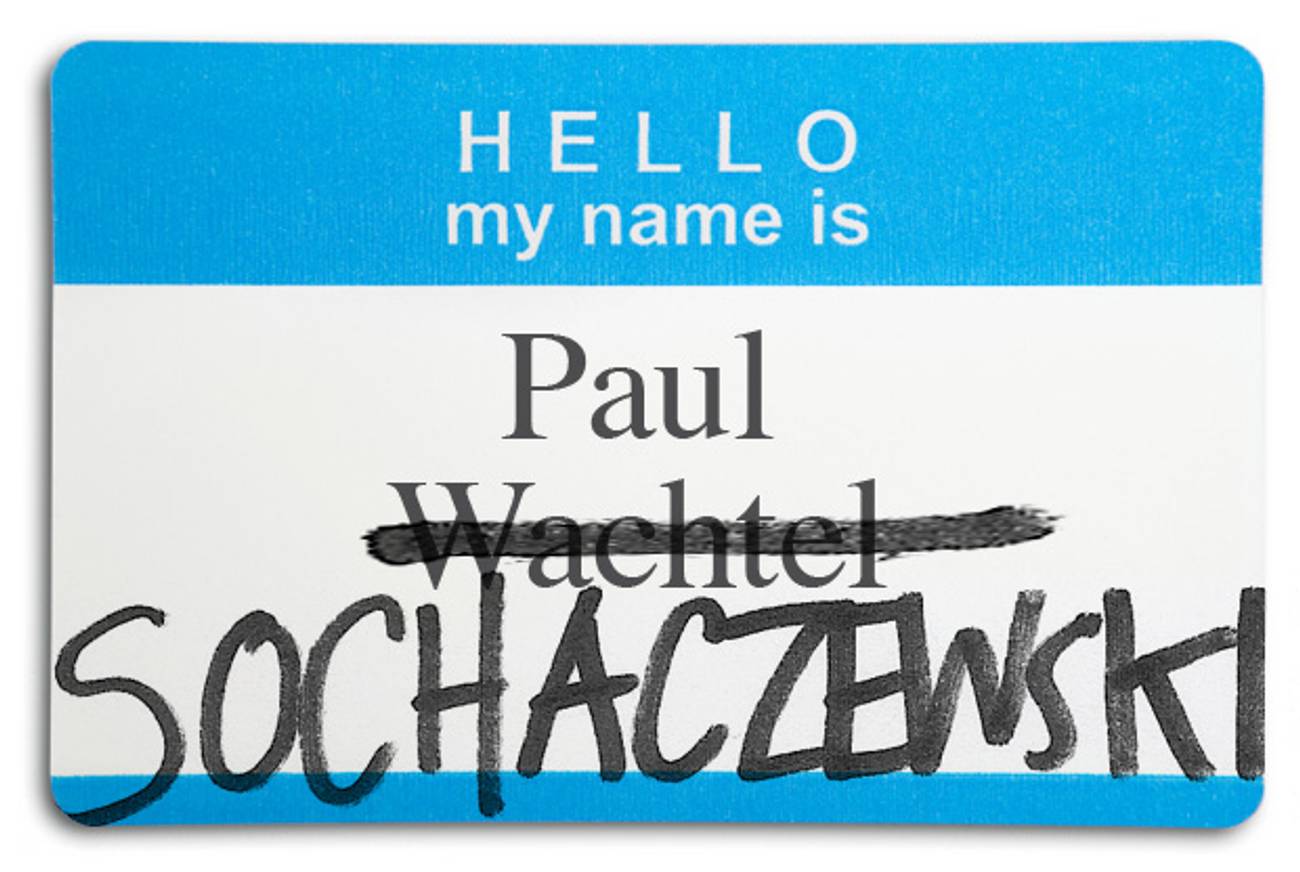
As I filled out the forms to change my last name back to my grandfather’s original surname, I wished my ancestors had been Burmese or Chinese, instead of Polish. Win or Wong would have been a lot easier to fit on a new credit card than Sochaczewski.
But we have little control over whose descendants we are. My grandfather, Josef Sochaczewski, came to America from Kalisz, Poland, then part of Russia, in 1912, during the great wave of European immigration. His family—my grandmother Esther, my father Samuel, and his older sister, my Aunt Syd—followed in 1913. I have an old family portrait that I treasure from back then. My mustached grandfather looks like a Polish Pavarotti, while my grandmother, pregnant with my uncle Bill, resembles a weary but very wise Madonna. Apparently she had tuberculosis when the photo was taken and died a year later.
A few years after the family passed the Statue of Liberty and arrived on Ellis Island, it came time for little Syd to go to school. Her Aunt Lena, my grandfather’s sister and the only relative who spoke good English, accompanied the girl. But the school official, apparently aghast at such an odd and difficult name as Sochaczewski, refused to register the girl and told Lena to come back with a simpler moniker. Today, the school official’s politically incorrect action would be grounds for a lawsuit, but the school clerk had made my family an offer they couldn’t refuse. Aunt Lena, thinking quickly, suggested that Syd Sochaczewski be registered instead as Syd Wachtel, which was Lena’s married name.
My grandfather thought this was fine, since, to him, Wachtel sounded more American than Sochaczewski. And, like most immigrants of that period, he wanted to jump into the American melting pot as quickly as possible. He legally changed the entire family’s name to Wachtel.
Americans change their names for many reasons. Some are motivated by show-business glitter (Norma Jeane Mortenson, later Baker, to Marilyn Monroe), some by religious conviction (Cassius Marcellus Clay Jr. to Muhammad Ali), and some by a personal vision of how a commercially successful name is constructed (John Paul “Jack” Rosenberg to Werner Erhard).
But most name-changers of the early 20th century, like my grandfather, never made the limelight. Thousands of people strove to de-link themselves from their pasts. It seems this desire to become American (and by definition un-become Italian or Russian or Polish) was part of a ritual cleansing, a symbolic burning of old vêtements, as if to say, “I can’t, I won’t go home again.”
As I grew older, I realized that home comprises many nests. My life was in transition. For me, the way forward lay in a growing desire to return to my roots. I wanted to change my name—not that I had a great affinity for Polish, but it certainly felt more “right” than German. While I had heard the basic, albeit vague, story of my family’s name change for years from my older relatives, several factors had prevented me from reverting to the original.
The first was concern that my modest writing career would be hindered, because I was already publishing as a Wachtel. The second was that I dreaded having to change all my records. And the third was that, as an American expatriate living in Switzerland, I had to wait until I returned to the United States long enough to establish residency before I could file a request.
The fourth problem, however, was the most daunting and problematic: No one in our family knew how to spell the original name. Aunt Syd didn’t remember, Uncle Bill never knew, and my father had already died.
I played with different spellings, even going so far as to send some orthographic variants to a numerologist friend in India who calculated the relative impact of different phonetic spellings of what I thought my name might be.
I came back to the States and, at age 45, eventually went to the Ellis Island Museum and saw an exhibit of belongings immigrants had brought with them to America. The handmade doll in a display case was probably not much different from a similar, cuddly friend I imagine Aunt Syd caressing; the frayed teddy bear similar, perhaps, to one my father might have embraced. I saw women’s jewelry and men’s watches and photos and mementos of home that were lightweight enough to fit into a steamer trunk but heavy enough to provide solace during the uncertain future. I admired the courage these people possessed to leave for a place where they neither spoke the language nor had any guarantee of success. I have lived overseas for more than half my life, but my adventures seem smaller than those of my daring relatives.
Officials at Ellis Island put me in touch with the National Archives and Records Administration in Bayonne, N.J., and I told them roughly what I had been told about the family’s arrival in America. Several weeks later, they sent me photocopies as long as my arm of the original folio pages from passengers arriving in Ellis Island aboard the S.S. Kaiserin Auguste Victoria, sailing from Hamburg. It was the best use of the taxpayers’ money that I’ve come across. SOCHACZEWSKI, the folio said in longhand. I called up some Polish friends to learn how to pronounce it: soh-kha-CHEV-ski. I practiced my signature a few times (it still hurts my hand to write, and I’m not comfortable enough with it yet to scrawl it). I spelled it on the phone to friends, first in English, then in French. It felt like I had been dealt a Scrabble hand with no vowels.
I took a sabbatical at the East-West Center in Honolulu, and the office of Lt. Gov. Benjamin Cayetano was helpful in walking me through the paperwork. Most Americans are immigrants, of course, but it felt somehow suitable to go back to my Polish roots in the Hawaiian melting pot. Fannie, the Chinese woman in the East-West Center in charge of aloha (that’s her real job description), organized a quasi-Chinese ceremony—although we substituted bursting balloons for the more traditional, but much louder, firecrackers.
I changed my name, not so much because I feel Polish (I don’t speak a word) but because I don’t feel German (and I certainly don’t feel like a quail, which is how Wachtel translates). Somehow it feels right. The 19th-century Scottish philosopher Thomas Carlyle recognized that a name can shape a life, reflecting, “what mystic influence does it not send inwards, even to the centre.”
Almost as cosmic proof that I chose rightly, odd and pleasant things began to occur. Strangers see my complicated name in a publication and write to me, asking if, just possibly, we might be related. A newly found cousin in Montreal, Ari Sochaczewski, invited me to his son’s bar mitzvah. I told a friend in Basel, Switzerland, about the name change, and she explained that she had a friend, Simon Sochaczewski, also in Basel, with a similar name. We couldn’t possibly be related, I thought, but she spelled his name and it had the same odd concurrence of Slavic consonants. I called him, learned about his service in the Résistance in France. He mentioned a relative who had moved to Brooklyn. “I’m from Brooklyn!” I said, and immediately called Aunt Syd. “Sure, Jack Sachs,” she remembered, explaining that his branch of the family had Anglicized the name rather than changing it completely, as ours had done. I called Simon back and we figured out that we are second cousins, I think (I’m not very good at figuring out these family trees). Right here in Switzerland.
When I’d first decided to make the name change, back in 1992, I called my aunt, who started all this trouble by wanting to go to school nearly a century ago. And that’s when I found out that more than one name had been changed.
She calls herself Syd, and I asked her why. “My name was Sadie,” she explained, “but I never liked that name so I changed it to Syd.”
“But your name isn’t Sadie,” I said. “It’s Sarah. Says so right here on the immigration documents they filled out when you got off the boat at Ellis Island. ‘Sarah. Four years old. Nationality: Russia. Race: Jewish. Final destination: Brooklyn.’ It says here you were ‘illiterate.’ ”
“Oh my,” my then-80-something aunt replied. “If I had known that I never would have changed my name. I rather like the name Sarah, don’t you?”
Paul Sochaczewski, author of the novel Redheads, has written for the International Herald Tribune, Wall Street Journal, Travel and Leisure, and Geographical.
Paul Sochaczewski, author of the novel Redheads, has written for the International Herald Tribune, Wall Street Journal, Travel and Leisure, and Geographical.