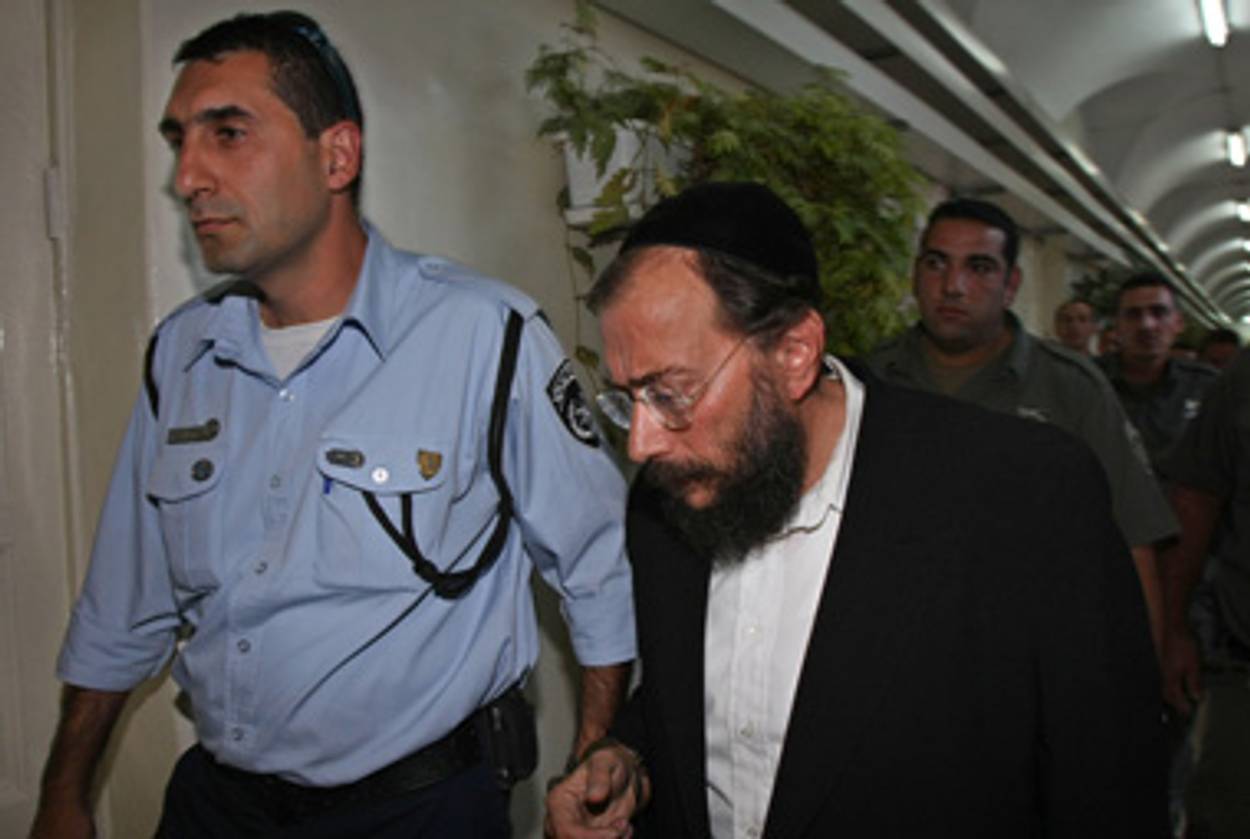
Most people have never heard the story of Avrohom Mondrowitz, which has received only a smattering of headlines in the Jewish media. A charismatic and eloquent member of the Ger Hasidic sect of ultra-Orthodox Jews, the 63-year-old claimed to be both a rabbi and a Columbia-trained psychologist. Though he was neither, for years he ran a psychology practice out of his basement, as well as a school for troubled youth. He is also alleged to be one of the worst sexual predators in Brooklyn history.
In 1984, Mondrowitz was accused of sexually abusing four Italian boys. Since then, the number of Mondrowitz’s alleged victims has been estimated at close to a hundred—making him, shockingly, an average pedophile. But given the shame and secrecy surrounding sexual abuse, and his broad network of contacts, the number of alleged victims could actually be much higher. Moshe Rosenbaum, one of the activists who first aired concerns about Mondrowitz in the late 1980s, estimates the number to be 300. If Mondrowitz were to be convicted of so many crimes, he would be the worst sexual predator in the Orthodox community on record.
But that would require a case to be brought against him—which, for a variety of troubling reasons, has never happened.
This fall, the New York Court of Appeals, the highest court in the state, will hear oral arguments pertaining to the release of documents about Mondrowitz. Michael Lesher, an attorney representing several of Mondrowitz’s alleged victims, asked the Brooklyn District Attorney’s office for the documents under New York’s Freedom of Information Law in 2007. A trial court initially ruled in favor of Lesher’s clients, but that verdict was overturned unanimously last year on appeal.
The fact that the Court of Appeals will hear the case is a significant victory for Lesher, who believes that Brooklyn District Attorney Charles Hynes stopped pursuing Mondrowitz, who’d fled to Israel, because of pressure from ultra-Orthodox voters. Although it seems that Mondrowitz could have been extradited to Brooklyn to stand trial as early as 1989, Hynes’ office waited two decades, until 2007, to launch the extradition process. Jerry Schmetterer, a spokesperson for the Brooklyn D.A.’s office, said that if Mondrowitz ever returns to the United States, he will be arrested and tried. “We don’t reveal files on open cases, and courts have upheld that,” he said. “I know we have handled this case properly.”
Lesher disagrees and is looking for a smoking gun to prove his theory. But even if he is wrong about Hynes, the Mondrowitz case—or non-case—has involved a series of brilliant two-steps on the part of a community that is looking to face its demons quietly. But the story, in part due to the complexities of extradition, simply won’t go away.
Mark Weiss, who is represented by Lesher, is one of Mondrowitz’s alleged victims. Today, he is a frequent speaker at Jewish sexual abuse conferences; in 2006, he appeared on a Nightline segment about Mondrowitz. In 1980, he was a 13-year-old in Chicago—a good kid with some philosophical differences from his ultra-Orthodox parents. “I didn’t see eye-to-eye with them,” he said last month by phone from New Jersey. “But I wasn’t stealing cars or taking drugs.” When his junior high school asked him not to come back, his parents sent him to a psychologist in Brooklyn named Avrohom Mondrowitz.
The Weiss and Mondrowitz families were friendly. They had lived close to each other in Chicago. Mondrowitz’s father was a popular figure in the community, both a scholar who studied in the Mir yeshiva and a businessman in charge of several nursing homes. According to a family friend from the neighborhood, the senior Mondrowitz was part of the group of Mir students who escaped Poland before World War II through Shanghai, China. Avrohom, who was born in 1947, moved to New York in the late 1970s to be closer to the Ger Hasidic community in Borough Park. By the time Weiss was sent to Mondrowitz, the older man had already established himself as a psychologist whose patients came to him through a wide network in the Orthodox community, including the Ohel Jewish social service agency, according to the Orthodox Jewish website Vos iz Neias? and other leading members of the community. (Ohel has publicly denied employing Mondrowitz but is more circumspect about referrals. “Given the lapse of time, it is impossible to determine whether any referrals were ever made to Mondrowitz,” a spokesperson said.) Mondrowitz agreed to treat Weiss by taking him for a week into his Borough Park house. Unknown to Weiss’ parents, Mondrowitz’s family was out of town, which left him alone with the teenaged Weiss.
Weiss remembers Mondrowitz as a dazzling figure. “He was just the essence of coolness, especially for a little yeshiva kid showing up,” Weiss told me. “He wined and dined me. He took me out to eat. He took me out to an amusement park. He basically showed me a good time and gave me lots of positive attention. I soaked it up. He was grooming me.” At night, Weiss said Mondrowitz gently persuaded him to sleep in Mondrowitz’s bed. (He declined to go into detail about what would happen next, but he alleges sexual abuse.) “He was very smooth and manipulative and really gave me no pause for thinking anything was inappropriate,” Weiss said. His descriptions are similar to those of the five other alleged victims represented by Lesher, none of whom are named in the appeal.
Part of Mondrowitz’s appeal relied on the stigma toward mental health professionals in the Orthodox community. “He had this reputation of being a wonderful guy and being very helpful,” said Deborah Dienstag, a physician who works with the Orthodox community. “People don’t want to go to psychologists, since there’s stigma. There is no stigma going to rabbis.” According to Jeff Dion, of the National Center for Victims of Crime, an advocacy group, certain abusers set themselves up as pillars of the community, targeting victims who are troubled, outcasts, or young people with drug and alcohol abuse problems. If a victim then chooses to disclose acts, he said, “it becomes the word of a ‘bad kid’ against the pillar of the community.”
In the years following Weiss’ visit, Mondrowitz’s star rose. He hosted a popular program called Life Is for Living on the now-defunct local radio station WNYN. “Don’t picture this man living in isolation or even living a double life,” said Lesher, the lawyer. “Don’t picture someone who was off in the corner abusing kids who came to him. He was very industrious about bringing victims to him and integrating himself into the institutional structure that made it possible. He founded a school. He got victims through the school. He ran a psychology practice and promoted it with a radio program. He got hundreds of kids.”
For years, no Jewish victim spoke out against Mondrowitz. But accusers say he also went after Italian boys on his ethnically mixed Brooklyn block; residents recalled him showering gifts on the neighbors’ kids. In 1984, someone made an anonymous phone call to two New York Police Department detectives, Pat Kehoe and Sal Catalfamo.“I never had received a call like that in my whole career in the New York City Police Department,” Kehoe told ABC News. “There was a rabbi and gave the name and he was abusing people on this block. And he said if you go knocking on doors, you’ll find victims.” Both detectives are now retired and, through another police officer, declined to talk to me about the case.
Responding to the tip, the detectives went down the block, knocked on doors, and quickly located four Italian victims who were willing to press charges ranging from sexual abuse to sodomy. “When people finally went to the police, it was the Italian kids,” Lesher said. “Several victims have told me that their parents were instructed not to approach the grand jury. Some victims were discouraged from reporting Mondrowitz’s crimes. I can only assume the rest were, also.”
Continue reading: the community’s response, extradition, and “the guy who broke the ice.” Or view as a single page.
A principal of a small yeshiva in New York who asked not to be named found out that three of his students said they’d been molested by Mondrowitz, but the principal said the students did not want to press charges. He said he then called a meeting with the leaders of Agudath Israel, the leading ultra-Orthodox organization in America. The meeting took place at the house of one of the leaders of the organization, Rabbi Yaakov Perlow, who leads the Novominsker Hasidic movement. The principal said that the Agudath representatives were horrified by the finding, but they did not go to the police. A ruling circulated in 1986—by which time Mondrowitz had fled to Israel—signed by Perlow and Rabbi Elya Svei stated that Mondrowitz had been “abusing and damaging children and adolescents.”
“Great Rabbis and Roshei Yeshivah have heard first-hand testimony from his victims, and were horrified to hear of these terrible crimes which cause one’s hair to stand on end,” the letter said. “Anyone who helps or defends him will be liable for his actions, and will be considered responsible and as an accomplice to his crimes. And for this the punishment is severe.”
Yet the yeshiva principal also believes that someone—if not many people—knew about Mondrowitz’s alleged actions before the meeting but kept silent. “I cannot believe that anyone didn’t know about it before,” he said. “The man was so proficient he had to be doing it before. If I were a betting man, I would bet 100 percent that there were people who knew about it.”
Rabbi Yosef Blau, a spiritual adviser at New York’s Yeshiva University and an activist against sexual abuse in the Jewish community, had an even less charitable view of the community’s response. “This is whitewashing,” he told me. “Yes, they didn’t want him abusing kids, but did they really do anything? They said get away from kids, but did they tell people to cooperate? How come not a single Jewish kid cooperated with the police? Yes, there was a meeting, they were shocked, and then what?”
Blau pointed to several other notorious but also unsettled alleged sexual abusers in the ultra-Orthodox community who he says also fled to Israel. “When it came down to crunch time they were afraid,” he said. “They didn’t tell anyone to go to the police, and they thought it”—having Mondrowitz go to Israel—“would be good enough.”
In 1985, Mondrowitz was indicted on eight counts of child abuse and five counts of sodomy, but 12 hours before detectives arrived at his house, he fled, first to Chicago, then to Canada, and finally to Israel. Activists believe he was tipped off. Coincidentally, Weiss, then 18, was one of the last people to see him in Chicago. “It was Sukkot and I saw him in shul and I hadn’t seen him in all this time,” Weiss recalled. “I said ‘Hey, let me go say hello to him,’ and mid-walk the whole situation flooded back into my head. I froze in my tracks and I spun back and went home crying.”
In 1985, then-Brooklyn District Attorney Elizabeth Holtzman began extradition proceedings against Mondrowitz in Israel. But there was a problem. Rape in Israel was defined as sex between a man and a woman, and Mondrowitz’s case, homosexual rape, was not an extraditable offense. The extradition request was denied. When Israeli law was amended in 1988 to broaden the definition of rape, some legal experts assumed that extradition would be possible retroactively. But the Brooklyn D.A.’s office, then under Hynes, does not appear to have filed a claim. (In fact, the district attorney’s office says it wasn’t possible to file a claim.) Lesher believes that Hynes, newly elected, failed to pursue the case because of pressure from the ultra-Orthodox constituents. A 1993 cable from the State Department that Lesher obtained through an earlier Freedom of Information request states that U.S. officials in Israel were waiting for the D.A. to make a move and believed that Mondrowitz could be legally extradited. Lesher’s argument is that a fledgling district attorney was happy to avoid a trial that would alienate a strong and vocal portion of his constituency, which tends to vote as a bloc. When I asked Brooklyn D.A. representative Schmetterer about that, he replied flatly, “Well, that’s not the case.”
Lesher believes that a network of interests has kept the D.A. from pursuing extradition. “You’re talking about the leading gedolim”—or revered rabbis—“of the generation and the institutions they support that gave a blank check to Mondrowitz,” Lesher said. “That may be too much for the community to tolerate.” Lesher said he obtained documents from the Justice Department that report that a member of Hynes’ staff requested the Mondrowitz case be closed in 1993. Meanwhile, Mondrowitz lived freely in Israel, and, in 1996, he was naturalized as an Israeli citizen.
In 2007, the extradition treaty between the United States and Israel was further amended and Mondrowitz was arrested in Israel in November of that year. An Israeli district court in Jeruslaem ruled in favor of extradition, but Mondrowitz’s lawyer successfully challenged that verdict. The case went before the Israeli Supreme Court, which in 2010 ruled against extradition, stating that it would be impossible for Mondrowitz to have a fair trial after so much time had passed. Not surprisingly, activists believe that decision was also politically motivated.
“Why did the Israeli government protect a pedophile?” asked Shmarya Rosenberg, of the blog FailedMessiah, which has chronicled the case extensively. “The answer is you have to look at Israeli politics. There was a political party called Agudath Israel that was controlled by the Ger Rebbe. It became the major part of the United Torah Judaism party,” an ultra-Orthodox, or haredi, Israeli political party. “Each successive government needs these haredi politicians to be in or to vote with their coalition.” Just as Mondrowitz’s alleged victims had been denied justice in the United States, they would also be denied justice in Israel—and for the same reason, the intersection of politics with the judicial system.
The Brooklyn D.A.’s long years of inaction were cited as the chief reason why the extradition from Israel to Brooklyn failed, according to Mondrowitz’s lawyer, Eitan Maoz. “In 1988 the law was amended in a way that the route to extradition was open and the district attorney was notified,” he told me at the time of the Israeli Supreme Court’s ruling against extradition in 2010. “But they did not do anything until 2007, when they decided to apply.” Even Lesher thought that defense, which entirely blames the Brooklyn D.A., to be ridiculous. “It’s preposterous to blame the D.A. for the fact that Israel and America simply did not negotiate a new extradition treaty fast enough,” he told me. “I don’t say that as a defender of Hynes—he did plenty to bury the case—but it isn’t his fault that the extradition treaty didn’t change sooner.”
When I spoke to Weiss about the verdict, he answered succinctly: “I think humanity has dropped the ball.”
Paradoxically, Mondrowitz’s most lasting legacy may be an increase in sexual abuse awareness inside the Orthodox community. Here was a man whose alleged crimes were so horrid that he forced the issue to the forefront. “It took over 30 years to be more responsive to the problems, not only to recognize it, but to get help for victims and abusers, some of whom were then brought to justice,” said Susan Schulman, a pediatrician in the Borough Park area. When Yehuda Kolko, a rabbi who taught at the Brooklyn yeshiva Torah Temimah, was accused of sexual molestation, many observers thought that the prosecution was a direct result of the attention given to Mondrowitz. “The only reason the Torah Temimah story came out was because of Mondrowitz,” Dienstag told me.” He’s the guy who broke the ice. That’s an awful way of saying it.”
Others are less sanguine. “My greatest concern is how little the community has subsequently learned,” Blau said. “The community should do whatever possible to ensure it does not happen again. That means cooperating with the police.” And while there still is a long-simmering conflict between the Brooklyn District Attorney and sexual abuse activists inside the ultra-Orthodox communities, a series of high-profile victories against abusers has largely quieted the animosity. The community itself has become more aware of sexual abuse, though many leaders of the community still insist on referring sexual abusers to rabbis instead of to the authorities. Most recently, Rabbi Shmuel Kamenetzky, one of the members of the Mo’etzet Gedolah HaTorah, the self-appointed counsel of sages that decide Agudath Israel’s policy, publicly stated that sexual abuse victims should speak to their rabbis before reporting to the police.
Mondrowitz lives in a fashionable Jerusalem neighborhood. He turns 64 in November, and his once energetic walk has probably slowed down. In all likelihood, he’ll spend the rest of his life there as a free man, unmolested. After the Israeli Supreme Court ruling, the only open route to extradition would have been an appeal, possible in the Israeli system, which was not made. The New York Court of Appeals case is merely about access to the Brooklyn D.A.’s records, and even if Lesher discovers that Hynes shelved the case, the repercussions are likely to be minimal.
I asked Lesher what he hoped to accomplish from the disclosures. “I’m not sure there is a simple answer to that question,” he said. “What I wanted from the beginning is to finish the story.”
Michael Orbach is the former editor of The Jewish Star, a weekly newspaper covering Orthodox communities in the New York area.