Disunion
Hebrew Union College prides itself on being open and pluralistic. But some Reform rabbinical students say the reality contradicts this vision.
December 16, 2011
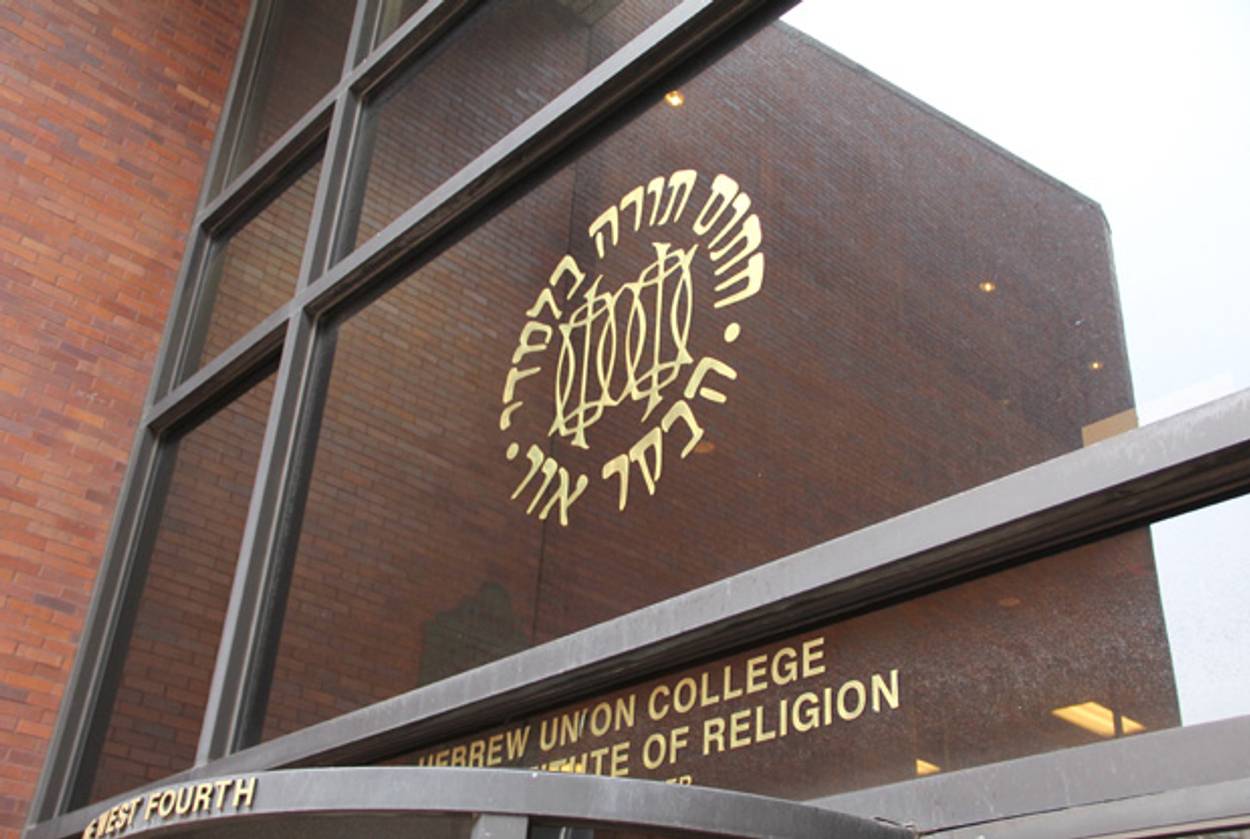
The entrance to Hebrew Union College in Manhattan.(Tablet Magazine)
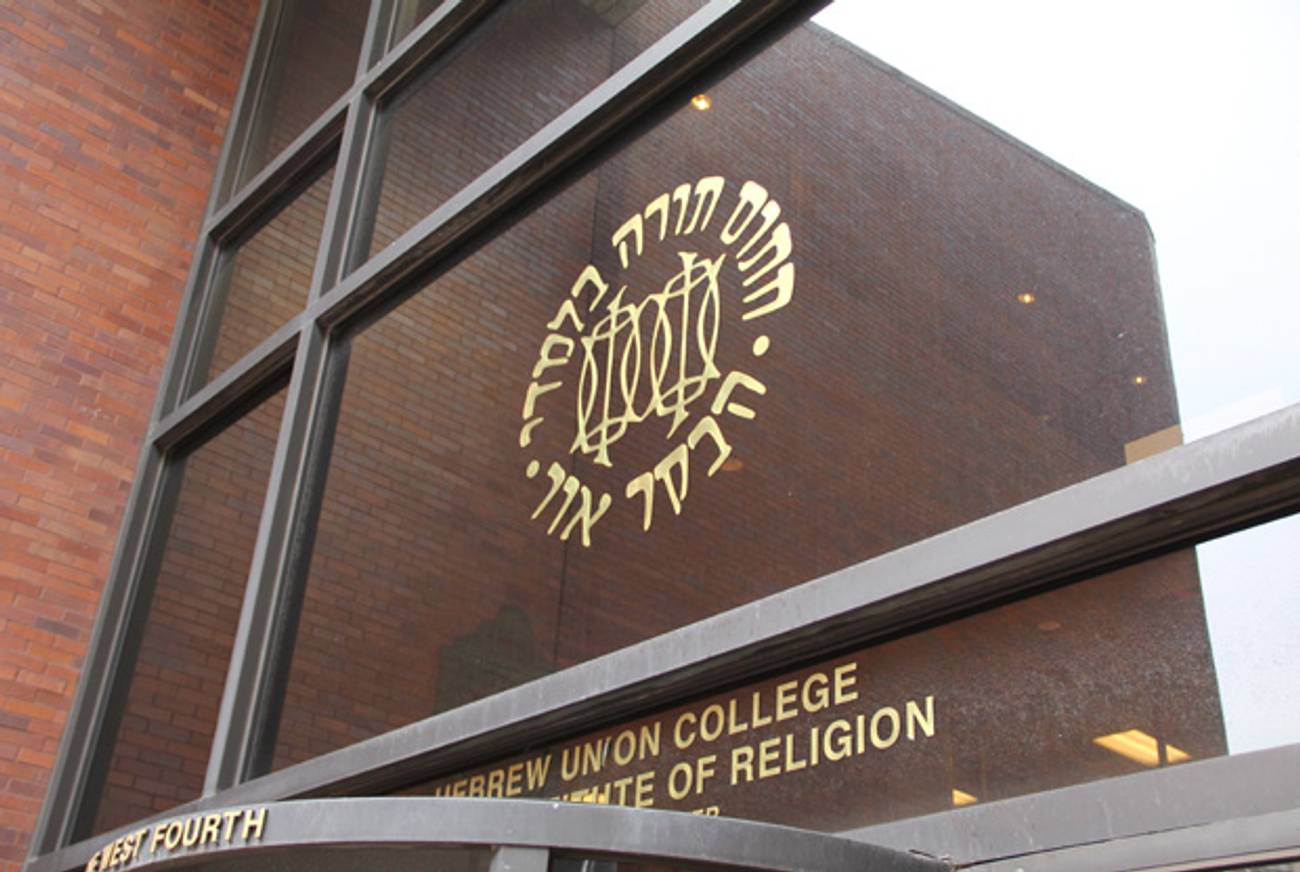
Earlier this year, word spread that the president of Hebrew Union College had been approached by a potential funder who wanted to endow the school with a chair for a politically conservative scholar. Like countless other religious and academic institutions, HUC had suffered tremendously in the aftermath of the financial meltdown of 2008. Less than three years ago, the seminary faced a $3 million deficit. Professors’ salaries had been cut, tuition had been raised, and reports surfaced that the school was considering closing two of its three American campuses. The school “was in the most challenging position it has faced in its history—even more so than during the Great Depression,” HUC President David Ellenson wrote at the time.
And yet, the conservative chair never materialized—a fact that came as a disappointment, if not a surprise, to some. Although American Judaism’s largest religious denomination prides itself on being a big tent—part of HUC’s mission statement is to apply “the open and pluralistic spirit of the Reform movement to the study of the great issues of Jewish life and thought”—certain students and observers are sensing a troubling trend that directly contradicts this vision, particularly on the matter of Israel.
“While I loved my time there and deeply respected my professors, I found that HUC was not comfortable exploring or discussing anything politically that wasn’t left,” said Rabbi Samantha Kahn, who received her ordination from Hebrew Union College in Los Angeles in 2011 and is now the assistant rabbi at Congregation Emanu El in Houston, Texas. “I definitely struggled with it, and I was hurt by the lack of openness and the anger toward positions of center and right when it came to Israel and foreign affairs.”
To be sure, most observers point out that the political atmosphere at HUC does not comprehensively reflect the reality of the wider Reform movement. But the differences can sometimes be unusually stark. Kahn, who worked at the Hillel at the University of Miami before entering HUC, recently recalled the “strange transition” she experienced: “As a Hillel professional, it seemed that I was [politically] very left. All of a sudden, at HUC I wasn’t left anymore, but very right. The truth is, being in Houston, I feel more left again. I pay attention to the New Israel Fund and read Haaretz. But I’m also still involved with and appreciative of AIPAC and Hadassah and am glad to see them still thriving in Houston. At HUC, AIPAC and Hadassah were four-letter words. They were the devil.”
HUC—like all educational institutions—is a bubble of sorts, and it is often difficult to find genuine ideological pluralism inside any such closed environment, especially on a subject as complicated as Israel. Nevertheless, some have grown concerned about the ways the political culture of HUC could influence the future texture of Reform Judaism and the broader American Jewish community.
“You could probably do the same story at Yeshiva University and you might get the exact opposite political trend,” David Wolpe, the rabbi of Sinai Temple in Los Angeles, said in an interview this week. “Having said that, the difference between right-wing support of Israel and left-wing support of Israel is that left-wing support much more easily morphs into indifference to and abandonment of Israel. That’s what the left wing has to guard against.”
***
Founded in 1875, Hebrew Union College has always been a proudly liberal institution. It has brought religious leaders through its ranks that have played integral roles in nearly every major social movement of the past century—from its social-action mandate in the 1885 Pittsburgh Platform to the March on Washington in 1963. Rabbi Jerome Davidson, a longtime pulpit rabbi from Great Neck, N.Y., who teaches a required course on social action at the seminary, seems to exemplify a certain model of rabbi-as-political-leader popular at the institution. “As far as I’m concerned, a rabbi should be able to get up on his pulpit and speak about why it’s necessary to have stronger gun-control laws or why the death penalty should be abolished or curtailed or strengthened or whatever she or he thinks Judaism teaches us,” Davidson said in an interview this week. And to his mind, the politics that should be transmitted from the pulpit are very specific.
“Judaism is very clear about the nature of government, that government is a social contract and that it exists, in significant part, to benefit the vulnerable,” he explained. “The Torah, the book of Deuteronomy, and the book of Exodus are filled with materials that reflect that. It’s about how the structure of government has to somehow take care of the vulnerable, the needy, the poor, the orphan, and so on. There’s a real mandate. Looking through Jewish values onto the political scene certainly mandates Reform Judaism and Jews, laypeople, or clergy to act on behalf of those Jewish values, and it is certainly reflected in the politics.”
But if Davidson believes firmly in supporting left-wing causes, some students in a younger generation argue that the very definition of “liberal politics” is in flux—particularly when it comes to Israel.
Kahn recalls that during her year abroad in 2006—all students are required to spend their first academic year in Israel—war broke out between Israel and Hezbollah. Several of her fellow students were excused from class to volunteer for Encounter, a group that connects Diaspora Jews with Palestinians in part by organizing trips to the West Bank, but when Kahn informed the school that she intended to volunteer for an organization that paid visits to IDF soldiers in hospitals, she was told that her absences would not be excused.
Josh Herman, a third-year rabbinical student at HUC’s Cincinnati campus—and, according to him, not among the school’s most politically conservative students—recently found himself in an argument with another student about Israel. The other student’s reply stunned him: “I would rather give up being Jewish than ever set foot in Israel again,” Herman recounted the student saying.
The halls of academia are littered with isolated incidents of this sort, and rumors about the exchange spread. Herman eventually met with some of the administration to register his disapproval. “I suggested that I wasn’t sure I wanted to continue with school if they were going to tolerate anti-Zionist statements like that, which ended up with the student sort of retracting the statement,” Herman said.
But the episode didn’t end there. “After it happened,” Herman said, “I ended up having a lot of conversations with people informally, friends and whatnot, about the parameters of what we think is acceptable for a rabbinical student or a rabbi to say. I wondered if there was something he could have said or done that would have made HUC say, ‘We’re sorry, but we can’t ordain you,’ and I was very much the minority.”
This sense of isolation is brought up by others, too. Josh Beraha, now a third-year student at Hebrew Union College’s New York campus, was raised in Providence, R.I., and attended college at the University of Wisconsin in Madison. After spending much of his life in cities and institutions that were, in his view, reflexively liberal, his politics shifted after five years teaching in New York City public schools. (At the same time, he married into a prominent Jewish conservative family.)
Beraha was particularly disheartened by the way the school handled the issue of Park 51—the so-called Ground Zero mosque—which became a political lightning rod in the fall of 2010. In the midst of the controversy, a group of students marched from HUC’s campus down Broadway to the proposed site—with the dean, Rabbi Shirley Idelson, a prominent participant.
“The Park 51 controversy happened during my second year,” Beraha said. “I was a little afraid, as I still am, about how to respond. Moments like that when there’s an assumption that everyone thinks a certain way. I really don’t know where to begin. I just walked out of class that day.”
Davidson, who teaches the social action course, saw nothing wrong with the march.
“It was the right thing to do,” Davidson said this week in an interview. “Most of the Jewish community doesn’t want anything to do with Muslims, they think they are all just a bunch of Arabs who just want to blow up Israel and the United States and everything else. They have no idea what the moderate Muslim population is all about in this country. Here was an opportunity for these students who felt that Islamic faith had just as much of a right to have a place anywhere they wanted.”
Some students argue, though, that this sort of homogeneous political activism has stifled the very dialogue that Hebrew Union College historically prided itself on fostering. “I do feel as if I am always the naysayer in class, I am constantly having to be a dissenting voice,” says Herman. “It’s not that people are being unfair; it’s that it’s exhausting to constantly have arguments and to be 1-on-9 in these arguments or 2-on-8.”
“We can never have a real conversation in class because everyone assumes we’re on the same page,” Beraha added, echoing Herman. “I go back and forth about whether or not to engage in the conversation at all. It’s almost not worth it.”
Hannah Goldstein, one of the co-presidents of Hebrew Union College’s Student Association in New York, admits that an overwhelming majority—“maybe 90 percent”—share what she calls “pretty liberal politics.” Accordingly, she says, it’s no wonder that students with more center or right-wing views feel alone.
“I think feeling lonely is not the same as being made to feel like an outsider,” she said. “If I had more conservative political leanings, I would feel lonely. I think there’s a lot of people who feel that way in the student body. It would be the same if you were in a liberal-arts school in New England. But is feeling lonely the same as being made to feel like an outsider?”
In Goldstein’s view, the faculty seems to have more political diversity than the student body—which, while possibly true, is also difficult to gauge.
“I would be curious to know how many registered Republicans there are among the HUC faculty, and I say this as an independent—not a Republican,” said Wolpe. “If there are few or none, for a representative education in America, that’s something that ought to be taken note of.”
In 2008, Martin Sherman—a self-defined “hawk” on Israel—was asked to be a visiting professor at the Los Angeles campus, teaching a course on the Arab-Israeli conflict called “Prospect for Peace.” According to Sherman, when he arrived on campus, it was explained to him that his views would be known and that he should anticipate that students would challenge him. Instead, only four students opted to take his course. When virtually no students registered for his second-semester course, Sherman taught exclusively at the University of Southern California, which had partnered with HUC to bring him to Los Angeles.
“I had the feeling they didn’t want to engage. And with the social milieu, I understand there was some hostility,” Sherman said in an interview this week from Israel, where he lives. “There were one or two people on the faculty who were interested in what I was saying and wanted to give me a wider audience, and they couldn’t. Some of them might have even had more assertive hawkish views than they could actually have expressed given their professional positions.”
***
The division between the old guard and at least some of HUC’s current students is not just over politics, but over what the very definition of pastoral duty should be today. The students I spoke to tend to believe in a very different conception of the rabbi than the previous generation.
“I personally—and this is an argument I get into constantly—have no patience for politics from the bimah,” Herman asserted. “I think that the job of the rabbi is to teach and that any given event or issue being played out, it’s usually very difficult to find what Judaism says about it unequivocally. You take any sort of issue, and there’s not usually a Jewish answer to that issue, which is why I don’t believe in the Religious Action Center and why I don’t think rabbis should be preaching from the pulpit, as they say.”
“The Jewish community needs spiritual leaders who can bring people Torah, they don’t need someone who’s going to read the New York Times and give a sermon about it,” Beraha added. “People are intelligent, you can tell them what Torah, Talmud, Midrash says, end of sentence. Let people go a step farther and understand that Judaism says feed the poor and don’t add Obama’s policies on wealth distribution.”
Despite their occasional objections, Herman and Beraha speak highly of the professors and their programs. Both are also confident that after being ordained each will find pulpits where they fit and are happy, as Kahn has done. The question, if this trend continues, is what it will mean for the Reform movement and its more than one million members.
“HUC is training a one-niche rabbi,” said Kahn. “It’s off from where the rest of the movement is. And if there’s more anger than hope, it will carry through to the movement.”
CORRECTION, January 3: This article originally stated that the rumored funder was Willy Stern, an adjunct law professor at Vanderbilt University and occasional contributor to the Weekly Standard. Stern, who originally declined to be interviewed for the story, has since informed us that he did not make this offer.
Adam Chandler was previously a staff writer at Tablet. His work has appeared in the New York Times, the Wall Street Journal, the Atlantic, Slate, Esquire, New York, and elsewhere. He tweets @allmychandler.
Adam Chandler was previously a staff writer at Tablet. His work has appeared in the New York Times, the Wall Street Journal, the Atlantic, Slate, Esquire, New York, and elsewhere. He tweets @allmychandler.