Thatcher and the Jews
Margaret Thatcher was a staunch defender of Jewish causes and a supporter of Israel in her political career, unlike most Tory politicians before her
December 28, 2011

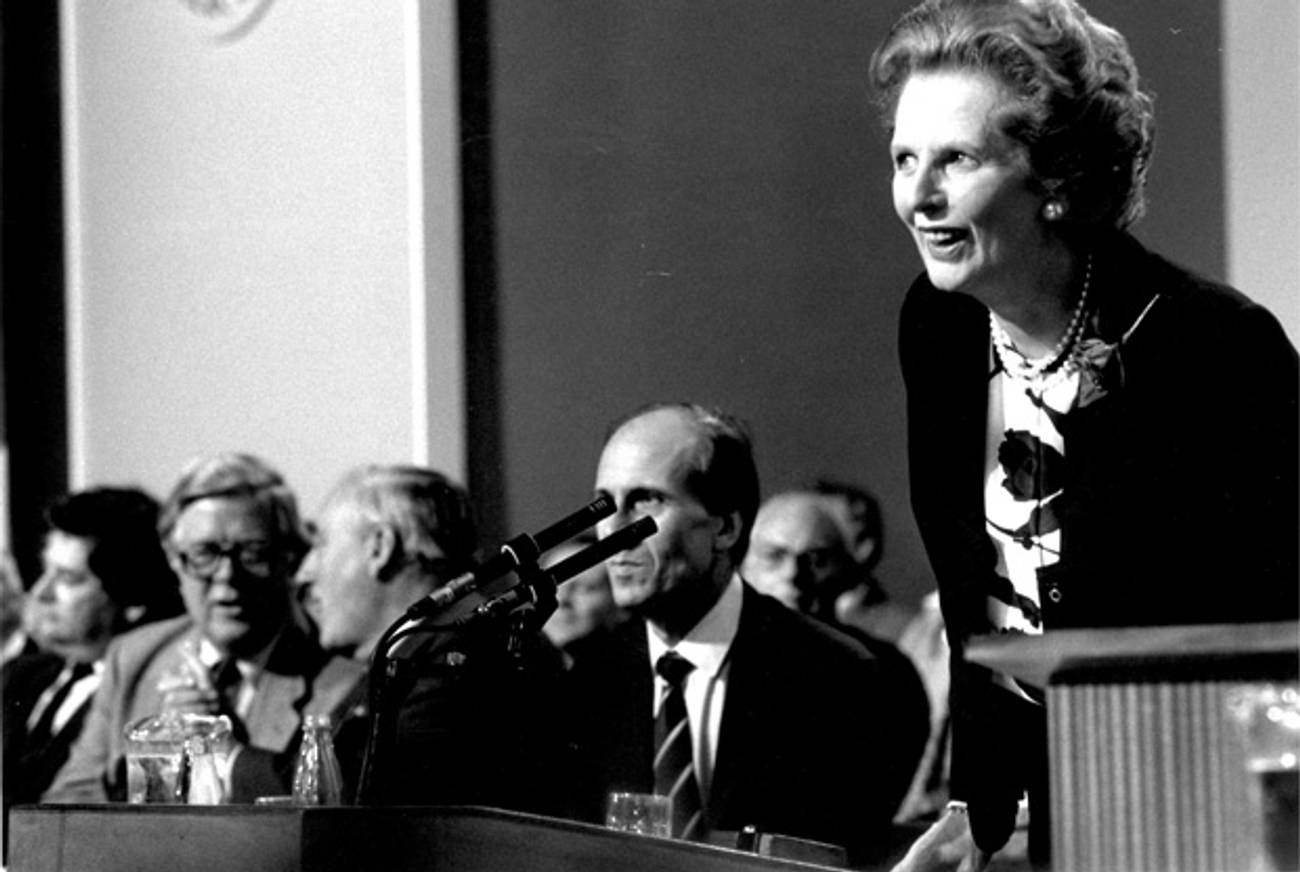
Margaret Thatcher, October 1986.(Keystone/Getty Images)
When asked about her most meaningful accomplishment, Margaret Thatcher, now embodied by Meryl Streep in the biopic Iron Lady, did not typically mention serving in the British government, defeating the Argentine invasion of the Falklands, taming runaway inflation, or toppling the Soviet Union. The woman who reshaped British politics and served as prime minister from 1979 to 1990 often said that her greatest accomplishment was helping save a young Austrian girl from the Nazis.
In 1938, Edith Muhlbauer, a 17-year-old Jewish girl, wrote to Muriel Roberts, Edith’s pen pal and the future prime minister’s older sister, asking if the Roberts family might help her escape Hitler’s Austria. The Nazis had begun rounding up the first of Vienna’s Jews after the Anschluss, and Edith and her family worried she might be next. Alfred Roberts, Margaret and Muriel’s father, was a small-town grocer; the family had neither the time nor the money to take Edith in. So Margaret, then 12, and Muriel, 17, set about raising funds and persuading the local Rotary club to help.
Edith stayed with more than a dozen Rotary families, including the Robertses, for the next two years, until she could move to join relatives in South America. Edith bunked in Margaret’s room, and she left an impression. “She was 17, tall, beautiful, evidently from a well-to-do family,” Thatcher later wrote in her memoir. But most important, “[s]he told us what it was like to live as a Jew under an anti-Semitic regime. One thing Edith reported particularly stuck in my mind: The Jews, she said, were being made to scrub the streets.” For Thatcher, who believed in meaningful work, this was as much a waste as it was an outrage. Had the Roberts family not intervened, Edith recalled years later, “I would have stayed in Vienna and they would have killed me.” Thatcher never forgot the lesson: “Never hesitate to do whatever you can, for you may save a life,” she told audiences in 1995 after Edith had been located, alive and well, in Brazil.
Other British politicians and their families housed Jews during the war, but none seems to have been profoundly affected by it as Thatcher was. Harold Macmillan, a Thatcher foe and England’s prime minister from 1957 to 1963, provided a home for Jewish refugees on his estate, but his relations with Jews were always frosty, the mark of a genuflecting anti-Semitism common among the Tory grandees.
During the controversial Versailles peace talks that ended World War I, Macmillan wrote to a friend that the government of Prime Minister Lloyd George was not “really popular, except with the International Jew,” the mythic entity thought to be behind all of Europe’s troubles and made famous by Henry Ford’s eponymously titled book. Macmillan often made snide jokes about Jews and Jewish politicians, derisively calling Leslie Hore-Belisha, a Liberal member of Parliament and a critic of appeasement in the years before World War II, “Horeb Elisha,” a jabbing reference to Mount Horeb, where the Ten Commandments were handed down to Moses. Viscount Cranborne, a Tory member of Parliament and a Foreign Office official in the 1930s, undermined attempts to ease the entry of Jews into Britain or Palestine, shutting out those other would-be Ediths from finding safety under the British Union Jack. And together, Cranborne and Macmillan were among the Tory parliamentarians who forced Hore-Belish out of the government in the early 1940s for allegedly conspiring to force Britain into a war on behalf of the Jews on the mainland.
Thatcher, by contrast, had no patience for anti-Semitism or for those who countenanced it. “I simply did not understand anti-semitism myself,” Thatcher confessed in her memoirs. Indeed, she found “some of [her] closest political friends and associates among Jews.” Unique among British politicians, she was unusually free of even “the faintest trace of anti-Semitism in her make-up,” wrote Nigel Lawson, her chancellor of the Exchequer, in 1992. Lawson knew of what he spoke. Alan Clark, a senior Tory politician, wrote in his diaries that some of the old guard, himself included, thought Lawson could not, “as a Jew,” be offered the position of foreign secretary. Lawson’s “Jewish parentage was disqualification enough,” the Sunday Telegraph wrote in 1988, without a hint of shame. Rumors and speculation persisted well into the 1990s about why this or that Jewish member of Parliament couldn’t be made leader of the Conservative Party.
Early on in her career—even before she entered politics—Thatcher had worked alongside Jews as a chemist at J. Lyons and Co., a Jewish-owned company. (She had graduated from Oxford in 1947 with a degree in chemistry.) After quitting chemistry, she became a barrister and grew increasingly involved in politics. She ran for office in some of the more conservative districts and lost each time. Thatcher finally won when she ran in Finchley, a safe Tory seat in a north London borough. Finally she had found her constituents: middle-class, entrepreneurial, Jewish suburbanites. She particularly loved the way her new constituents took care of one another, rather than looking to the state: “In the thirty-three years that I represented [Finchley],” she later wrote, “I never had a Jew come in poverty and desperation to one of my [town meetings],” and she often wished that Christians “would take closer note of the Jewish emphasis on self-help and acceptance of personal responsibility.” She was a founding member of the Anglo-Israel Friendship League of Finchley and a member of the Conservative Friends of Israel. Aghast that a golf club in her district consistently barred Jews from becoming members, she publicly protested against it. She even joined in the singing of the Israeli national anthem in 1975 at Finchley.
The Jews of Finchley were “her people,” Thatcher used to say—certainly much more so than the wealthy land barons that dominated her party.
***
When Thatcher became leader of the opposition in 1975, it was suggested that her closeness with British Jews might imperil the country’s foreign policy. Official correspondence released in 2005 shows the unease with which bureaucrats at the Foreign Office treated Thatcher’s affiliations in the run-up to her election as prime minister in 1979. Michael Tait, an official at the British embassy in Jordan, worried that Thatcher might be too readily seen as a “prisoner of the Zionists” unless she severed her official ties with pro-Jewish groups. Tait even suggested that Thatcher give up her beloved Finchley constituency for Westminster, a less Jewish district, and distance herself from the “pro-Israel MPs” that might make Middle East peace impossible. In the end, Thatcher reluctantly agreed to quit the Jewish groups she belonged to, but she kept her district and her relationships with pro-Israel parliamentarians.
Once she became prime minister, Thatcher appointed a government of outsiders. “The thing about Margaret’s Cabinet,” Macmillan would later say, “is that it includes more Old Estonians than it does Old Etonians.” (Eton, the famous prep school, required that its students’ fathers be British by birth, so as to keep out the Jews.) British politics had always been a club for genteel gentiles; Thatcher wanted to make it a meritocracy.
Thatcher appointed whomever she liked to positions in her government, whatever their religious or family background. Chaim Bermant, the Anglo-Jewish writer, probably went too far when he said Thatcher has “an almost mystical faith in Jewish abilities,” but he wasn’t completely off the mark. In addition to Nigel Lawson, she appointed Victor Rothschild as her security adviser, Malcolm Rifkind to be secretary of state for Scotland, David Young as minister without portfolio, and Leon Brittan to be trade and industry secretary. David Wolfson, nephew of Sir Isaac Wolfson, president of Great Universal Stores, Europe’s biggest mail-order company, served as Thatcher’s chief of staff. Her policies were powered by two men—Keith Joseph, a member of Parliament many thought would one day be the first prime minister who was a practicing Jew, and Alfred Sherman, a former communist turned free-market thinker.
With Thatcher, Joseph and Sherman formed the Centre for Policy Studies in 1974 to inject classical liberal ideas into Britain’s Conservative Party. Joseph, son of one of the wealthiest families in Britain, wanted to “fundamentally affect a political generation’s way of thinking.” It wasn’t enough to win elections, he believed; there had to be a change in how people thought of politics. He took his cue from his ideological nemesis, the Fabian Socialists, a group of British intellectuals who wanted to make Britain a socialist country through gradual change. Joseph would copy the Fabians’ style by writing policy papers, giving speeches, and writing to famous Brits to try to change public opinion. One of those forays became a co-written book, Equality, published in 1979, which argued that equality of opportunity “requires that no external barrier shall prevent an individual from exploiting his talents. No laws shall permit some men to do what is forbidden by others.” It was Thatcherite to the core.
***
Thatcher’s philo-Semitism went beyond the people she appointed to her government; it had clear political implications as well. She made Jewish causes her own, including by easing the restrictions on prosecuting Nazi war criminals living in Britain and pleading the cause of the Soviet Union’s refuseniks. She boasted that she once made Soviet officials “nervous” by repeatedly bringing up the refuseniks’ plight during a single nine-hour meeting with Mikhail Gorbachev, “The Soviets had to know that every time we met their treatment of the refuseniks would be thrown back at them,” she explained in her book The Downing Street Years. Thatcher also worked to end the British government’s support for the Arab boycott of Israel. During the Yom Kippur War of 1973, Thatcher criticized Tory Prime Minister Ted Heath’s refusal to supply Israel with military parts or even allow American planes to supply Israel from British airfields. In 1986, Thatcher became the first British prime minister to visit Israel, having previously visited twice as a member of parliament.
Yet despite her support for Israel, and though she rejected the stridently pro-PLO stance of some members of her government, she believed Israel needed to trade land for peace, wishing in her memoirs that the “Israeli emphasis on the human rights of the Russian refuseniks was matched by proper appreciation of the plight of the landless and stateless Palestinians.” She also condemned Israel’s bombing of Osirak, Saddam Hussein’s nuclear reactor, in 1981. “[The Osirak attack] represents a grave breach of international law,” she said in an interview with London’s Jewish Chronicle in 1981. Israel’s bombing of another country could lead to “international anarchy.”
In fairness, Thatcher wasn’t alone in this position. Jeanne Kirkpatrick, the U.S. ambassador to United Nations at the time, compared Israel’s bombing of the nuclear reactor to the Soviet invasion of Afghanistan. The U.N. Security Council unanimously condemned the raid. “Just because a country is trying to manufacture energy from nuclear sources, it must not be believe that she is doing something totally wrong,” Thatcher said in the House of Commons. Iraq’s facility, she noted, had just been inspected and so it was particularly unhelpful for Israel to have attacked. Reagan agreed—at least, officially. “Technically,” Reagan wrote years later, “Israel had violated an agreement not to use U.S.-made weapons for offensive purposes, and some cabinet members wanted me to lean hard on Israel because it had broken this pledge … but I sympathized with [Israeli Prime Minister Menachem] Begin’s motivations and privately believed we should give him the benefit of the doubt.”
That Thatcher did not give Israel the benefit of the doubt is disconcerting, though she made good by later calling for the liberation of Kuwait and eventually the overthrow of Saddam Hussein. But in this Thatcher ought not to have let the mandarins in the Foreign Office get the better of her judgment: She should have trusted her philo-Semitic instincts.
Charles C. Johnson is author of the forthcoming Coolidge: Then and Now.
Charles C. Johnson is author of the forthcoming Coolidge: Then and Now.