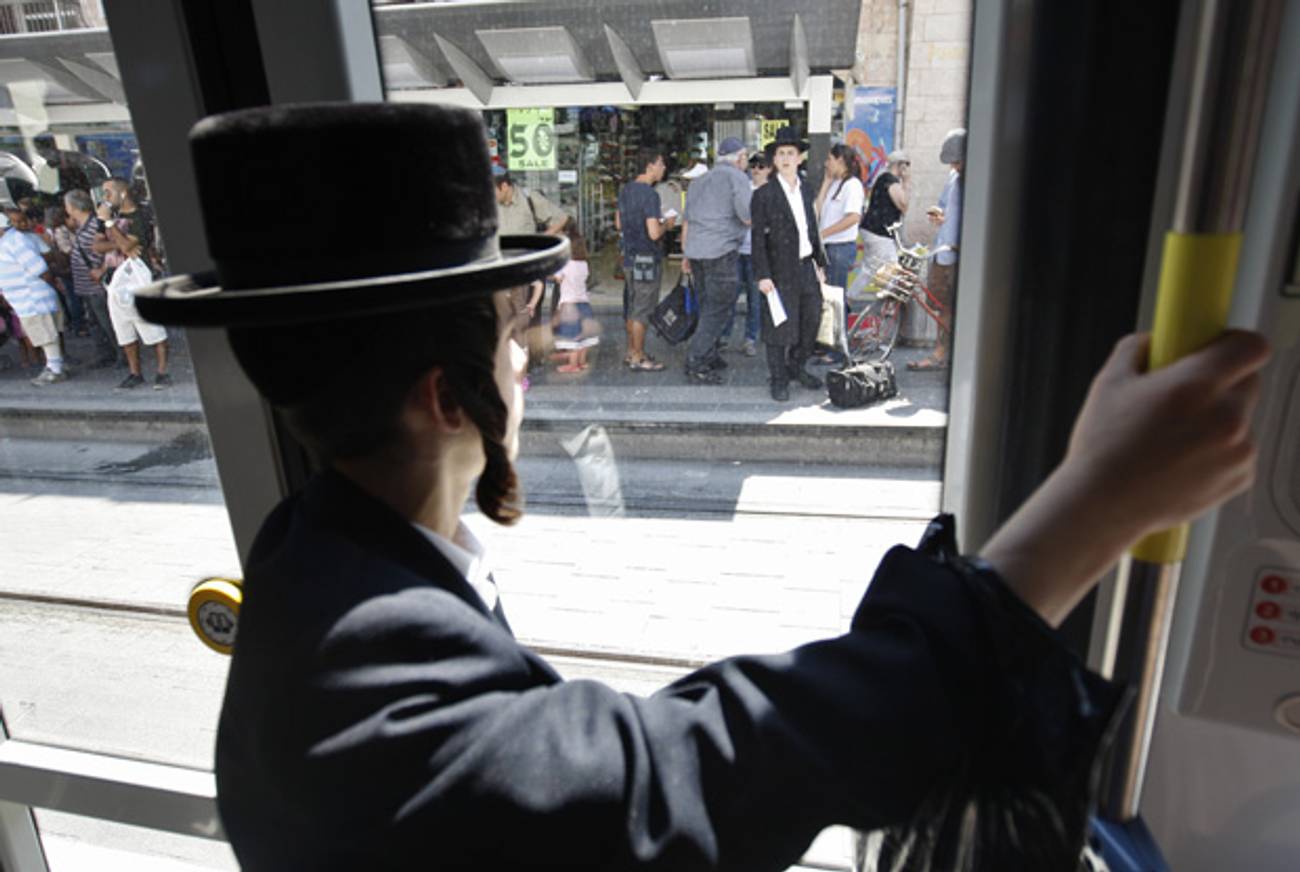
Feb. 2, 2012: Stanley Fischer, the governor of Israel’s Central Bank, delivered a harsh message yesterday to Israel’s ultra-Orthodox and Arab citizens: Stop having so many children and get to work.
OK, Israel’s banker-in-chief didn’t put it quite that way in his keynote speech on the second day of the Herzliya conference, Israel’s premier national-security gathering. Fischer instead called the skyrocketing growth of these two distinct minorities “unsustainable.” He expressed particular concern about the ultra-Orthodox, who don’t work or serve in the army but receive a disproportionate share of government benefits.
While claiming to “very much appreciate our religion and our religious people,” he argued that having so large a group that does not work “cannot continue.” If it does, Fischer warned, “in the long run it’s going to be very difficult in our economy to supply our citizens with a standard of life that keeps improving.”
The numbers are all too well-known to Israelis, but less so abroad, where Israel is known largely as an economic miracle, given its small population and lack of oil and other natural resources. Indeed, most of the economists who spoke at a succession of panels yesterday highlighted aspects of Israel’s impressive economic performance, particularly in light of the global recession. The Jewish state enjoyed a growth rate of 4.8 percent in 2011, with low inflation (2.2 percent).
But Fischer stressed, and others agreed, that the country’s growth—not to mention its social cohesion—would be seriously jeopardized unless the country finds a way to address the challenge posed by these two burgeoning sectors of society.
The numbers he and others cited are truly staggering. In 1980, non-Orthodox Jews constituted 80 percent of the population. Since then, that population had dropped by some 12 percent. By contrast, in 1980 ultra-Orthodox Jews constituted 4 percent of the population; today they account for over 7 percent. While Israeli Arabs made up 15 percent of Israel’s population in 1980, they are over 20 percent today. Only 40 percent of ultra-Orthodox men are employed, while among Arab Israelis, less than a quarter of the women work. Such non-participation rates in the Israeli economy are stunning considering that unemployment in Israel hovers around 5 percent.
The growth of such large ultra-Orthodox and Arab families living off government pensions and other benefits has triggered a sharp rise in poverty in Israel, a situation that Prof. Alex Mintz, the dean of the Lauder School of Government at the Herzliya Interdisciplinary Center, called “intolerable” in his talk. The Israeli government, he said, had to declare a “war on poverty” before the gap between have and have-not Israelis grew even more dramatic.
Fischer and other economists stressed that poverty rates are tied to the growing number of unemployed ultra-Orthodox and Arab-Israelis: The larger the number of children a family has, the more likely it is that the children will be poor. In families where two parents were working, he said, there is little poverty. In families where no one works, poverty rates stand at 80 percent.
How is Israel’s middle class faring? Not great, it turns out.
A recent study by the Finance Ministry published by Haaretz found that wage mobility has been declining for decades and fell particularly sharply over the past 10 years. The study’s authors, Galit Ben Naim and Alex Belinsky, found that Israel had relatively little socioeconomic mobility compared to other Western countries. Tracking salary data for over a million Israelis between 2003 and 2009, the study showed that 65 percent of the people in the bottom 10 percent on average in a given year were likely to remain there in the following year. It also found that overall mobility decreased during the 6-year period they studied. While 49 percent of those in the lowest economic rung remained there a year later in 2004, 56 percent of those in that same category in 2008 remained there in 2009.
Dahlia Moore, dean of the department of behavioral science at the College of Management Academic Studies in Rishon LeZion, called this the “sticky floor.” But there’s apparently a sticky ceiling in Israel as well: Some 86 percent of the top 10 percent of earners were likely to stay there the next year. The lack of downward mobility was even higher for the top 1 percent and the top 0.1 percent. These lack of mobility rates are far higher than those of the United States and the European Union.
Such inequalities helped trigger the middle-class protests last summer in Tel Aviv and around the country—Israel’s own version of “Occupy Wall Street.” While the demonstrators did not openly blame the ultra-Orthodox for the growing financial pressures and rising housing prices they face, resentment about what secular Israelis consider a “leech” class, as one young student at the conference called them, runs deep.
The solution to such growing poverty and income inequality depends on “changes in behavior,” Fischer told the conference. Other experts spelled out what he implied: having smaller families, joining the army, and getting jobs. Some 6,000 ultra-Orthodox Israelis are now in college, Fischer said, a good indication that they might work after graduating. He added that there are already signs that reduced government welfare payments were having a positive impact on Arab-Israeli families: More Arab men are now starting their own businesses or seeking work.
Fischer’s tough warning is consistent with his blunt style. Greatly admired within the business community for his creative, but cautious, stewardship of the central bank, he is credited with having helped Israel avoid the financial bubbles that have swamped Europe in recent years by keeping credit tight and buying up billions of dollars in foreign currency reserves to ensure that, in a time of financial stress, Israel would not run short of hard currency reserves. Prime Minister Benjamin Netanyahu’s government has run a responsible fiscal policy, he has said. Such policies may serve Israel well in an unpredictable region where political earthquakes can easily trigger economic and financial upheavals.
Jan. 31, 2012: The hottest ticket in town right now is the revival of Cabaret, the iconic musical set in 1931 Berlin about a star-crossed romance between Sally Bowles, a young nightclub singer at the Kit Kat Klub, and a naïve young American writer named Cliff Bradshaw. While the play was staged in Israel over 20 years ago, this is the first original Israeli production of the Broadway classic. Based on euphoric reviews and word-of-mouth in a country that hates the sound of silence, the run at Tel Aviv’s Cameri Theatre is sold out for the next three months.
This being Israel, the revival focuses less on the ill-fated romance between Bowles and Bradshaw, and more on the equally doomed Weimar Republic and fascism’s rise in what had been the most liberal and cultured city in Europe. This production has been updated with black-and-white photos of Berlin before and after the war and video sequences of German Jews in coats carrying suitcases as they board the trains to Auschwitz.
The terror of this Cabaret is how ordinary and inevitable that transformation seems—and how its major characters try to avoid seeing the implications of what is so obvious to the audience. This was, of course, the director’s intent. “I wanted to provide a political and moral lesson about the dangers of living in a bubble,” director Omri Nitzan told me over the weekend.
“I’m not by any means equating Israel of 2012 with Germany of the 1930s,” he added quickly. “But there is a strong lesson here.”
“Inside the Kit Kat Klub, life is beautiful, the performers are beautiful,” he said. “But it was all theater. The ugly reality of Germany eventually could not be denied. In Tel Aviv, too, life seems normal—sensual, dynamic, and liberal. But it’s not normal. Only a short distance away is the occupation and Israel’s political reality.”
“Israelis should wake up and be aware of the situation that threats to our life and democracy are all around us,” Nitzan said. “And that it is dangerous to do nothing, to prefer to live in illusion.”
That same sense of profound uncertainty—if not foreboding—pervades the 12th annual Herzliya Conference, which began yesterday in a tony suburb of Tel Aviv. Usually a buoyant assembly of Israel’s best national-security experts, globe-trotting defense analysts, talented pro-Israeli politicians, and policy wonks, this year’s almost weeklong conference opened last night with intense, worried discussions about the country’s future and the many challenges facing the region.
Humility is not a widely admired trait in this crowd. But speaker after speaker at the meeting’s early sessions offered long lists of unknowns. They also revisited a litany of predictions about the Arab Spring offered at last year’s conference that turned out to be dead wrong.
The revolution in Egypt—the first Arab state to have made peace with Israel—was greeted with some euphoria at last year’s conference. Many experts claimed that freedom and democracy were finally coming the Arab world. While some conference participants—many of them American—still claim that, in the long run, Arabs and Israelis will benefit from the political earthquake on the Nile and in other Arab capitals, the majority this year have so far expressed skepticism.
Many of the experts noted that almost no one in Israel had predicted the dramatic upheavals that have transformed the political map of the Middle East. Egypt alone is stunning to consider: A truly democratic election resulted in Islamists garnering over 75 percent of the vote. The September raid on the Israeli embassy in Cairo, the Jewish state’s first diplomatic presence in an Arab land, led to the temporary withdrawal of Israel’s ambassador. (A new envoy has recently returned to Cairo, but with a heavy security presence and diminished political expectations.) The Sinai, where tourists once flocked for vacation, has become a dangerous, crime-infested “no-go” zone for Israelis, as is most of the country. The pipeline providing Egyptian gas to Jordan and Israel has been bombed at least 10 times. The Jordanian government announced this week that due to the disruptions, the government is raising gas prices by 9 percent, another hardship on its already hard-pressed citizens.
Martin Kramer, a senior fellow at the Shalem Center in Israel, listed in an interview the dramatic changes that had taken place since the 2011 conference. Last January, he noted, Hosni Mubarak was still the embattled president of Egypt. Bashar Assad of Syria was telling the Wall Street Journal that he had nothing to worry about. Libya was still intact, and “the London School of Economics was still proud to have Saif al-Islam Gadhafi as an alumnus.”
Amidst tremendous regional uncertainty, Israel has begun to address at least one source of its military insecurity: It has deployed its “Iron Dome” air-defense system to counter the shorter-range rockets and artillery that Hamas has been accumulating in Gaza and that Hezbollah has stored by the thousands in northern Lebanon.
The day before the conference opened, some participants were invited to tour the anti-missile and rocket defenses—a source of enormous national pride, but still highly sensitive.
The tour began not far from Ashkelon, a city of about 110,000 in the Negev, which the anti-aircraft system is supposed to protect. Developed by Rafael Advanced Defense Systems, the system is mobile and is designed to intercept and destroy short-range threats up to 70 kilometers no matter the weather. Initially deployed last March, the system reportedly intercepted a Grad rocket launched from Gaza for the first time last April. Late last year, the Jerusalem Post reported that the system had succeeded in bringing down three quarters of rockets launched by Hamas from Gaza.
Both the command and control center—the heart of the system, which picks up signals from a fired rocket or heavy artillery—and the launchers it commands are mobile and can be moved on short notice. The wireless command and control center we visited was in the midst of a carrot and cabbage field a few miles from Gaza. While barking dogs protected the adjacent fields, Iron Dome was protecting Ashkelon’s citizens. Scanning the airwaves for signals of rocket fire, the system is monitored by soldiers who watch computer screens inside the command and control center. The command center’s only distinguishing feature is a tall antenna.
The launcher, which resembles a tilted dump truck, was parked next to a tree in the midst of a wheat field. Even closer to the Gaza border, the deceptively innocent-looking interceptors can hit incoming targets at least 300 meters above ground—high enough to avoid hitting civilians on the ground with falling debris. (It only takes between 8 and 9 seconds for a rocket from Gaza to reach the southern area of the city, and between 20 and 30 seconds to strike northern Ashkelon.)
The Iron Dome system will be even more effective when it is integrated with the rest of Israel’s air defense system: the Patriots, which can destroy rockets with a range of up to 200 kilometers; the David Sling, to counter targets with a range of 350 kilometers; and the Arrow, which destroys rockets and missiles with a range of up to 1,000 kilometers.
Judith Miller, Tablet Magazine’s theater critic, is the author of the memoir The Story: A Reporter’s Journey.