Free Thinkers
How Europe’s 19th and early 20th century Jews changed everything
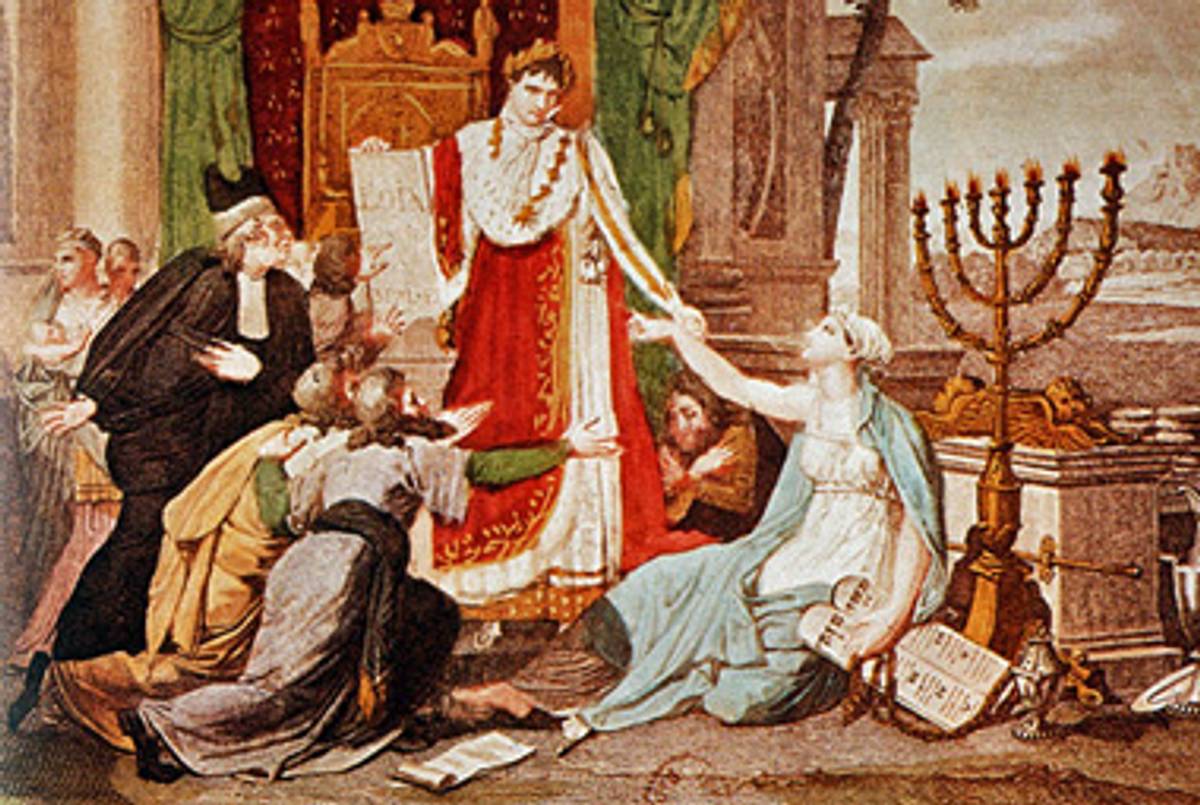
The French Revolution is not generally considered a key moment in Jewish history. But in his new book, Emancipation: How Liberating Europe’s Jews from the Ghetto Led to Revolution and Renaissance, Michael Goldfarb argues that the period that began with the Revolution and Jews’ consequent enfranchisement and ended nearly two centuries later with the Holocaust was marked by astonishing contributions by Jews to Western culture—in philosophy, industry, politics, literature, music, and the sciences. Newly liberated Jews were in a unique position to challenge received wisdom in all areas, after experiencing such radical changes in their own way of life. But their integration into European society also came at the expense of religious and cultural identity.
Goldfarb, former London bureau chief for National Public Radio and now an independent journalist living in London, speaks to Vox Tablet host Sara Ivry about signifcant moments and personalities of that period, from philosopher Moses Mendelssohn, who left his Talmud studies in the Dessau ghetto to become what some referred to as “Germany’s Plato,” to the Rothschild dynasty and its antithesis, Karl Marx.
Your browser does not support the audio element.
 Vox TabletSo Long, FarewellAfter 11 years and 500 episodes, Vox Tablet signs off for good
- Vox TabletTanya’s StoryHow a young woman learned the painful lesson that there are times when trying to do what’s ‘right’ can go very, very wrong
- Vox TabletA New Kind of Prayer BookThe Conservative movement’s latest siddur goes way beyond traditional liturgy
- Vox TabletHey, Mister DJ: Put a (Diaspora-Blending, Genre-Bending) Record OnBooty-shaking new music from A-Wa, Sandaraa, and Schizophonia
- Vox TabletWhat’s Free Will Got To Do With It?Especially in election season, we love talking about the moral fiber (or lack thereof) of our candidates. But when it comes to ethics, no man—or woman—is an island.
- Vox TabletBuilders of a New JerusalemIn a new book, Adina Hoffman brings to life three architects who transformed the city in the days of the British Mandate
- Vox TabletBathe in the WatersA radio documentary asks: Is there a way for women to dunk ritually that doesn’t conflict with their feminism?
- Vox TabletBeyond DrakeA handful of personalities come to mind when we think of African-American Jews. Let’s change that.
- Vox TabletThe Saddlemaker, the Schindler, and the Miller of WlodowaGolems, messiahs, tradesmen, Nazis, and townspeople converge in the story collection ‘In the Land of Armadillos’
- Vox TabletA Year of FirstsAn audio portrait of Luzer Twersky, just after he quit his life as a Hasid, and long before he played one in films
- Vox TabletFor the Love of Suzie Louise: A Christmas StoryIn middle-century Skokie, a young Jewish boy searches for a stolen Jesus to comfort his bereft Christian girlfriend
- Vox TabletThe Most Haunted Leading ManIn ‘Son of Saul,’ actor Géza Röhrig defies our every expectation of a Holocaust movie hero
- Vox TabletGirlhood, InterruptedCynthia Kaplan Shamash fled Iraq 40-odd years ago, when she was just a kid. Her flight foreshadowed that of young refugees fleeing Syria now. Where did she land? Where will they?
- Vox TabletLet ‘Freedom’ Ring: A Flutist Gives Life to Musical Celebrations of LiberationsMimi Stillman’s new album features works inspired by upheaval in Europe and the Middle East
- Vox TabletPuzzle MasterFor years, scholars dismissed the Arabic on text fragments from Cairo’s genizah as unimportant scribbling. Then along came Marina Rustow, bona fide ‘genius.’
- Vox TabletMy Grandfather, the Secret PolicemanRita Gabis knew only that her mother’s Catholic family came from Lithuania after the Holocaust. Then she started asking hard questions.
- Vox TabletBeyond the PulpitWhat does a rabbi do in late August when he no longer needs to prep for High Holidays?
- Vox TabletAndré Aciman, Sarah Wildman, and Others Build a Summer Reading ListLooking for a good book to sink into at the beach in these waning dog days? Friends share what they’ve loved lately.