Your email is not valid
Recipient's email is not valid
Submit Close

Your email has been sent.

Click here to send another

thescroll_header thescroll_tagline thescroll_tagline_RSS

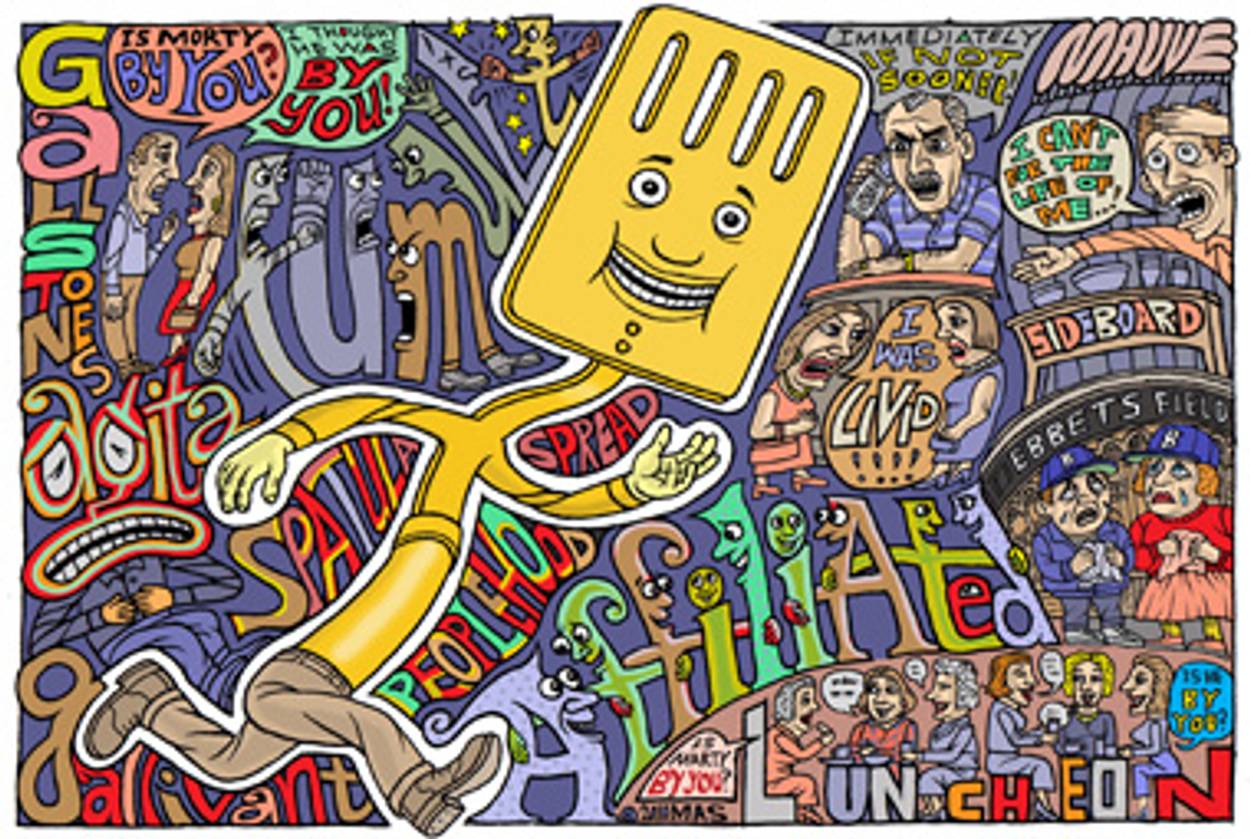
The Gallivanting Spatula

Words Jews use

Print Email

Not long ago, Tablet editor Alana Newhouse asked Jeffrey Goldberg, of The Atlantic, when he would be able to travel to New York from Washington to finish a Tablet Magazine project. He hemmed and hawed; she sighed.

“Well, whenever you’re finished gallivanting around Washington, come up here so we can finish,” she said, wearily.

“ ‘Gallivanting’?” Goldberg asked. “Who says ‘gallivanting’?”

“Jews,” Newhouse responded.

“Only Jews?” Goldberg asked.

“Only Jews,” Newhouse said.

“Like ‘appetizing’ as a noun?” Goldberg said.

“Yes,” Newhouse said. “And ‘mauve.’ Or ‘sideboard.’ ”

“And ‘drapery,’ ” Goldberg added.

“We could make a list,” Newhouse said.

***

As with everything else in Jewish life, Philip Roth got here first—in this case, with Portnoy’s Complaint:

The novelist, what’s his name, Markfield, has written in a story somewhere that until he was fourteen he believed “aggravation” to be a Jewish word. Well, this was what I thought about “tumult” and “bedlam,” two favorite nouns of my mother’s. Also “spatula.” I was already the darling of the first grade, and in every schoolroom competition, expected to win hands down, when I was asked by the teacher one day to identify a picture of what I knew perfectly well my mother referred to as a “spatula.” But for the life of me I could not think of the word in English. Stammering and flushing, I sank defeated into my seat, not nearly so stunned as my teacher but badly shaken up just the same … and that’s how far back my fate goes, how early in the game it was “normal” for me to be in a state resembling torment—in this particular instance over something as monumental as a kitchen utensil.

“Spatula,” we eventually decided, didn’t actually meet the requirement of our new Jewish lexicon; the list we have in mind does not feature Yiddish words, real or faux, nor will it include words such as “spatula” that have been confused, in the past, for Yiddish. (Though “tumult” might count.) Still, in honor of Roth—whose 31st book was published last week—we decided to name this project “The Gallivanting Spatula.”

Here, then, is the beginning of the list, which we’ll update each week. We invite readers to suggest additions (phrases—for instance, “a tumor of the size of a grapefruit”—as well as individual words, are welcome.) We feel no need to ask for corrections, knowing that these will come with or without an invitation. You can email us at spatula@tabletmag.com.

Appetizing (noun only): “I have to pick up the appetizing for the Men’s Club sukkah event.”

Federation (noun): “Federation’s Peoplehood Committee is commissioning a study on unaffiliated Jews in the Greater Metro region.”

Gall stones (noun): It is a well-known medical fact that non-Jews, while not immune to gall stones, do not discuss gall stones, publicly or privately.

Livid (adjective): “Irma is livid with the caterer.”

Luncheon (noun): Not “lunch,” which is an ecumenical term. “Join us for the kick-off luncheon of the American Friends of the Weizmann Institute.”

The Arabs (noun): “There could be peace if the Arabs would stop teaching hate in their textbooks.” (“Arabs” without the article “the” is used by non-Jews.)

Traipsing (verb): Fatigued gallivanting.

  • http://www.tjctv.com Steven I. Weiss

    “Famished,” particularly when said with a different pronunciation — “I’m fuh-MISHED.”

  • Marcia Almey

    This is hilarious!

  • JanetG

    “Rock cornish game hen”

  • mjfrombuffalo

    Wow. According to this, I’m a native Jewish speaker. The only thing here I didn’t hear or say myself growing up in Buffalo is “The Arabs.” Only when I say “Federation,” I am usually referring to the Federation of Protestant Welfare Agencies.

  • Tulle Tilsynet

    Needs more fact check. I always thought “gallivant” was exclusively a (US) Southernism, but just a little googling shows that it is pretty international.

  • Susan Averbach

    “Coffee and” pronounced “Coffee an . .” which is what you serve when the ladies come to visit.

  • Robin

    I’m as WASP as you can get and my mother used traipse all the time. I use it still. My kids learned to use it. I claim traipse for our tribe. Gallivanting too. In fact, I’m claiming all fancy words for walking for team WASP.

  • amadeus482000

    Yes indeed. While we’re at it, let’s have ethnic Germans write in with a list of words “only” they use. Y’know, as a way to strengthen identification within culture and magnify the power and validity of statehood.

    Deal?

  • Heleno

    I’m afraid I use gallivanting quite often, as does my entire family, and we’re all Irish. As in from the island of, none of this Irish-American nonsense.

  • Dan Klein

    Robin, amadeus and Helen: clearly it’s time to explore your family’s secret histories.

  • Laurie

    Strangely, I am a combination of previous commenters (Buffalo WASP here) and I have to agree, the walking terms especially are ours too. Do you also reconnoiter if you are being nosey near the neighbors?

  • Gene

    Aggravating and aggravated. I always thought they were Jewish words until I entered school.

  • amadeus482000

    @Dan I’ve got no secret family history– but perhaps you do.

  • Robin

    City block, used as a measure of wealth: “Their house was 2 city blocks long!”

  • Seemore

    How about aggravation? Also, one is not hungry, one is famished. Stingy? Magnesia? Chifforobe? I l also thought heart-burn was Yiddish and that candidate was pronounced kandidat putting them in league with America-gonef.

  • Becky

    One thing for gentiles to keep in mind: These words, when said by Jews, have an element of subtle passive-aggression (and sometimes a grim quality) that I do think is unique to that sub-population. Our mothers and grandmothers are quite well-versed in using words like “gallivanting” differently from how you probably would use them.

    Also: “shut the light.” “you shouldn’t know from X.” “Don’t worry about me.”

  • Paul

    Armoire to mean closet when not used with any pretension

    “I should be so lucky?!”

    Valise instead of suitcase

    The single most Yidsy line I’ve ever heard anyone say obviously goes to my grandma which was in the process of describing Edith Piaf after having seen La Vie en Rose back in 2007. “Two good days in her life that girl did not put together.”

  • Laralee

    “Be careful how you go”, “lox”, “We’re eating by the Gruens on Shabbos.” I could go on.

  • Laralee

    Okay then! Credenza (for sideboard),Breakfront (for glass shelves in the living room)and my personal favorite from Grandma Lillian, z’l “What I’ve forgotten you don’t know yet.”

  • Beth

    How about asking children “Do you have to make?” meaning, “Do you need to use the toilet?”

  • Valda

    A doting Jewish grandmother once described her pre-verbal granddaughter to me thus: “She has no words yet”. I’ve always thought that was a very beautiful phrase.

  • MB

    M.O.T. (“Member of The Tribe”)

  • Kjle

    You need to get out more. These words are all in common usage by the English speaking peoples. There must be some other reason that you’re unique.

  • Toby Perl Freilich

    How about Yiddish mis-pronunciations of English terms, as in my immigrant mother’s references to the “CuisineArt” as the “Sqveezinart” or “Home Depot” as “Home People”… Does that count? Or, better yet, words that were entirely fabricated, such as “That dress is very sliminizing.”

  • http://www.bethsurdut.com Beth Surdut

    When I lived in Hawaii,an elderly Filipino widow–believe me,if you saw what she ate,you’d know she wasn’t Jewish, even a little bit– told me with a twinkle in her eye that since the death of her husband, she was not lonely.”I go out gallibanting!” she announced proudly.
    I grew up in a family of word mavens (maven,now that’s a word. I don’t find any of the words listed as particular to being Jewish, including the discussion of gall stones. The furniture descriptions are more regional and/or generational than ethnic.
    And Paul, I agree with your grandmother’s assessment of Edith Piaf (may she rest in peace)!

  • Rabbijan

    My mother always “took umbrage” at things she didn’t agree with. She once looked at a crinkly fabric dress at Macy’s and “took umbrage” that it hadn’t been ironed before being put on the manniquin!

    She also said “spring I wish it were already.”

  • Dani

    “Please close the light.”

  • jay

    People,

    Stick to the assignment: words.
    Save the expressions for another day.

    Here’s mine: compote.

  • Rodger Kamenetz

    It’s more subtle than vocabulary. It’s about intonation.
    Quite a while ago I wrote a poem “You should” with dozens of variations on “you should” such as

    You should be so lucky.
    You should be poor like the Rockefellers.
    You should have such problems.
    You should drop dead you mamzer
    etc.

    There’s a swivel in the intonation & then the meaning is a palimpsest; the meanings are crossed through & reversed. “Gallivant” said this way actually means: “fancy people gallivant & I’m going to gallivant too but it’s a big joke me saying it.”

    Whether at this stage any of this is still a Jewish linguistic marker is dubious. We are talking language that came out of a felt class inferiority from 50 years ago. Now it’s just an affectation. Unless you really somehow want to cling to it.

  • jay

    Well, looks like I read the assignment incorrectly.
    It includes both words and phrases, but not those that are confused for Yiddish.

    So sue me.

  • Joelle

    Supper, instead of dinner;

    “Let’s have a bite (to eat)”.
    “Did you eat?” pronounced ” D”Jew eat?”

    “Close your mouth or the flies will get in”

    And let’s not forget the multi-purpose adjective,
    Knucklehead.

  • Jeff Carpenter

    My all-time favorite saying, from Leo Rosten’s collections, is “So what’s the matter?—was the bride too beautiful?” in response to the habitual complainer who could find fault with anything in any situation.

  • Marilyn Cohen

    “Supper” is a Southern term for dinner. It is not Jewish.

    “Close the light” is a literal translation from Yiddish-”farmakt di likht”.

    I also hear “take a haircut”, again from Yiddish.

    Then there are regional differences. New Yorkers call the body of grass surrounded by street “an island”. In the South it is a median or intersection.

  • http://tabletmag.com Dan Klein

    As good as the article is, I hope everybody clicks on the picture to see the big version. It’s great!

  • Rose

    Brisket?

  • Joel Kangisser

    Laralee — in addition to the warning ‘Be careful how you go’, my Great Aunt Sadie (thee’s a name not in use now — remember Barbara Streisand’s ‘Sadie Sadie, Married Lady’?)used to tell me ‘Don’t run with the car!”. (I of course aanswered her that I don’t run, but sit inside and drive.)

    Seemore — what’s with ‘aggravation’? The correct woid is “Apoplexy” — my mother told us kids 10 times a day that we’d give her ‘apoplexy, (and I always thought it was apple-plexy).

    When you are gallivanting and traipsing, you are also shopping and then you have to ‘shlep’ the packages home.

    Finally (a phrase –sorry Jay)– the famous ‘Throw Mamma from the train a kiss!’ (Or was it a knish?)

  • Berta Calechman

    This is a wonderful post. I’ve been “traipsing” all my adult life, and the “definition”….fatigued gallivanting(which I’ve also done most of my life) is perfect. Growing up, I thought for years that “being a kandidat” meant you were sick, since my grandmother would feel my forehead, and say “bist a kandidat.”

  • Chana Batya

    I have so many:

    1. The Grippe (not the flu)
    2. NOT, as in “she’s Jewish, he’s NOT”
    3. the Top Man for your doctor. NOBODY sees a doctor who didn’t graduate #1 in his (always his!) class.
    4. ___Man, as in the Ear Man, Bone Man, Stomach Man; synonym for Doctor (see the Top Man, above)

    Agree totally with Aggravate, which was my mother’s catch word for any annoyance whatsoever.

    @mjfrombuffalo: ME TOO! The Federation is ALWAYS the Jewish Federation, however.

  • Beverly

    This is hysterical. Agree that “by” generally meaning “at” definitely makes the list: “I’ll be by my mother for Thanksgiving.” or “How’s by you?”

  • Eddie

    I appreciate tour inclusion of “The Arabs” but the definite article is used much more widely and deserves an entry of it’s own.

    “The produce at the Waldbaums is not so great.”
    “I think the gays have a point about marriage.”
    “My sister and I went to see the Les Mis on Broadway.”

    And then there is the lovely habit of always answering a question with a question.

    “Sonia, have you and Morris gone to dinner at the Le Cirque?”
    “What am I a Rockefeller?”

  • Phyllis

    My Grandma Sadie always used to say “Wait awhile” instead of “wait a minute.”. Also, my vote is that “aggravating” is definitely a Jewish word!

  • Steve

    I understand why many commenters didn’t think of some terms as Yiddishisms- what many people forget is how many yiddish words became main stream being used by many commentators. I have heard weather peole call light rain “spritzing” and yesterday some one on a newscast referred to something being “smutzy”
    Steve

  • http://www.tabletmag.com/scroll/47216/the-gallivanting-spatula/?utm_source=Tablet+Magazine+List&utm_campaign=7614a45747-10_13_2010&utm_medium=email P. Fischer

    I must agree with those from Buffalo who say that many of the so-called “Jewishisms” cited here were common vocabulary for all (not just Jewish) upstate NY citizens.

    Words regularly used by my mom [Oswego/Rochester]:
    spatula,gallavanting,traipsing,aggravating

    Plus, any person in Chicago is apt to say “I have to go by ‘the Jewel’(local grocery chain) on my way home.”

  • Robert

    “You’ll be cold, you don’t put on a little sweater.”

  • Chaim Yankel

    Velvet.

    “Take off the table.” (clear off the table)

    “You want I should go there?”

  • Sharon

    To Beth, you may have had “to make”, but if you told her(mom)you would aggravate her(mom).

  • Ellen

    How about “pocketbook” for purse?

  • Sharon KH

    How about shlep as descriptive adjective – I can tell by his clothing he’s not a shlep; as a measure of distance – it’s a real shlep from here to there; or as a verb – today’s students shlep heavy book bags? I had always thought that shlep in any of its forms, was uniquely Yiddish and so was stunned to discover that it’s a borrowing from the German word schleppen to drag, lug or haul.

  • http://www.njjewishnews.com/tribe Alia Ramer

    I never heard “come with/go with” growing up in Ohio. Only in Jewish New Jersey do I hear “I’m going for coffee. Want to come with?” or “They’re going to the movies; they said we could go with.”
    Are we that poor a people that we can’t afford an extra pronoun?

  • http://pepgiraffe.blogspot.com PepGiraffe

    I think these are like Jewish Standard Time. I always thought the notion of running habitually late was Jewish so I was quite surprised to hear someone refer to it as Mormon Standard Time.

    I think of it as particularly Jewish, but Mormons probably don’t. cf: Gallivanting.

  • Rick Goldberg

    Two traditional food names used pejoratively: “baloney” and “chopped liver”. I happen to think “baloney” is an important food group for growing children and “chopped liver” is disrespectfully undervalued.

  • Fredi

    How about “keep kosher” or “keep Shabbat” I don’t think anyone else uses keep like this.

  • Marcos El Malo

    I loves me some Mark Alan Stamaty. I’ve been a fan since “Who Needs Donuts?”

    Funny column! If you are including phrases, may I suggest a “favorite” of my father’s (judging by his usage, which is frequent), “If you want, take.” This us usually accompanied by his shoving food in the direction of the person addressed.

  • Bill Burns

    I use “spatula,” “gallivanting,” “luncheon,” “gall stones” and “federation” as a noun (you don’t actually mean federation as a noun, but federation as a noun without a “the,” the inverse of what you describe with “the Arabs”) Anyway, the point is I’m not Jewish, and you really need some evidence as to Jewish uniqueness here.

    Appetizing as a noun I’ll give you, though.

  • http://www.newrulesofinvesting.com zack

    I like ‘by’ — as in, “Where are you going to be for Shabbat. Oh, you’re eating by the Cohens?”

    Who says that?

  • JG

    “From” – as in, “What do you know from funny?”

  • MarysMom

    My ex is blue collar Italian American from NJ & they all say “by” instead “at”. Kind of charming. I’m west coast & don’t know any other word for “spatula”.

  • sonia

    when I was a child, and Yiddish was our ‘mameloshen’ I had no idea of the English for ‘Ribbisen’ now I know it’s grater!

  • JD

    Reversing subject and predicate: “Oh…a big affair you’re having.” “Quite the diamond she’s wearing.” That’s the Klopman diamond, of course (for those of you who know perhaps the greatest Jewish joke of them all).

  • Simi

    Easy – “God Forbid.”

  • Leslie Felner

    Though this may be more New York than Jewish…”Put the lights on or Shut the lights outs” for Turn the lights on or off. Great topic though for those of us who cherish words.
    Leslie Felner

  • Badpete

    I never heard a non-Jew describe someone as a LUMMOX; have you?

  • http://www.tabletmag.com/author/mingall/ marjorie

    Cholera. Bungalow. Agita. Divan.

  • Fagelah Shikse

    My second husband — my gorgeous Jewish prince, Marty — introduced me to all things Jewish, going so far as to grade my occasional use of Yiddish based on accuracy, appropriateness, pronounciation, etc.

    For a GWASP (Gay, White, Anglo-saxon, Protestant), Yiddish words and expressions were a revelation.

    Each is so multi-layered with subtle meanings, so full of emotions and opinions, and so onomotopoetic as to include physical release that using them seems to soothe the savage soul — especially therapeutic for GWASPs who are taught emotional repression before their mothers will allow them to suckle.

    Thank you, Gallivanting Spatula, for making public your discovery of yet another form of Jewish language.

    But what’s it called ? Yinglish ? Eng-ish? What …??

    And is this an example? — one Seder, Marty’s Aunt Sonia told me “Speak up! I’m having hard of hearing!”

    And yes, Marty. I still miss you.

  • http://? Richard

    “Conniptions”, or “Conniption fit”. As in “he had a conniption fit when he saw the mess in the kitchen”. What IS a conniption, anyway?

  • Henry

    Do phrases count or just words?

    If phrases too, how’s about:

    “Don’t hock me to China” — derives from something in Yiddish referring to a teapot. Do non Jews use the word “hock”

    “How’s By You?”

    “You should be so lucky”

  • Laura

    The Mishuga, referring to in-laws. “hock me a Chanuk,” as in tell me the story. Ver as an all-use prefix: vertumult, vershmeered. Schlepp, as in The Great Schlepp of grandchildren to grandparents in Florida, persuading them to vote for Obama, and now used as visiting grandparents anywhere for any reason.

  • MizFurball

    I am not a Jew, nor was I raised as a Jew (Catholic school). But I do use all the words mentioned except “appetizing.” I have a couple to add:

    Such a deal!

    Mother speaking: Why you never call your mother?

    I can get it for you half-price.

  • BRDavis

    Answering a question with a question:

    “Do you like it?”
    “What’s not to like?”

  • http://www.esamiljan.net Ed Samiljan

    How about “Goyshke Bread”. referring to white packaged sandwich bread?
    Don’t Patzkie around!
    “My Stevie or Eddie or Moshe” as the case may be.
    Two cents seltzer.
    “Eat kinda, The Chinese are starving”
    He’s a Doctor, doctor.

  • http://mideastparalleluniverse.blogspot.com/ Bella

    All right already! Go know! Who knew?

  • hexag1

    drapery? that’s in common use in many communities.

  • Nuchschlepper

    “Be well” is something only American Jews say.

    How about our use of “up,” as in “Come up the house.”

    Regarding the lights comment, we New York Jews say “close the light,” which makes no sense in English.

    The use of “by” mentioned already is definitely Jewish-speak. “That’s dinner by you?”

  • David Fried

    Perhaps not exactly on topic, but irresistible. Many years ago my very blonde, Catholic and midwestern girlfriend made . . . tuna casserole for dinner. Tuna casserole! I had never eaten tuna casserole in my life. I had definitely heard of it, though. I looked at my GF, perhaps too scornfully. “And what do you call this?” I asked gesturing toward the casserole. She replied in a timid voice “goyishe kop?” Game, set and match. . .

  • Dan

    Growing up I thought “farce” was yiddish.
    “It was such a farce!” pronounced with a dismissive wave of the hand.

  • Alan Paul

    This is a lot of fun, but you do realize that a lot of non Jews use most of these words — certainly gallivanting… We do own appetizing, though.

  • N Abkarian

    Be Well, Nu?, So? Kishkes, plotz,famished, enough already

  • James Fallows

    “Appetizing,” as a noun, may be a Jewish-specific usage. I’m sure I (non-Jew) have never said that.

    All the rest are part of general American usage, with regional and class variations. Well, maybe not “plotz.” The rest I’ve heard all along (we had spatulas in our house; my grandmother had a sideboard, etc) and even used!

  • Ken Halpern

    “March,” in the following sense: “She marched right down to that school and threatened to sue if they didn’t put a halt to the bullying!”
    “Instigate” to refer to what NY Italians call “starting” (is it a coincidence that the NHL has adopted the “instigator rule” since landsman Gary Bettman became Commissioner?).
    “Dummy” is a big one. I’ve never heard a Gentile use the word “dummy,” whereas it’s a staple of the Jewish vernacular. I completely agree about “lummox” as well.

    Jews also overuse certain words compared to non-Jews: “Moist,” in describing desserts, though unfortunately ad agencies have appropriated that word (which, when used by Jews of a certain age, makes me squeamish) and drained it of meaning. And “bastard.” Jews use “bastard” much more frequently than non-Jews, if not exclusively, and not to refer to illegitimate offspring.

  • Gene

    There’s no percentage in it.
    Alright already.
    Of the words on the list, the only one I can see as “Jewish” (the phrase “Jew speak” seems offensive) is the apptetizing.
    Luncheon I associated with real hosuewives of New Jersey type efforts to be classy, like going to Frank in AC was classy. Actually could be a fun thing to do but not “classy.”

  • Joanie

    AS an editor, I was always told that luncheon is what the goyim eat at fancy restaurants; lunch is not classy. Draperies is correct and elegant, it was said, but drapes may be Jewish. I’m sure gallivant is areligious. As are traipse and moist. And spatula (check Bloomies).
    I’ll give you tumult, though. Are you sure that’s not a Yiddish word?

  • rumtumtugger

    what a load of absolute shit

  • Danny Fingeroth

    Maybe it’s because my father was a kosher banquet caterer, but I’ve never heard Jews use the term “pigs-in-a-blanket” for the hors d’oeuvre. We always called them the awkward-sounding “hot-dogs-rolled-in-dough.”

  • Oy vey

    To the people who seem to find this an annoying exercise in Jewish self-congratulation, or think that Jews are “claiming” words that belong to everyone… you’re completely missing the point. This is self-mockery, not boasting… some or all of these words may well be used by others, but the common thread is that they tend to be used heavily by Jews, or at least Jews of a certain age and set of experiences, because they are self-dramatizing, critical, and/or passive-aggressive (or otherwise reflect the sensibility of Jews of that generation). And to the kind of people who read Tablet (mostly the children of those Jews), it is entertaining and amusing to recall them.

  • http://aflawedbeauty.blogspot.com Susanlee

    I’m from Texas, and, unfortunatley, not of Jewish heritage, but I use almost all those words in the ways that you’ve described. The only exceptions being appetizing, Federation and the Arabs. I also use gallivanting, and I have no idea what other word would possibly used to describe a spatula.

  • Daniel

    “Soon by you” the inevitable greeting any single adult will receive at a wedding.

  • David Grundy

    Hey, all this is overcooked. Here in the UK we must all, well, most of us Brits use what the USA sees as Jewish words. BTW there is no other word in English for spatula than spatula.

  • Bill Burns

    If you want people who use Federation as a noun, who you really want are Star Trek fans.

  • Katie P.

    My Anglo, Texan, Mormon mother would be quite surprised to both “gallivanting” and “spatula” to be claimed as words used only by Jews, as she used those words pretty constantly.

    Is there even another word for spatula? What else could anyone possibly call it?

  • Katie P.

    I see that another Texan has pointed out that all of these words take regular turns on the verbal dance floor in Texas. If you think these are words only Jews use, then your sample is seriously flawed.

  • http://xpostfactoid.blogspot.com ASP

    Zack’s “you’re eating by the Cohens?” triggered memory of a story my father (b. 1928) used to tell about the local candy store owner, refusing a frequent request: “You buy by Bungalo Bar [ice cream truck] and now you want a drink of water?? Fuy! Get out of here!”

    I imagine that “by” in place of other prepositions is a yiddishism. Is there a pronoun in Yiddish that sounds like “by” that’s used where we use “from” or “at”?

  • R. Kevin Hill

    My mother was German-American Catholic, and she used to say “all fershimmeled” about anything damaged. Decades later genealogical research revealed that the “German Catholic” family was in fact Austrian Jewish.

  • Alison Rutledge

    “From your mouth to G-d’s ear” said as a quick prayer.

  • Badmoodman

    “ ‘Gallivanting’?” Goldberg asked. “Who says ‘gallivanting’?”

    “Jews,” Newhouse responded.

    – - My mother, who was 100% Swedish Lutheran used to frequently use the phrase, “gallivanting hither and yon.” Of course we lived in the very Jewish village of Skokie, IL so maybe she picked up while traipsing around town.

  • Andrea K

    Phrase: “like a hole in the head”

    As in, “I needed that second ruggalah like a hole in the head.”

    Translated from the same phrase in Yiddish.

  • Alan

    You must be joking. Gall stones, Livid, Luncheon, Traipsing and Gallivanting are all words WASP’s use, too. Maybe you need to get out more, make a few non-Jewish friends, and run the list by them before you publish it.

  • Shmuel

    “You want I should” instead of “Should I” or “Would you like me to”…You want I should call you later?

  • Jenn

    I think the “spatula” story is a joke–he assumes it must be a Yiddish word!

    R. Kevin, that’s exactly what happened in my Dad’s family. I grew up speaking dozens of Yiddish phrases because my dad and his dad and his dad before him all used them. Then we realized that every other family in the U.S. with our last name was Jewish! Then we realized they fled Bavaria and erased their former Jewish identity in the process.

  • Boldface

    How about “verbatim?” Back in yeshiva the rabbi used to see we had to know the talmud page verbatim. It sure sounded yiddish to me.

    And spatula sounds yiddish because it has the same feel as “maidele” or “yingele” or, for that matter, “rugele” – which means the plural of spatula in yiddish would be spatulach?!!?!?!?!?

  • Nigel

    Leslie, “put out the light” is Shakespeare, so that usage predates New York.

    As has been mentioned above, most of the words discussed are in regular use in the UK.
    (And bungalow is of Indian origin.)

    Still, I like the idea behind the list.

  • ret3

    My Italian-American grandfather, born and raised in the Scranton area, uses all of these save appetizing. He also uses dummy, lummox, snookered, conniption and God forbid. He has never, to my knowledge, uttered fuggedaboudit.

    Also, I’ve heard some refer to a spatula as a turner or flipper, but they didn’t know from kitchen implements.

  • Bill

    Depending on the kind of spatula and/or how it’s being used at the moment, you might describe it as a flipper, a spreader, maybe a scraper.

  • kirk

    I put “the” in front of every proper noun now because of the “teh” meme or just because…
    the Google
    the Walmart
    the Facebook
    the Mexicans

    But not Talking Heads, the name of this band is Talking Heads.

  • PatK

    I come from Southern stock, and have always thought that words such as “gallivanting,” “traipsing,” “livid” and “luncheon” were Southern-speak. Who knew?

  • Randy

    “Finagle” – not yiddish; never spoken by a gentile to my knowledge.

  • http://example.com example

    Federation (noun): “Federation’s Peoplehood Committee is commissioning a study on unaffiliated Jews in the Greater Metro region.”

    You’ve never seen startrek? United Federation of Planets? Hello?

    Did you run this list by any non-jews or did you just assume were vocabulary deprived idiots?

  • jjburch

    Like the comment above, my Southern Methodist grandparents have always used the above list (again, save “appetizing” as a noun). Perhaps this isn’t just a Jewish thing?

  • Jon Ihle

    Most of the entries in the comments are Yiddishisms, not words of non-Yiddish origin used predominantly by Jews.

  • eatswombats

    traipsing, gallivanting and drapery are words in popular use in Ireland and the UK and have been for a very long time; livid is about as ordinary an adjective as you could find and is certainly not a word used only by jews.

    Luncheon vouchers? Jewish? Nonsnse.

  • Robin

    Hey, example, stop flaming! The point of “Federation” was not its usage as a noun in an absolute sense, but its use to mean the Jewish Federation, which is a huge fundraising organization. It is always referred to as the Federation, not the Jewish Federation, not the Federation of (Santa Rosa, Berkeley, etc.) Just Federation.

  • Lizard

    I believe it was Abe Burrows who wrote that he was well into his teens before he realized that spatula was not a yiddish word.

    How about such phrases as: “to 120!”
    or “from your mouth to God’s ears”
    or “take a haircut”

  • http://www.halevi.com P. Windsor

    I remember the slightly insulting term,’Big-Jaw’often used by my grandmother in the 1940s to describe a mouthy person.
    I have never heard this expression used by Jew or non-Jew since. Is it a derivative of a Yiddish term?

  • Peter Farley

    I’m Irish all the way back. I grew up (in Brooklyn yet) with gallivanting, traipsing (synonym for sashaying?),drapery, dummy, hock (what you did in a pawn shop), conniption (“he had three fits and two conniptions,” my mother used to say if someone made a megillah) and lummox–always a “big lummox.” I never heard of a small lummox. Mrs. Mandel to her husband when they opened their grocery store in the morning: “Sidney, make the lights.” Mrs. Mandel was a mensch. I have to stop, the memories are flooding. Oh, and Bill Burns above ends his blog with “”appetizing as a noun I’ll give you though.” And he says he’s not Jewish. About me? Who knows–or knew?

  • confused

    Middle-aged WASP here, of WASP descent, married to Catholic – what the hell would anyone call a spatula besides a spatula?

    Gallivanting – my parents used it. I probably use it more than I’d like to admit (it is a slightly old-fashioned word…). Also livid. Also traipsing.

    And I know English non-Jews who use all the above also. Yes, they are talkers – maybe some New England and northern Californian firends might not use those words (a little dramatic, maybe?) but I think you are not honing in on quite the ethnic phenomenon you describe.

    The rest, however – yeah, have to give you those!

  • Gaiagnostic

    I grew up in northern minnesota and northern wisconsin us being one family among all the finns and swedes there. my mom was livid about my traipsing around when I was a teen. I was always gallivanting in the woods. We had spatulas then and I have a really great spatula now.

  • JB

    we used all of these words in New England, ‘cept for “appetizing” as a noun. Jewishness not required for any.

  • UCBert

    Piece of fish, as in ‘A good piece of fish’ or ‘A good piece fish’ if you’re old enough.

  • Maury Marcus

    I suspect may immigrant groups use these phrases and other
    pomposities when they begin to become upwardly mobile to distinguish
    themselves from ‘dose’ who say locutions like ‘fugeddaboudit’.
    Listen to the intonations of native speakers of Brooklynese trying
    erudite, you will hear many forced vowels. You will hear the same
    from African-Americans who say ‘ahhnt’ when every other American
    refers to his or her mother’s sister and ‘annt’.
    A similar affect occurs among Souther preachers. Rather than drop
    final consonants, they emphasize them, repeatedly putting a metric
    beat on final syllables.

  • fraught

    My Irish born mother used traipsing and gallivanting frequently. But…
    She worked as a maid in a Jewish home for several years in her teens and twenties and might have picked the words up there. Although…
    She was born and raised just a few miles from where Yeats and Lady Gregory lived and the area is known for it’s way with words. Including finagling, which sounds Gaelic and Yiddish, “both at the same time.”

  • Jon Garfunkel

    The comments by now are testimony enough to the screwiness of this whole endeavor, and it’s beginning to sounds like Jewish exceptionalism at its worst (only we Jews say spatula!) At some point the editors need to admit defeat and call in a linguist to explain the delusion that certain words– without Yiddish derivation– are thought to be Jewish.

  • Eddie

    I feel compelled to jump in and say that my Irish Catholic family from Queens uses almost all of these words as well. My mother was always quite livid when we kids would gallivant around the living room chasing each other with the spatula. And my aunts have always seemed to absolutely love traipsing around town from luncheon to luncheon discussing the family’s gallstones.

    Honestly, Like Roth’s Markfield, I can’t for the life of me think what you would call a spatula other than a spatula.

    From reading the posts above it sounds like lots of groups use these archaic terms. Maybe it’s actually more of a economic class thing?

  • lilly

    I use gallivanting regularly. Sideboard and drapery are words my Italian American in-laws from the Lower East Side use, and they also talk about their gallstones (and their rectums) with impunity.

    Maybe these are New Yorkisms rather than Jewishisms?

    And everybody I know calls a spatula a spatula. I don’t know any other word for it. I’m a WASP from Virginia by the way.

  • jossa

    Gallivanting is also commonly used by 1st generation Filipino immigrants. They hate when their kids are out late.

  • NYer

    I myself am not of the Jewish faith, but once had a very funny friend, now deceased, a Chicago-to-NYC Jew who loved to tell tails of his life-to-be when riches came his way.

    At the center of many of his stories were sagas about his housekeeper, a hardworking soul who, despite her dogged efforts, often created chaos in the kitchen. He tagged her with a moniker that was incredibly wrong in many ways, but in doing so he made brilliant and hilarious use of a utilitarian household tool.

    The housekeeper’s name: “Spatula”

  • confused

    Agree with Garfunkel – the comments set the story straight. Authors: who have you been talking to (or not listening to) to get these weird notions?

    (Also applies to commenters – clearly these are not New Yorkisms/immigrant patterns/class indicators! Get over those ideas too! And “finagle” not used by gentiles? Please!)

  • cookie

    saying I made a bridal shower instead of I gave a bridal shower or saying I hosted Note: more Bklyn than yidish

  • Snarkworth

    We called spatulas pancake turners. On reflection, that sounds pretty lame. But we were Unitarians.

  • abrxas

    I’m with Garfunkel, confused, and others: Get out among us gentiles more! :)

  • Dan

    Have Goldberg or Newhouse ever been south of Washington? We galivant, we traipse, we argue over who will inherit Grandmama’s sideboard if she dies of her gall stone attack. If she recovers, she might attend a luncheon, wearing her hat and pearls. Hats and pearls distinguish a luncheon from lunch. The “the” article attaches to any identifiable group large enough to invoke the plural, as in “I’m just livid! The folks at The Atlantic seem to think the world ends at the Potomac River.”

  • Tim

    My parents have used traipsing, gallivanting, and livid. (Boy would they use livid.) non-yiddish words used by Jews near-exclusively is a hard field to plow.

    Jewish-exclusive usage, however, is a gold mine. Like how many Jews use “such”. Such a thing! To take a quote from Goldblog, quoting Goldblod correspondent Stuart Abrams “‘Such a President could well decide to make massive cut-backs in US military aid to Israel.’”

    Or Glodblog his own self in regard to Yglesias going to Israel “but such is blogging”.

    Gentiles would say “that” where Jews would say “such”, but such is life.

  • Emily

    Brassiere.

  • Charlotte

    Livid, Luncheon, Gallivanting, Traipsing used extensively by both my genteel southern Moma but also my extremely southern vaugely xenophobic grandmother Grandmoma would use The Arabs but also The Jews. [and of course mauve, sideboard and drapery (although more usually drapes pronounced with three syllables)]

  • Scott

    Tim, that use of “such” might sound odd in colloquial conversation owing to its formal flavor, but it comes up frequently enough in writing. And “that” doesn’t work in such a situation as your first example.

  • David Fried

    “Oy veh” exactly gets, and explains, the point of this exercise. But could I add something? It’s always seemed to me that the first generation of Eastern European Jewish immigrants had a love affair with the English language. They may have spoken with an accent, but they delighted in slightly-offbeat, expressive, literary and archaic English vocabulary–which they used with great, but not perfect, accuracy. (Leonard Bernstein’s mother used to take the “shuffle” from Boston to NY to see Lennie conduct.)

    Anyway, their grandchildren, like me, remember how they spoke, the oddity of their auto-didacts’ vocabulary, and do think of many of these words as “Jewish,” although they are self-evidently not.

    “It is not an accident,” as the Marxists used to say, that the great American popular song lyricists, as well as composers, were mostly Jewish. They had a stock of Victorian/Edwardian poetry in their brains that they cannibalized for form even as they mocked and satirized the content. (Granted, you can see the same thing in P.G. Wodehouse–”it’s not an accident” that he wrote lyrics for Jerome Kern, either.)

  • Kevin

    Please. I grew up in the 50′s and 60′s in Albuquerque, and my parents were WASPS from the western US, although both spent time in the NYC area as young adults. Both were undergraduate English majors. In our home, a spatula was nothing but a spatula. If I heard anyone, anywhere, call a spatula anything else, I don’t remember it — maybe the tag in the store said “turner.” My mother used “finagle,” “traipsing” and “livid.” An organization’s mid-day meal event was always a “luncheon.”

    Jewish usage of non-Yiddish-derived words may well differ, on average, from that of Gentile Americans, because Jews have a higher level of education and have read more books. One would expect a greater frequency of words commonly found in written but not spoken English, or British usages an American would have learned by reading rather than hearing. But that doesn’t create a divide or a marker.

  • FreeAtLast

    My Jewish family never uses the simple adjective “rich”. We always say “well off”. It’s like the word rich “sticks in our throats”, like a piece if pork.

  • http://www.genreville.com Josh Jasper

    “Doctor Brown’s Cel-Ray”

    Seriously, how many gentiles drink that stuff?

  • Seantanu

    You most clearly never ran this by a goy. I use all those words regularly, with one exception, and I learned them from my gentile Minnesotan mom. Appetizing, meanwhile, is a phenomenon that exists only because you had to sell it separate from delicatessen – that is, kosher rules.

  • Chana

    Using “Lazy” as a verb, as in: “I should be working, but I’d rather lazy around reading Tablet Magazine.”

  • Susan

    “You should live, but not too long.”
    “Come with.” (no object of the preposition)

  • WSCohen

    My mother always called a basin a schissel, and to this day, I always have to pause to remember to use the English word .

    To Susan re: “come with” – I never heard the expression until I became friendly with someone from Wisconsin, & I thought it was a Mid-Western thing. My friend, who is Lutheran, will be surprised to hear that it’s a Jewish phrase.

  • Dan

    My Southern belle Episcopalian grandmother from Savanna, GA used gallivanting, traipsing and livid all the time. Was she secretly Jewish?????

  • Katie P.

    I first and have only heard “come with” sans prepositional object in a small town in Northern Utah, and not, needless to say, from a Jew.

  • judith

    “I’ll break your neck.” Was mine the only Jewish mother who said that?

  • Another Luke

    This is number 1 on my list of the laziest most non-researched lists ever.

  • judith

    The evening meal, which was supper, always began with a slice of honeydew or half a grapefruit, which was called the entree. After that came the main course.

  • Boldface

    how about “verbatim”? That was always a favorite of my rabbis who tried to get us to read that Talmud page yet again.

    And if the plural of rugela is rugelach, then the plural of spatula obviously is spatulach.

  • tw

    As a gentile growing up in the Midwest, I also used most of these terms and still do! Here’s one, though, that I wonder if anyone else has heard: my dad calls the blacktop on roads and parking lots “tarvea.” Not tar, but tarvea. My sister and I always thought that was the real word until we got strange looks using it out in public. Anyone else heard that term? Also, my folks (Swiss-German descent) speak of hair in the plural, as in “Your hair look nice, did you just get them cut?” Drives my husband crazy.

  • http://robrites.blogspot.com Rob Lewis

    What is wrong with you people? I grew up in Sacramento, California in the 50′s and 60′s and my family used virtually all those words and expressions, and I didn’t even know any Jews. And my parents certainly weren’t intellectuals.

    Reminds me of my Tennesseean wife, who’s always claiming that this dish or that is “Southern cooking”, when in fact I grew up eating it and didn’t know any Southerners, either.

    Oy :-)

  • Kristen

    So my family is from way up in the Appalachians in South Carolina and we grew up saying “traipsing” and “gallavanting.” In fact, this is considered an ideal way to spend any day…

  • Steven

    My Mississippi born-and-raised, Southern Baptist grandmother talked about “the Arabs” all the time. Who knew she was a secret Jew?

  • Oy vey

    ATTENTION: I HAVE SOLVED THE MYSTERY BEHIND THIS LIST. Sorry for the caps, but in light of all the WASPs, Southerners, Irish folks, et al. who are breaking the news that none of the words on this list are used exclusively by Jews, I think I have figured out what the list really represents. It is a list of words that make Jews using them sound extra-Jewy to other Jews.

  • sheila

    OK you can have appetizing. Everything else is ridiculous. and I’m from Oklahoma!

  • CanadianJew

    Here are a few from the Jews of Montreal that I haven’t seen posted yet:

    -Open and close the lights, instead of turn on or off (though that might also be borrowed from French – ouvrir et fermer).

    -”Put up” instead of “prepare” for food, as in “I have to go put up the potatoes.”

    - For some reason scissor is always singular – “Pass me a scissor.”

    - Another favourite (er, favorite): “I should be so lucky.”

  • Jake W

    I was raised a high church Episcopalian and my family is southern, and I like many others in the comments use all of those words. Especially luncheon.
    On the other hand, I grew up among Jews, many of my childhood friends were Jewish, we got Yom Kippur off school and all that, so who knows? Perhaps there some sort of Jewish-Southern linguistic synergy that has been previously unnoticed.

  • David Fried

    Judith, my mother always said “I’ll break your neck.” But she didn’t stop there. If, as a teenager, I angrily slammed a door, she would say “Your head should hit the floor with that sound.” I never heard that anywhere else. And an oldie that my father once quoted to me, “You should swallow a streetcar and shit transfers.” But now we’re in the world of the Yiddish curse–a wonderful but different topic altogether. As for the present topic, I’m growing tired of it, or as my father would say “Ch’hob es im bod.”

  • Theresa

    “Gallivant” is definitely a Catholic school nun/Irish grandmother word. “Gallivanting” is what you were doing if you missed class or curfew.

  • Abe

    Yeah, “Gallivanting” did not seem to resonate with me and the nun example clarifies why.

  • John Small Berries

    My midwestern Methodist mother used “gallivanting” all the time.

  • Pat

    Yes Gallivant is also Irish. As in:

    (You lamenting the big dent that the idiot– while driving his SUV and talking on his cell– put in your back bumper..)

    Your Irish Catholic school-raised mother responds with “well darling that’s what you get for gallivanting around in the city at the ungodly hour of 3:00 am!”

  • Thisby

    Well, I am Norwegian Lutheran and my parents and friends always accused me of gallivanting and/or traipsing… in fact, I still traipse all over the place. As for gall stones, I never talked about them until I started getting them, and then I noticed (at about age 50) that everyone else was talking about them too. So I think that one is age-related more than ethnic.

    Still, this is a fun site. I always related to Portnoy, because I would sometimes be caught trying to think of the English word for something ordinary that I thought was just in Norwegian.

  • Lisa

    Wow–after looking at all the comments here, I was surprised how many non-Jews are reading this. So here is a quote from David Sax’s book, “Save the Deli” using the word “appetizing” explaining how dairy products were sold in a separately named section:

    “As non-kosher delis grew in number, so too did they expand in size. They were big. They boasted everything under the sun: a full kitchen, deli counter, appetizing section (which sold dairy items like cream cheese and smoked fish) and in-house bakery.”

    There used to be many appetizing stores. Now it seems only one remains: Russ and Daughters, which has been around since 1914 and has great fish and cream cheeses. totally worth a trip.

    http://www.russanddaughters.com/

    Zabar’s has an appetizing counter, I think.

  • Leigh Williams

    I’m a Southerner also, and in my family we traipse and gallivant. We also schlep, so go figure. I had Jewish friends in college, we should all be so lucky.

  • Abe

    It is also interesting how a stereotype can sound so plausible, at least initially.

    My own recollection: Long ago, I had the experience of running into my pre-school teacher outside of school (a major event in the life of a four year-old). It was late in the afternoon and after we spoke for a bit she said, “You better get home or your parents will call the militia.”

    An unfamiliar term, ending in a vowel — I asked, “Is that a yiddish word?” My own spatula-like experience.

  • David

    The misuse of the word “by.”

    As in: “I’m staying by Judy’s house for the weekend.”

  • Jon Ihle

    It’s clear from the comments that everybody actually just wants to be Jewish. Get your own linguistic idiosyncrasies, gentiles!

  • http://www.shlomohsherman.com shlomoh

    A woman I knew from an upper middle class Jewish suburban family
    came to Manhattan and became Orthodox. Her sister went into a rage
    when this woman would ask her mother to “come and eat by us this
    shabbes.” She would say, “What is wrong with you? What do you mean
    ‘eat by us’? You never spoke that way before you became a religious
    nut.” I was not aware that there is a secular Jewish way of speaking
    except the use of certain Yiddish and Hebrew words I know that there
    is definitely an OJE, OrthoJewish English. This is expressed by word
    for word translating of idioms from Yiddish into English. Unfortunately there is not enough space here to give too many examples. I always thought that many of these Yid-English expressions were more New York than Jewish but maybe they became New Yorkish. By now, show business
    and the Internet have brought cross-fertilization of cultures,
    certainly in the linguistic realm. It no longer surprises me to hear gentiles using “our” expressions because after Saturday Night Live, I I know that 80 million gentiles know what FARKLEMPT means. Of course, insulting Yiddish words beginning with SHM- and SHL- have become commonplace, and words such as MEYVIN and CHUTSPA are now practically
    American English.
    in much of America.

  • amadeus482000

    So have you found something “uniquely” and “particularly Jewish” to bring back to your funders yet?

  • http://www.jewishtimes.com Neil Rubin

    Jews use the word “rabbi” as it’s a first name. “Rabbi says…” or I’ll check with “Rabbi…” That’s a lot of people with the same first name.

    Also, Jews are the only ones I know who express their temporary angry/being upset with “Jesus Christ.” As in, “Jesus Christ! How could you do that?” or “Jesus Christ! You did what?”

  • David

    “Eat by us” and “stay by us” — I think the origin of this misuse relates to Yiddish. In Yiddish, the word for “at” is “by” or “bai” (or however one might spell it). Over the years, it got mixed in as part of the vernacular even for non-Yiddish speakers, who don’t think twice about it because “by” is an English word, and it’s usage relates closely enough.

  • EastTexan

    CanadianJew: Interesting on “scissor”. My girlfriend’s family is from Pakistan and that is how they say it. Could it be British usage?

    After emailing this article to my mother, I can confirm what a lot of people are saying in that a lot of these may be southernisms, or at least commonly used in the south. My mother and I couldn’t think of another word for spatula either. As always, “appetizing” is all yours.

  • Casey McSpadden

    I don’t see these words (except for “appetizing” used as a noun) as being especially Jewish. I’m an Irish/Norwegian, nominally Presbyterian crossbreed and I use these words all the time. Admittedly, I use “gallivanting” in a sort of jocular way, but I’d be hard-pressed to find another word for “spatula.”

  • Ed

    My (Jewish) mother used to say, “I’ll give you [fill in the blank] in a minute,” which was bascially a kind of threat, as in “I’ll give you I’m not going to Hebrew School in a minute.”

  • Fran

    I still remember feeling my face turn red also being tripped up by the word “militia” ( see Abe’s comment above.) Eagerly raising my hand to read the word aloud in 3rd grade, I proudly pronounced it me-leet-i-a, sure it was of Yiddish origin and I could show off.

  • Vic

    the other word for “spatula” is “turny thing,” or possibly “flipper.”

    my Brooklyn-born and raised mother never pluralizes “scissor” either, CanadianJew! i assumed it was left over from yiddish grammar. if a Pakistani does the same thing, though, could it be a semitic language quirk, or maybe just a weird coincidence. (or as my mom or dad might say, a co-inky-dinky. ;)

    oh yeah, and my ma says “sliding pond” instead of slide (ie on the playground.) no clue where that comes from.

  • Vitkin

    As misbehaving kids we were called “bandits” with a strongly accented last syllable. I was sure it was a Yiddish word when I heard it in Western movies only now with the accent on the first syllable.

  • Lyman R.

    Yiddish for “spatula” is (der) shpatl;
    (di) shpatlen (pl.)
    My mother, O”H, used the Polish “szpatchla.”

    Go figure.

  • Deborah

    Sliding pond – haven’t heard that one in a while. We called it that too, growing up on LI, but my mom grew up in Brooklyn. No idea why it was so. Anyone?

    And along the lines of “eat by us”, what about “How’s by you?”

  • Ariadne

    East Texan, “scissors” is the only British usage: often “a pair of…” meaning one!

  • Addie

    Has anyone heard this one? “Close the switch” (turn off the light switch) “Do you think Edison is my Uncle?” For New Yorkers only, I guess.

  • Margie

    Re: Deborah’s comment.

    My mother, z”l, who grew up in Brooklyn, used the word “sliding pond” for the slide in a playground. My father, z”l, (who was from New Jersey and used to make fun of her “Brooklynese”) thought he knew why. He thought it was a corruption of “slide upon,” since one slides upon a “sliding pond.” Has anyone else ever heard this explanation?

  • gene

    “Sliding pond” is a playground slide, probably from the name of the original maker, “Slide-Upon.”

  • Jaimele

    My mother never used gallivanting. Could it be that she did not speak English?

  • saffta

    I suspect that the words you specify have more regional application than ethnic. I grew up in a completely Jewish neighborhood [Roxbury Massachusetts] in the 1940′s and most of your examples were never used there. Tumult, bedlam, spatula are all perfectly respectable English words [in fact bedlam is, I believe, derived from the name of an English psychiatric hospital for severely disturbed patients]. For some specific examples of how Yiddish has entered our daily ‘speak’, I submit the following article:

    http://www.dontmindme.com/10bid1018.php

  • Ed

    My mother (72 years old, Jewish, Brooklyn) and her friends have always referred to the gastroenterologist as the “gastro-man.” I thought this was normal and used it myself until someone asked me if my stomach doctor wore a cape and tights.

  • David Fried

    Shlomoh,

    What you are calling “OJE” is actually a well-recognized phenomenon studied by actual linguists. They generally call it “yeshivish,” which I think may be more accurate, because you hear it more the further to the right you go from the Modern Orthodox. Some people think that yeshivish is an English-based “Yiddish” in embryo. Google it!

  • David Fried

    Apropos of “sliding pond,” we used it too on Long Island in the fifties, but it was commonly pronounced “sliding pon.” As a kid I vaguely thought of “sliding pond” as a mistake committed by those who didn’t know the real word! This fits very well with the idea that the name comes from the manufacturer, “Slide-Upon.” But Gene, is this something you know for a fact?

  • judith

    It was sliding pond in the playground on Houston (that’s howstin) street.
    What about chifferobe?

  • http://www.tjctv.com Steven I. Weiss

    “Crazy person.”

  • Elaine

    If my coat or jacket was unbuttoned near my neck, and it was cold, my mom always said “button up your neck.”

  • ahad ha’amoratsim

    Two more uses of ‘by’:

    In the opinion of:
    By the UN, anything Israel does to defend itself is a war crime.

    and to mean ‘in the case of’, or ‘as applied to’. “By Yom Tov, the laws of mukzteh are stricter than they are by Shabbos.’

  • ahad ha’amoratsim

    David Fried — for more about Yeshivish, google the book Frumspeak.

    http://www.amazon.com/Frumspeak-Dictionary-Yeshivish-Chaim-Weiser/dp/1568216149

  • Pete

    The Gallivanting Spatula sounds like the ultimate Edward Gorey book.

  • Peter Farley

    Synonym for spatula; Uh . . . as in someone hand me the uh . . . . And who the hell ever had two! You should live so long.

  • ahad ha’amoratsim

    Peter Farley — what do you mean, who the hell ever had two? One for dairy and another for meat, chabibi.

  • Peter Farley

    Sorry, I said I was Irish. One for corned beef AND Cabbage. And what’s with chabibi? Should I be insulted?

  • anon

    He “doesn’t know from…” There’s something about that phrase that seems to embody Jew as Outsider.

  • Michal

    I always assumed svelt was yiddish–as in, the opposite of saftig.

  • Pnina Baker

    Chabibi is dear one, so don’t worry. Also from LI, we had sliding pond too. 1960s. I hadn’t given it a thought until now! And I’m with Roth, tumult just seems extremely Jewish. Nobody else I know uses it. This is all very amusing.

  • ahad ha’amoratsim

    Peter Farley — sorry for introducing a Hebraisher vort into a discussion of Yiddish; the least I could have done was stuck to a word that became Yiddish by way of loshon kodesh. And sorry if you felt insulted — believe me, tatele (like chabibi, a term of endearment; this one is usu. used toward male children of tender years — literally, ‘little daddy”), if I had takkeh wanted to insult you, there were a psak of other words I could have used. But I try not to insult at friends or guests without provocation — what kind of pisherke do you think I am?

  • Peter Farley

    “What kind of pisherke …?” How many kinds are there? I didn’t know there was one. Is it Jewish to complicate things? And I’ll bet there’s a Yiddish word for that.
    Sliding pond is ringing a faint bell in my head, but the loud bells are drowning it out. I’m a male but my tender years are long gone.
    My non-Jewish mother used svelt (no implication that I had a Jewish mother as well) and if it’s not Yiddish it should be. I was going to look it up, but what good would that do?

  • Steven Waldman

    From my parents:

    “Don’t have a conniption!”

    “You’re going to get a rupture!”

  • Nick S.

    Gallivanting, conniption and traipsing? The lost tribe of Israel must have ended up in Yorkshire.

  • PhilSax

    Also, use “also” wherever remotely practicable. Don’t use “too,” “as well,” “either” or “neither” – substitute all of them with “also.”

  • http://www.living-room-ideas.com/ Living Room Ideas

    Hello there, I just wanted to tell you I have linked to your site with a great dofollow link so all of my visitors can come and check out your blog. I stop by your site on a pretty regular basis, and I figure that since I enjoy reading your blog, others would want too. You can find the link right here: http://www.living-room-ideas.com/sites-we-love/ Thanks & keep on writing!

  • Richard Cohen

    Drug commercials supply the wonderfully yiddish “chondroitin” —
    tailor-made, surely, for a reading by landsman Jerry Lewis.

  • http://LebronJamessaidthatiftheheatlosetheserieshesgoingtotheNHLnextwheretheyonlyplay3quarters Kerrie Brodfuehrer

    I like this site very much Its a rattling nice office to read and obtain info

  • http://www.cheapswarovskioutlets.com/swarovski-hoop-earrings-c-1_5.html Swarovski Hoop Earrings

    Anways, i do love engaging with your company. Your word wide web layout is rather easy on the eye. You have got a great spot for their shop. I actually enjoyed navigating plus ordering out of your site. It is rather, very intuitive and simple to use. Great job at a fabulous web page.

  • http://grill.altanydoogrodu.pl Grill

    I appreciate, cause I found just what I was looking for. You’ve ended my 4 day long hunt! God Bless you man. Have a nice day. Bye

  • http://www.directsoccer.org soccer direct

    Once I originally commented I clicked the -Notify me when new feedback are added- checkbox and now each time a comment is added I get four emails with the same comment. Is there any manner you can remove me from that service? Thanks!

  • http://xjp.pl/ pozycjonowanie w internecie

    I have recently started a web site, the information you offer on this site has helped me greatly. Thanks for all of your time & work.

  • http://aa4679694.com a4679694

    I’ve said that least 4679694 times. The problem this like that is they are just too compilcated for the average bird, if you know what I mean

  • http://www.jexet.com computer services chicago

    Kudos to that!

  • http://www.backlinksgoldmine.com Roscoe Noll

    lFvJEiVK Phentermine

Thank You!

Thank you for subscribing to the Tablet Magazine Daily Digest.
Please tell us about you.

The Gallivanting Spatula

Words Jews use