Still Wandering
More than a century after false charges were leveled against him, the unquiet ghost of Alfred Dreyfus continues to roam the streets of Paris
October 18, 2011
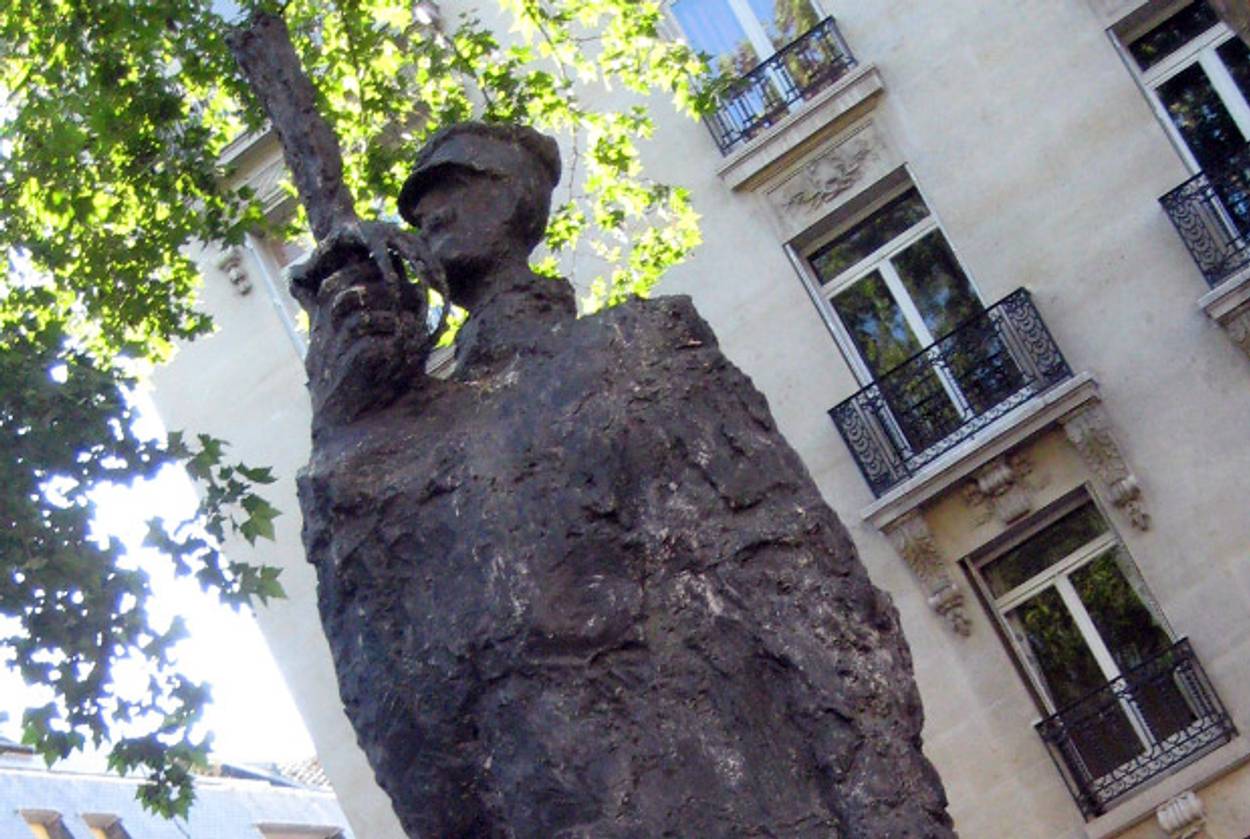
“Hommage au Capitaine Dreyfus,” in the Square Pierre Lafue.(Thomas A. Bass)
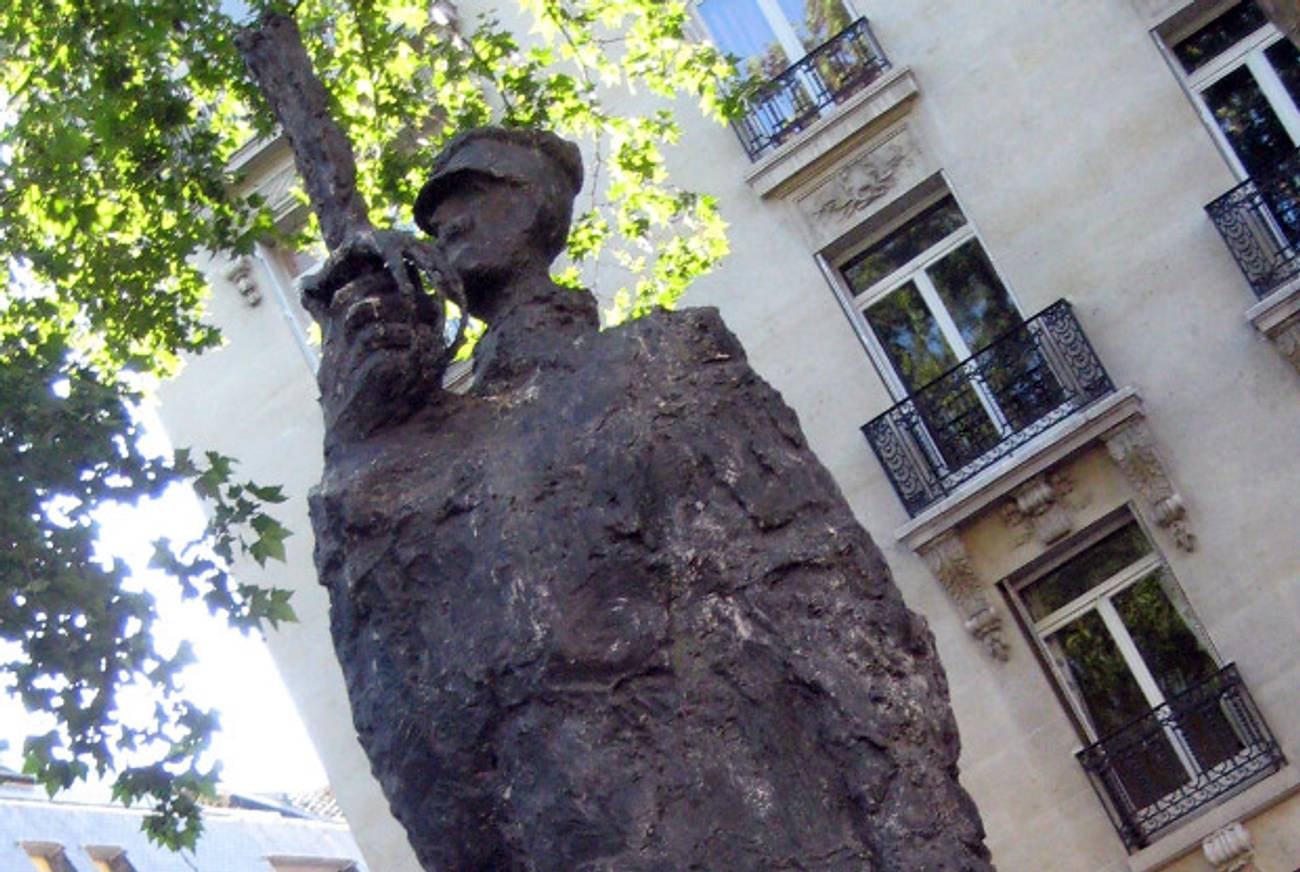
Down the street from my Paris apartment, in a vest-pocket park filled with students eating their lunches and mothers sitting beside baby strollers, stands the outsized statue of a military man, ramrod straight, eyes forward, as he salutes the world. The statue is a bit of a joke, modeled from gobs of clay that still show the artist’s hand prints after being cast in bronze. The statue is twice the height of a normal man. The head, peering out from under a kepi that sits on it like a lid, is too small. The feet are too big and flat. The chest is puffed out. Most noticeable are the oversized hands, particularly the right hand, which grips the upright hilt of a broken sword, the symbol of an officer broken in rank.
Whenever I see the old soldier, in memory of his sufferings and as a mark of respect, I raise a hand to my forehead and call out—much to the embarrassment of my children, who pass this park every day on their way to school—“Je vous salue, Capitaine Dreyfus.”
The oddity of the statue is exaggerated by the fact that it doesn’t seem to belong here. The Square Pierre Lafue, named after a Parisian journalist, is really little more than a traffic circle planted with banks of shrubbery and a few trees. It floats like a green island at the intersection of two narrow streets, Rue Stanislas and Rue Notre-Dame des Champs, while facing the wider Boulevard Raspail. The statue looming over this small square is a caricature of military honor, a three-dimensional scribble. The work was designed by the political cartoonist Louis Mitelberg, who signed his work—inverting the first letters of his last name—TIM. Dreyfus is saluting because that’s what soldiers do. They follow orders, no matter how criminal or stupid these may be.
While trying to figure out why Dreyfus was here, I learned that his presence is a historical accident. Mitelberg had been commissioned to design a sculpture for the courtyard of the École Militaire, where Dreyfus had been degraded. If Hommage au Capitaine Dreyfus had been installed in its rightful place, Dreyfus would be saluting his fellow officers and the army that tortured him. But the army was on to Mitelberg and his subversive sense of humor. They wanted no cartoons of soldiers holding broken swords. They vetoed the placement of TIM’s statue at the École Militaire, and, after that, Dreyfus was sent wandering around Paris, looking for a home. Anyone who sees Dreyfus standing on this leafy traffic island can sense that the Jew is still wandering and that the memory of his famous affair still divides France.
***
Down the street from Mitelberg’s statue, at the corner of Raspail and Rue du Cherche-Midi, is the site of the military prison where Dreyfus was incarcerated after his arrest. A plaque on the lawn announces that the Prison Militaire du Cherche-Midi stood here from 1853 to 1964. Modeled on the prison in Auburn, N.Y., which was among the first to experiment with solitary confinement, Cherche-Midi held other famous inhabitants, including Resistance fighters during World War II. Many were tortured and killed here, and then later their cells were occupied by members of the Abwehr, German military intelligence, whose headquarters was located across the street in what is now the Hotel Lutetia.
The prison was torn down to make way for the Maison des Sciences de l’Homme, a think-tank for French historians and other scholars. The building was condemned recently for asbestos contamination. A homeless Russian and his German shepherd have taken up residence on an open porch, where they sleep at night in cardboard boxes. The lawns are overgrown with weeds, out of which rises a grim memorial to Dreyfus and the other prisoners held unjustly at Cherche-Midi. Meant to resemble the dolmans and menhirs of Celtic burial sites, seven blocks of black granite lie scattered on the ground, with five more blocks of granite standing upright beside them.
For a dozen years, from his arrest in 1894 until his rehabilitation into the army in 1906, Dreyfus and his affair rocked France to its revolutionary root. Partisans lined up on either side, fighting duels, rioting in the streets, and bringing down one government after another. Degas, Renoir, and Cézanne proclaimed his guilt. Pissaro, Cassatt, and Monet defended his innocence. The affair began in September 1894, when Marie-Claude Bastian, an Alsatian cleaning woman, who was actually a French intelligence agent working at the German embassy in Paris, brought to Col. Jean Sandherr, head of the Section Statistique, the anodyne name for French counter-intelligence, a note, written on onionskin paper, that she had fished from the wastepaper basket of German military attaché Lt. Col. Maximilian von Schwartzkoppen. Torn into six pieces, but easily reassembled, the note, henceforth known as the “bordereau,” or receipt, offered for sale to the Germans technical manuals and other information about France’s 120 mm Baquet howitzers. We now know that the information in the bordereau was fluff of little value, much of it already known, about a weapon that France would soon be retiring. In fact, this breach of security may actually have been a ruse, a piece of disinformation intentionally planted in von Schwartzkoppen’s inbox. Sandherr alerted the French minister of war that the army had a traitor in its midst, and the search was on.
Founded in 1871, after France’s disastrous defeat in the Franco-Prussian War, the French counter-intelligence agency—not to be confused with France’s main intelligence agency, the Deuxième Bureau—was a crackpot outfit of assassins, spies, and clairvoyants good at forging documents and faking evidence in court martial and other legal hearings. Reminiscent of President Richard Nixon’s former CIA operatives who specialized in dirty tricks, they were the Plumbers of their day. After the Plumbers were caught breaking into the headquarters of Nixon’s Democratic opponents in the Watergate Hotel, the president was forced to resign, and his operatives were convicted for their crimes. But imagine a different scenario. What if the Plumbers had succeeded in their dirty tricks? What if the U.S. military had lined up behind them and the courts had started convicting people on fake evidence, sending them to prison for life? What if the Plumbers, for a dozen years, had led a reign of terror against Jews and other people inscribed on Nixon’s “enemies list”? When the country finally realized what was happening and tried to recover from this trauma, people would have felt that something had gone terribly wrong with the judicial system and government, which had failed to protect them. Such was the effect of the Dreyfus Affair.
After Sandherr’s death from a stroke, the Section Statistique was put under the charge of Maj. Armand Mercier du Paty de Clam, who was directed to find the spy responsible for leaking the bordereau to the Germans. An anti-Semitic Catholic royalist who interviewed witnesses under hypnosis, du Paty was an amateur graphologist who believed in spiritualism, table rapping, and other forms of the occult. Three years later, when Émile Zola published his famous essay “J’Accuse,” which exposed some of the fake evidence on which Dreyfus had been convicted, Zola blamed the “whole demented torture of Dreyfus” on du Paty de Clam. Dreyfus was “the victim of the lurid imagination of Major du Paty de Clam, the religious circles surrounding him, and the ‘dirty Jew’ obsession that is the scourge of our time,” Zola wrote.
When he became a “person of interest” to the Section Statistique, Captain Alfred Dreyfus was a 35-year-old married father of two children, who lived in a well-appointed apartment on the Avenue du Trocadero while working as a trainee at French army general staff headquarters. Born in 1859, in Mulhouse, in the Alsatian region annexed by Germany after the Franco-Prussian war, Dreyfus was the youngest of nine children fathered by a wealthy Jewish textile manufacturer. Alfred and one of his brothers received French educations, but the rest of the family spoke Yiddish at home and conducted business in German. Graduating as a sub-lieutenant from l’École Polytechnique, the elite military engineering school in Paris, and then trained as an artillery officer at Fontainebleau, Dreyfus had gone to the War College for another two years of training. The only Jewish officer on the army general staff, Dreyfus was beginning a brilliant career, save for one blot on his record. He had finished ninth in his class at the War College, only because his grades had been lowered by an examiner who said, “Jews were not desired” in the army. Dreyfus and another Jewish officer lodged a protest with the director of the college. Their grades remained unchanged, and the protest was later counted against Dreyfus.
Whether he was set up by French counter-intelligence as the fall guy or fingered as a Jew or targeted as the hapless victim of an investigator desperate to find a leaker, Dreyfus was secretly charged with treason on Oct. 15, 1894 and thrown in Cherche-Midi Prison, where du Paty interrogated him night and day. Du Paty’s hare-brained schemes for shaking a confession out of Dreyfus included locking him in a mirror-lined room, sleep deprivation, and waking him suddenly in the middle of the night with a bright light shined in his face. Word that Dreyfus had been charged with treason was leaked to the public by one of France’s anti-Semitic newspapers, La Libre Parole. This ignited a violent campaign against traitorous Jews, particularly the German-speaking population that was scapegoated for the loss of Alsace and other territory to Germany. Like the rest of the rogues in the Section Statistique, du Paty began forging documents, and his vendetta against Dreyfus endured for decades. In 1944, du Paty’s son Charles was appointed commissioner of Jewish affairs in the Vichy government. His job was to apply Nazi racial theories in France while pauperizing French Jews and deporting them to German concentration camps. One of the Jews whom the Vichy regime deported was Alfred Dreyfus’ granddaughter Madeline, a Resistance fighter responsible for hiding Jewish children in the French countryside. Madeleine Dreyfus was gassed at Auschwitz in 1944.
Captain Dreyfus was not the author of the bordereau. It was not in his handwriting. (This was proof of nothing more than “self-forgery,” said du Paty.) Dreyfus had not confessed, and no evidence linked him to the crime, save for a homoerotic love letter between military attaché von Schartzkoppen and his Italian counterpart, which referred to someone whose name began with the letter “D.” On Dec. 22, 1894, after a court martial at which most of the so-called evidence was presented in secret, Dreyfus was convicted of treason and sentenced to life in prison on Devil’s Island in the Atlantic Ocean off the coast of French Guyana. First he had to undergo the grim ceremony that marked his being broken in rank and expelled from the army.
On the morning of Jan. 5, 1895, Dreyfus was picked up at Cherche-Midi by a military convoy that trotted down the Rue de Babylone toward the Champ de Mars. At one end of the parade ground stood the newly constructed Eiffel Tower. At the other end, in a courtyard of the École Militaire, were massed the thousands of troops that had been brought into the city to watch his humiliation. Outside the courtyard, held behind police barricades, was an agitated mob yelling for vengeance.
It was a cold, clear morning, reported the New York Times in its account of this “intensely humiliating punishment of a convicted officer.” Captain Dreyfus’ regiment, the 39th, was among the first to arrive, at 8:30 in the morning. At 9:00, Dreyfus was led into the courtyard. He marched with his sword in his right hand to the center of the square, where he stood at attention. An adjutant of the Republican Guard read the verdict of the court martial. Then the presiding general said, “Dreyfus, you are unworthy to carry arms. In the name of the people of France, we degrade you.”
The adjutant walked up to Dreyfus and took his sword. With a quick, sharp movement, he broke it across his knee, throwing the pieces on the ground. Then he cut the buttons and military insignia off Dreyfus’s uniform and threw these on the ground. “Vive la France!” shouted Dreyfus. “You have degraded an innocent man. I swear that I am innocent.” The rest of his words were drowned out by the rolling drums and the shouts of the crowd yelling, “Death to the traitor!” “Down with the Jews!”
In what is called a “Parade de l’Exécution,” Dreyfus was marched along the four sides of the square. When he reached the reserve officers who were shouting, “Down with the Judas!” Dreyfus stared at them through his eyeglasses and replied, “You are cowards.”
In front of the journalists assembled in the courtyard, he said, “Tell the whole of France that I am innocent.” The crowds outside were “almost delirious,” as they kept shouting “Death to the Jews!” The streets were lined with more people hurling abuse as the convoy carried Dreyfus back to Cherche-Midi.
Dreyfus had been prepared for the ceremony the previous day, when a tailor came to his cell and removed all the buttons and stripes from his tunic and trousers. They were replaced with a single stitch, which allowed them to be pulled off easily. A bladesmith had filed his sword nearly in half, preparing it to be broken with a single gesture. Dreyfus’ degradation may have been a piece of theater, but everyone played his role so perfectly, and the ceremony was so visceral and shocking, that its repercussions shook France for decades.
***
Chained and manacled, Dreyfus was shipped to his desolate island in the Atlantic, where he was the sole prisoner. His cell had been altered to prevent him from seeing the ocean that surrounded him. Hearing a false report that Dreyfus planned to escape, his guards locked him at night in “la double boucle,” which forced him to lie flat on his bed, immobilized under iron bars. While Dreyfus was rotting on Devil’s Island, wracked by fever and losing his voice during four years of solitary confinement (he spoke after this in a hoarse whisper), the scandal surrounding his conviction was growing into the affair that divided France, with Zola and the Dreyfussards on one side and the clerical anti-Semites on the other. The unforeseen hero in this phase of the affair was Lt. Col. Georges Picquart, who became head of French counter-intelligence in July 1895, two months after Dreyfus had taken up residence on Devil’s Island.
The case was so rotten with irregularities that the minister of war put Picquart in charge of investigating the situation. An anti-Semite, like the rest of the Section Statistique, Picquart was also an honest man. He discovered almost immediately, simply by looking at the handwriting, that the real traitor who had written the “bordereau” was Ferdinand Walsin Esterhazy. An infantry major in the French army, Esterhazy was well-known to the Section Statistique. In fact, he was a former member of the group, who may still have been working for them as a double agent masquerading as a traitor selling secrets to the Germans.
By mid-1896, Picquart had fingered the traitor. He submitted his findings to the general staff. The evidence was incontrovertible. The bordereau, in Esterhazy’s hand, was written on the same onionskin paper that he used to correspond with his stock broker and mistresses. A paid agent of the Germans was serving as a French military officer, while an innocent man was rotting on Devil’s Island. Instead of being rewarded for his work, Picquart was transferred into the farthest reaches of the Sahara desert in southern Tunisia. Later, he was imprisoned, supposedly for revealing state secrets, after a court martial that involved more forged “evidence” from the Section Statistique.
Word of Picquart’s findings was leaked to the public. Esterhazy demanded a court martial to clear his name. After a secret hearing at Cherche-Midi in January 1898, Esterhazy was acquitted unanimously. He was greeted outside the prison by a cheering crowd, which proclaimed him a national hero, as anti-Semitic riots broke out in Paris. Esterhazy’s court martial was what provoked Zola into writing “J’Accuse,” which appeared in the first issue of Georges Clemenceau’s newspaper, L’Aurore (“The Dawn”), on Jan. 13, 1898, two days after Esterhazy’s acquittal. Zola was charged with libeling the French government and put on trial amid large crowds of demonstrators, most of them against Zola. He was convicted, appealed, and then fled into exile in England, rather than spend a year in prison and pay a fine of 3,000 francs. The publisher of L’Aurore was also fined and sentenced to prison.
Zola’s trial marked the turning point in the Dreyfus Affair. Picquart was brought out of the desert to testify. Esterhazy’s best friend at the Section Statistique, Lt. Col. Hubert-Joseph Henry, accused Picquart of lying, and the two men fought a duel with rapiers, in which Henry was wounded in the wrist and arm. (Zola would also fight a duel over the affair.) Henry was busily leaking yet more forged evidence, but later that year, when his handiwork was discovered, he was arrested and thrown in prison. In his jail cell, he penned a letter to his military superior saying, “I absolutely must speak to you.” He added cryptically, admitting his guilt: “You know in whose interest I acted.” He was halfway through a bottle of rum and mid-way through a letter to his wife, writing, “I am like a Madman,” when he jumped up and slit his throat with a straight razor. A fund was established, with 250,000 subscribers, to aid Henry’s widow and son, “whose father was killed by the Jews.” Another agent in the Section Statistique met an untimely death, supposedly hanging himself from a window frame. Even the man whom Zola described as the “diabolical” mastermind of the Dreyfus Affair, du Paty de Clam, ended up being forced to retire from the military at half pay.
Esterhazy disappeared from Paris on the day that Henry slit his throat. He made his way to England and lived there in exile, writing articles for the French anti-Semitic press and receiving a pension, from unknown sources, until his death in 1923. He was never investigated or charged with any crimes. When Esterhazy later admitted that he was the author of the bordereau, he claimed to have written it under orders from Sandherr, while working as an agent for French counter-intelligence. Support for this claim appeared in 1994, when French military historian and army reserve officer Jean Doise, after 40 years of research, published Un secret bien gardé: Histoire militaire de l’affaire Dreyfus, or A Well-Kept Secret: The Military History of the Dreyfus Affair. By examining the affair’s roots in counterintelligence, Doise was able to explain what had long been mysterious about the affair. Why was an infantry officer selling artillery manuals to the Germans? Why did the army fabricate a case against Dreyfus and persist in scapegoating him for so many years? Why was Picquart packed off to the desert and put in prison? Why was Esterhazy—the real culprit—allowed to slip out of France and continue living happily in England? Dreyfus, in his autobiography, published posthumously, raised the same question: “There is still the need to explain how a low level infantry officer such as Major Esterhazy could have had access to so much detailed and diverse technical information.”
Doise argued that Esterhazy was a double agent disguised as a traitor, tasked with planting disinformation. He was peddling “secrets” about the technologically obsolete 120 mm Baquet howitzer, which the French army was about to replace. Selling old secrets and framing Dreyfus to make this information look important was a ruse designed to keep the Germans from discovering France’s real military secret, the development of the new quick-firing 75 mm field gun. The French 75 was ahead of its time technically. The Germans and Americans did not produce a field gun that matched its performance until 20 years later, on the eve of World War I. In fact, in 1918, the U.S. Army simply adopted the French 75 as its own and began building the gun under license in the United States. Doise argued that Esterhazy’s bordereau was merely one among many ruses designed to keep the Germans in the dark. Dreyfus was sacrificed for reasons of state—or, as we say today, for national security.
Whether the Dreyfus Affair was rooted in French military intelligence or Esterhazy’s venality, whether it was diabolically clever or bureaucratically stupid, everyone agrees that Dreyfus was innocent of the charges leveled against him. After the double coup de théâtre of Henry’s suicide and Esterhazy’s flight into exile, the case against Dreyfus collapsed. In June 1899, his conviction was reversed by a civilian appellate court. The minister of war dispatched the frigate Sfax to Devil’s Island to carry Dreyfus, still in chains, back to a secret hearing in Rennes. Once more, he played perfectly the role of the honorable soldier, ramrod straight, unemotional and calm as he received the verdict, “Guilty!” His penalty, this time, was 10 years in prison.
Dreyfus at his second trial is reported to have looked a bit like Rip Van Winkle. “After five years of physical and mental torture,” said a witness, he was disoriented during the proceedings and “had difficulty realizing the situation.” The examination of Dreyfus was “without interest; he confined himself to denials” and “preserved an entirely military attitude, the exaggerated correctness of which did not win much sympathy,” said another witness. By the end of the second court martial, after one of Dreyfus’ lawyers had been shot in the back by an unknown assailant who fled the scene, the army had lost its grip on the narrative of the treacherous Jew. Ten days after the military verdict, the French president annulled Dreyfus’ punishment, and the army was ordered to free him. He retired with his family to the south of France, then Geneva, and finally returned to Paris, where he remained excluded from the army and legally dishonored. By 1906, after five years in prison and another seven years spent trying to clear his name, Dreyfus finally got his case heard by the French supreme court, which declared him innocent. The next day, the French National Assembly ordered Dreyfus reinstated in the army and promoted to commander of an artillery squadron, or major. A week later, Dreyfus was honored with a dress parade in a courtyard of the École Militaire—though not the courtyard in which he had been broken in rank—and awarded the Legion of Honor, while the Catholic daily La Croix lamented “the traitor’s reintegration into the army.”
On realizing that he stood no chance of joining the general staff, Dreyfus resigned from the military in June 1907. He was called back to active duty as a reserve officer, fighting in the Great War, from 1914 to 1918. He commanded a battery of French 75 mm artillery at Verdun. Dreyfus’ son Pierre served as a lieutenant and later as a captain in French 75 mm batteries on the Western Front. Dreyfus’ two nephews also fought as artillery officers in French 75 mm regiments. They both died in the war. Alfred Dreyfus died quietly in bed on July 11, 1935, on the 29th anniversary of his official exoneration.
***
A year later, Léon Blum became the first Jewish prime minister of France. Five years later, anti-Semitism became the official policy of the government, as collaborationists in the Vichy regime helped to deport 76,000 French Jews, including Dreyfus’ granddaughter, to Nazi death camps. Today, France once again has a head of state, President Nicolas Sarkozy, who is Jewish, at least according to Vichy’s definition.
Jack Lang, minister of culture in the Socialist government of Francois Mitterand, commissioned the statue of Dreyfus in 1985. The commission went to Mitelberg, a Polish Jew who had been studying architecture at the École des Beaux-Arts when World War II broke out. Mitelberg fought in the French army for two years before being captured. He escaped, twice, from Nazi concentration camps, walked across Russia, and eventually made his way to England, to meet up with Gen. Charles DeGaulle’s army in exile. Mitelberg designed his 12-foot-high sculpture of Dreyfus and cast it in bronze, before learning that the commanding general of the French army had vetoed its placement at the École Militaire. The statue was rejected by a half dozen sites, until finally, in 1988—the same year that Dreyfus’ tomb was desecrated in the Montparnasse cemetery—the sculpture was installed in an out-of-the-way corner of the Tuileries Gardens. Unfortunately, even this obscure location in the old royal garden was too public for a statue whose style has been described as “peculiar” and “troubling.” People also complained about the statue being “too political.” So, after six years of uncomfortable residence on the Right Bank, Dreyfus was carried across the river and reinstalled in October 1994 in the Square Pierre Lafue.
Presiding over the statue’s rededication was Jacques Chirac, then mayor of Paris, who delivered a stirring speech about how the Dreyfus Affair had “cut like a steel blade through French society, dividing it into two irreconcilable camps.” The affair “speaks in a loud voice to our hearts and consciences,” he said. “Why? Because it consists of a triple scandal: the scandal of injustice, the scandal of anti-Semitism and xenophobia, and the scandal of a nation divided. To this day, these menaces continue to weigh on the European continent and on France itself.”
Soon after its reinstallation in the 6th arrondissement, TIM’s statue was defaced. It was spray-painted in yellow paint, with the word “Traître” written on the base. In 1995, 101 years after the beginning of the Dreyfus Affair, the French military officially conceded that Dreyfus was innocent. Gen. Jean-Louis Mourrut, chief historian of the army, speaking before an audience of 1700 rabbis and other notables, acknowledged that the Dreyfus Affair was a “military conspiracy,” based on fake evidence, against an “innocent man.” Mourrut’s remarks were prompted by another scandal the previous year, when the army’s historical journal published an article that questioned Dreyfus’ innocence, saying that this was merely “the thesis generally accepted by historians.” After an outcry from France’s Jewish community, Mourrut’s predecessor had been fired, and the general was forced to step forward to make amends.
In 2006, Jacques Chirac, then president of France, made another speech commemorating the Dreyfus Affair. The occasion was a state ceremony at the École Militaire marking the centenary of Dreyfus’ rehabilitation into the army. Invited as guests of honor were the living descendents of Alfred Dreyfus and Émile Zola. The event took place in the cobblestone courtyard where Dreyfus had been stripped of rank. It was a somber affair, with Chirac reminding everyone that “the combat against the dark forces of intolerance and hate is never definitively won.” What was odd about the ceremony, as noted in the press, was the fact that Dreyfus himself was missing. For 20 years, he had been cast in bronze, waiting to get back into this courtyard. But even on this state occasion, he was kept standing outside near the old Cherche-Midi prison.
Thomas A. Bass, a professor of English and journalism at SUNY Albany, is the author of six books including, most recently, The Spy Who Loved Us. He taught last year at L’Institut d’Études Politiques in Paris.
Thomas A. Bass, a professor of English and journalism at SUNY Albany, is the author of six books including, most recently, The Spy Who Loved Us. He taught last year at L’Institut d’Études Politiques in Paris.