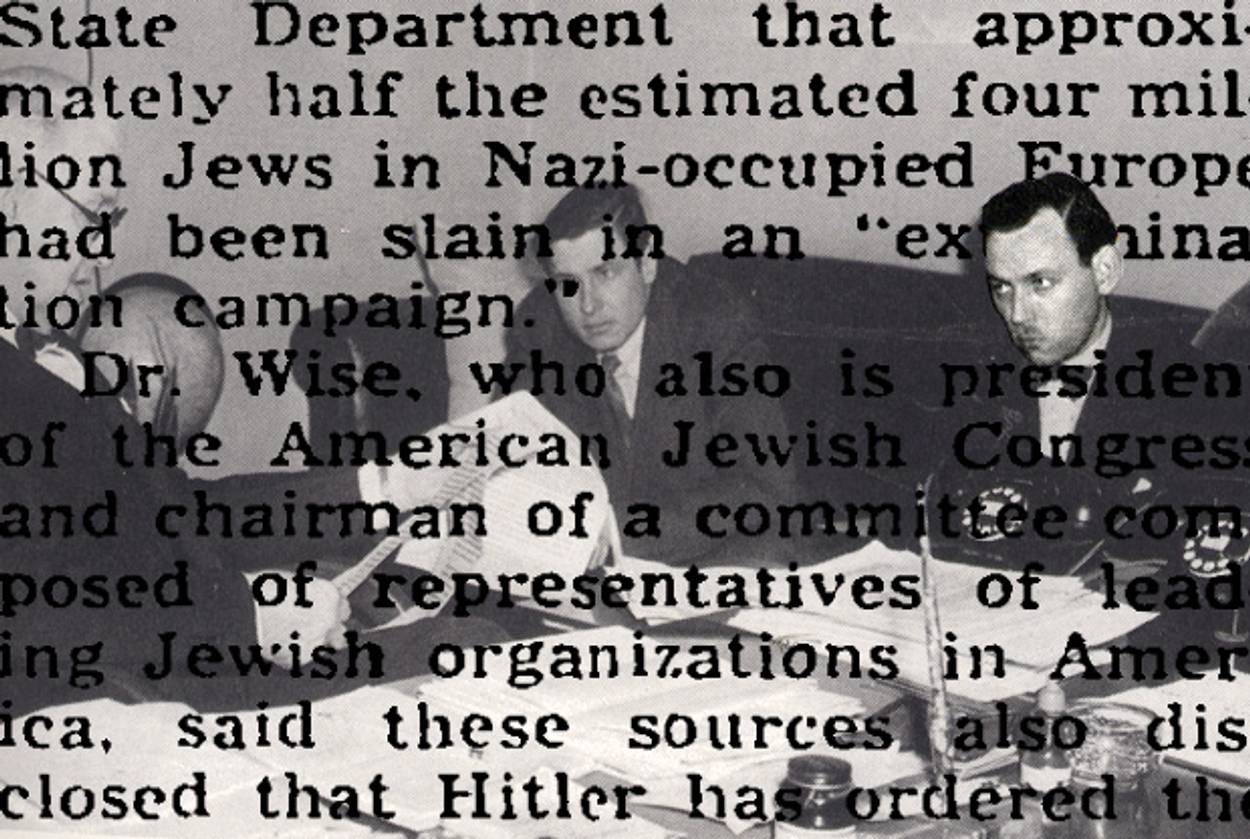
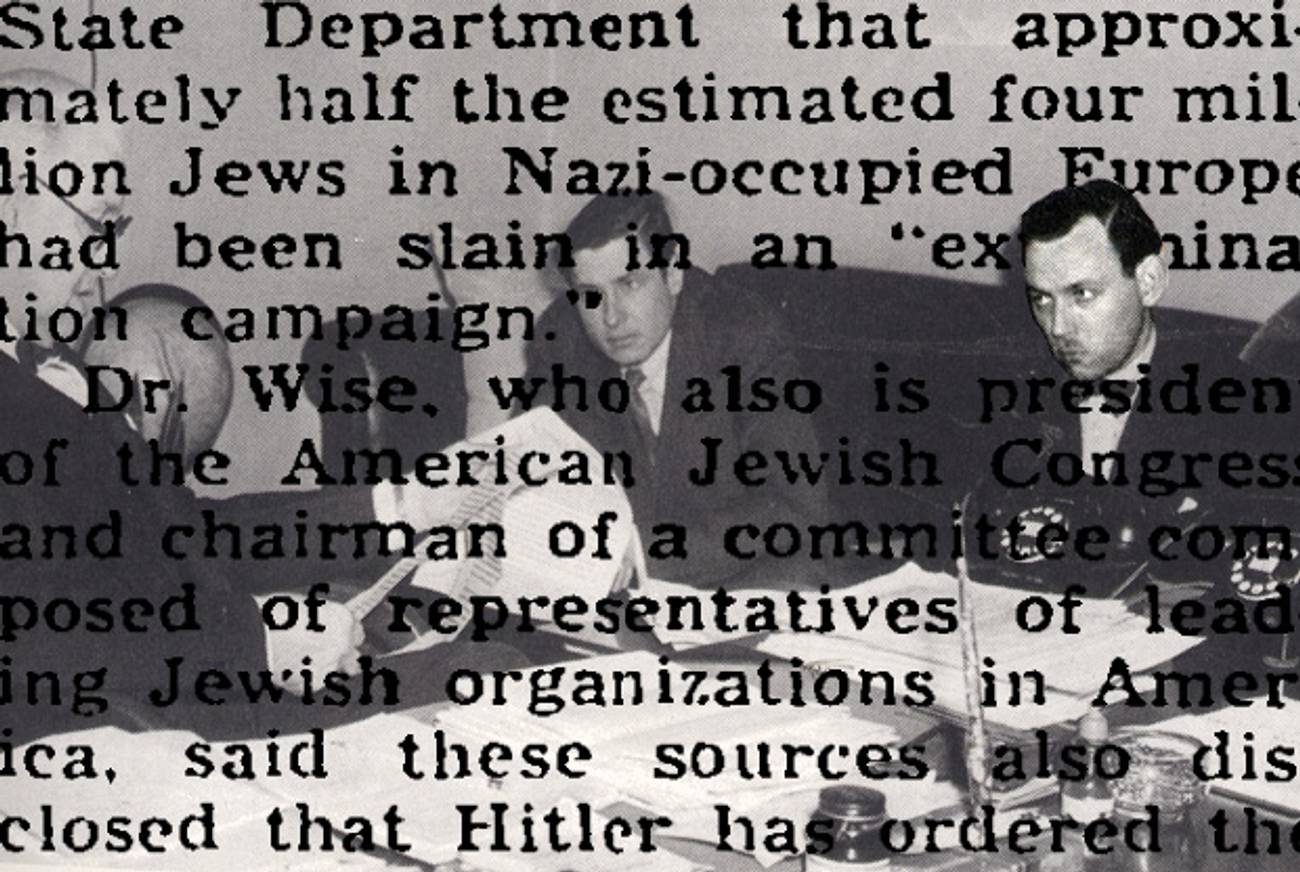
Pierre Sauvage has spent his life trying to locate the secrets of human goodness in the horrors of the Holocaust. His most recent film, Not Idly By—Peter Bergson, America and the Holocaust (2012), tells the story of Hillel Kook, nephew of the first chief rabbi of Palestine and a founder of the Irgun, who traveled with the Revisionist Zionist leader Vladimir Jabotinsky to the United States in 1940 to raise money and warn American Jews of the fate that awaited their families in Europe. Adopting the alias Peter Bergson, Kook stayed in New York after Jabotinsky’s death and organized the Bergson Group, which mounted the most sustained and effective effort to save the Jews of Europe in the face of widespread communal apathy, and against the fierce opposition of the leadership of the American Jewish community.
Sauvage is a filmmaker of rare moral perception, whose fixation on the Holocaust is both deeply felt and deeply personal. He grew up in Manhattan and attended the French Lycée, an elite private school. His first film, Weapons of the Spirit (1989), told the story of the Huguenot village of Le Chambon-sur-Lignon, whose 5,000 inhabitants, led by their pastor, André Trocmé, saved an equal number of Jews from the Nazis. A testament to the goodness of an entire village, the film was also Sauvage’s attempt to understand his own life: At the age of 18, his parents told him that he was a Jew and that he had been hidden in Le Chambon as a baby before he and his parents escaped to America.
The revelation of his origins in a perilous time and place left Sauvage with a bewildering yet intense sense of injury that has greatly enriched his art. His films about rescuers are a means of addressing the foundational mysteries of his life. Who were the people who saved him? Why did they act as they did? Why did his parents act as they did? Over the course of our two-hour conversation, I have a strong perception of a man who is coping in a brave and well-balanced way with the refracted trauma of his childhood, a trauma that was actually repeated twice: In seeking to protect their son from a fate that he had already escaped, his parents condemned him—or the Jewish part of him—to remain a hidden child in the middle of Manhattan, long after the war was over.
The third in Sauvage’s trilogy of rescuer films, the upcoming And Crown Thy Good, tells the story of Varian Fry, the young Harvard-educated classicist who smuggled more than 2,000 of Europe’s leading intellectuals and artists, including Hannah Arendt and Marc Chagall, out of Nazi-occupied France and brought them to America.
Sauvage arrived at the Tablet offices on a cold afternoon in December with Astra Temko, the shy, soft-spoken, and beautiful daughter of Hillel Kook, aka Peter Bergson.
David Samuels: Pierre Sauvage, you make films about people who put their lives at risk to save others: André Trocmé (the pastor of Le Chambon), Peter Bergson, and Varian Fry. Do these men have anything in common, aside from being good?
Pierre Sauvage: People often say that there’s nothing to be learned from them, that their goodness is just a mystery. I hate that characterization. They were all very strong-willed individuals, who responded to their own intellectual and emotional and physical and religious needs. Who could not be dissuaded by nonsense. They were all extremely smart. I don’t sense that any one of them was necessarily the easiest person in the world. I certainly know in the case of Varian Fry that he was downright difficult and ornery.
One of the themes in my Fry documentary is going to be the fact that there are situations and times that are particularly suited for one type of person. The key is to be able to recognize that sort of time.
Another characteristic that they all three had in common—and [turning to Bergson’s daughter, Astra Temko] this might’ve made your father a little difficult, I suspect—is that they didn’t suffer fools gladly.
Astra Temko: I have memories I don’t want to share. (Laughs.)
David Samuels: I think one reason your film about Le Chambon, Weapons of the Spirit, made such an impression on me was that it told a story about an entire community of simple, deeply rooted people who followed the dictates of conscience in an uncomplicated way. I remember seeing the film in the theater and being very struck by the explanation that these were Huguenots and that their connection to the Bible was direct and their own history of persecution in France was very alive to them. Saving Jews was a natural and uncomplicated if also very dangerous thing for them to do. So, is this kind of heroic activity really the product of relentless and exceedingly intelligent individuals? Weapons of the Spirit suggested the opposite.
Pierre Sauvage: It’s always nice to make a film and have someone summarize it so accurately. I actually think that there were, in the broadest terms, two types of rescuers. There were people who had no intention of being rescuers. They got up in the morning, were faced with a particular situation, and responded appropriately. Then there were others who struck me as being more driven characters, out to embody or to prove something. What’s interesting about Le Chambon is that it had both types. Wherever there was a strong Huguenot presence in France, there was rescue—for the reasons you started to identify. It happened that Le Chambon was the most densely Huguenot area in France, so you had the most intensive rescue activity.
David Samuels: There is a criticism of stories about rescuers that goes like this: The Holocaust wasn’t about human goodness. It’s a story about the mass murder of women, men, and children, often with the passive or gleeful help of their neighbors. All those people are dead, and an entire culture was destroyed. You can go to all of those villages in Poland, or to Prague, and you will find only museum-like traces of what once was an incredibly vital world, whose Jewish inhabitants died in horrible ways. Giving people the feel-good stories of a handful of individuals who heroically rescued a few of these people is in the end a profound distortion of a catastrophe, which had no redeeming value.
Pierre Sauvage: Of course there is nothing redemptive about mass murder. But any aspect of any story can be distorted. One can distort the righteous as well. But if faithfully addressed, if honestly approached, every story of rescue is an act of accusation. It’s the opposite of an alibi.
Peter Bergson himself is an incredible example. Here he was, saying all this stuff and doing all this stuff. So we now know that it was possible to say that stuff and to do that stuff. If we don’t have examples of what was possible to do and say, then we will be giving future generations the greatest alibi of all: that it wasn’t possible to do anything.
But I can understand some of the criticism of Schindler’s List, for example. Schindler was actually anti-Nazi, but that didn’t work. Spielberg wanted to tell this more dramatic story. Any dramatist wants a transformation, wants big moments.
David Samuels: I think there is also something inherently comfortable for Jews about the stories of gentile rescuers. We get to say, “Oh, well, look, the goyim were not all bad. We remember the good ones. On the other hand, the rest of you are a bunch of bloody murderers.” And then we get to have these wonderful discussions: Why didn’t they, the world, do more to rescue us while we were being murdered and victimized? It’s a very easy place, I think, for American Jews to rest. However, the story of Peter Bergson, especially for the American Jewish community, is much less comfortable.
Pierre Sauvage: Because it raises fundamental questions about what American Jewish attitudes were during the Holocaust. And because we live on lies about that period.
David Samuels: What are the biggest lies we tell ourselves about the Holocaust?
Pierre Sauvage: The biggest lie is that we didn’t know. It’s possible, I suppose, for some rancher in Montana who wasn’t reading the press or listening to the radio maybe not to know. But it was massively present. God, this question goes in so many directions. When you think of movies that come out, like Woody Allen’s Radio Days. What is Woody Allen’s Radio Days about? A happy childhood in Brooklyn, in a Jewish family, during the years of the Holocaust. Or Lost in Yonkers, which is a Pulitzer Prize-winning play by Neil Simon having nothing to do with the Holocaust. Wonderful play, by the way. But it’s like Hitler is totally removed from their frame of reference. This is nonsense. This is absolute nonsense. Woody Allen’s parents—Woody may not realize it—but Woody Allen’s parents were in their bedroom scared to death about what was happening to their relatives in Europe. So that is the biggest lie.
The second biggest lie is that we couldn’t have done anything. That was the conventional wisdom after the war. The people who were propounding that point of view were, for the most part, the people who had done nothing.
But I’m not so interested in judging the generations then. I think those were very difficult times, very challenging times. Yeah, I believe they made mistakes. But I don’t believe that we would have acted any better. That is facile and glib and smug.
What shocks me is that we today are not willing to let in that past, we’re not trying to understand it. I’ll give you one example: At one point in the Bergson film, I mentioned Einstein, we were talking about Rabbi Wise, and I have some footage of Einstein, who actually is in his office sitting down. Well, Einstein was the most powerful Jew, virtually in the world and certainly in America. In 1938 at Princeton, there was a vote among Princeton freshmen, and he was judged the second greatest living person in the world. The first greatest person in the world—according to the Princeton freshman class of 1938—was Hitler.
There was a book a few years ago, by Walter Isaacson, on Einstein. And there is a chapter in it called “1939-1945.” The main title of that chapter is “The Bomb.” There is not one word about how Einstein was reacting to the murder of his relatives. But Einstein could’ve picked up the phone, and he would’ve been received by Roosevelt at any time.
Again, my point is less about Einstein, but how can Walter Isaacson write a biography of Einstein and consider that his reactions to the massacre of his culture, his people, his culture, was not on his mind? That’s absurd.
David Samuels: It actually raises a very funny counter-factual history. What if Einstein, Robert Oppenheimer, and everybody else working on the bomb said, “You know what? We’re going to stop working.”
Pierre Sauvage: There’s a great movie there.
David Samuels: “We’re going to stop working on the bomb for three days unless you bomb the tracks to Auschwitz. Because otherwise we will be guilty of mass murder twice over.”
Pierre Sauvage: I love it. I never thought about that. But that is so far removed from the reality of that time. All that time, in fact, Einstein is giving advice. There’s no way they could have ignored his comments.
David Samuels: Astra, how did your father explain the American Jewish community and how it acted during the war? He came to this community, as a young man, and told them that everybody was being killed in Europe, and they had to do something—and they didn’t do it. He then chose to live here. He obviously must have had strong feelings of attraction to American life, and he also must have had strong feelings of anger and real criticism of the community that hadn’t listened to him.
Astra Temko: I think that’s probably true. But I think he loved America. He was quite inspired by it. You know that he was a member of the first Knesset and then resigned. I think he was the only Knesset member who ever resigned out of principle. He thought that they should write a constitution. He felt very passionately about that. They weren’t interested, so he resigned.
He always had the more unpopular view. But he loved America. During the war, he had a real belief that if only he could get the word out there, Americans would make the moral choice and do the right thing.
David Samuels: You’d think that that would be a devastating experience for someone to come here with that kind of belief and to find that in fact he wasn’t listened to. But it didn’t affect him that way. Why not?
Pierre Sauvage: I think your father felt that even though the American government didn’t respond the way it should have, it was not sufficiently pressured to do so. How can you expect an administration to do something if American Jews aren’t putting tremendous pressure on their congressmen, on the government?
Astra Temko: I think he was very inspired by the support he had. He had tremendous support in Congress. You think of him with his heavy Lithuanian accent, coming, age 25, from Palestine. He was really cringe-making for a lot of the Stephen Wise establishment. He was brazen, vulgar, not ashamed to splash the word “Jew” all over the front page. His march of rabbis on Washington with their long beards—the last people they wanted to be identified with. He loved the freedom here. He used to call Israel a “shtatel.”
David Samuels: A “shtatel” as opposed to a state?
Astra Temko: Yes. He used to say it was a theocracy run by atheists. He was both very irreverent and very religious at the same time. He was quite a character. I don’t think he had gripes with America the country; he was incredibly pro-American.
Pierre Sauvage: I just want to underscore your point. That was his experience, I think, with politicians here. There was a wellspring of belief that could be tapped into. By the way, when we say Bergson is obscure, which of course he is, but the American political figures who were supportive and helpful, they were as obscure as one could be. These were people from states with no Jewish districts: Sen. Gillette from Iowa, Sen. Elbert Thomas was a Mormon from Utah. These people were among his strongest supporters, often influenced by religious values.
David Samuels: Why was it that he could touch the heart of a senator from Iowa or Utah with this story but the people whose relatives were being incinerated in ovens didn’t join him?
Pierre Sauvage: I think he says it in my film. One of the key moments in my film is, he says—he was talking about American Jews—and he said, “they were petrified.” They were scared of making waves. American Jews felt legitimately protected by Roosevelt. This was a very scary time. Obviously there was tremendous anti-Semitism in America, and who knows where the world was going?
David Samuels: Did he feel that the Israeli leaders, especially the leadership around Ben-Gurion, were any different in their attitude toward the Holocaust than the leaders of the American Jewish community?
Astra Temko: That’s kind of a minefield.
Pierre Sauvage: I’ll just say real quickly, he felt that the yishuv [the Jewish community of pre-Israel Palestine] failed as well.
David Samuels: Talk in a little more detail about the response of Stephen Wise and the leaders of the American Jewish community to the massacres in Europe. Wise had a very famous press conference in which they announced that this was happening—after sitting on the information they had for three months.How do you then explain his subsequent actions, and what was his relationship with Bergson and Ben Hecht?
Pierre Sauvage: Ben Hecht is hilarious on Wise actually. If you look up Child of the Century, there are several encounters that are really funny. And there are about 30 pages on Bergson, which are among the funniest. But your question about what was in Wise’s head, it may very well be that he cared deeply on some level. And yet my experience has been that people who care act.
There’s a moment in my film where Bergson is talking about a key meeting that he had with a representative of the American Jewish Congress and a representative of the American Jewish Committee. And the representative of the American Jewish Committee was Judge Joseph M. Proskauer. They wanted Bergson to not publish an ad in the New York Times. And he said, “Look, if that’s all it takes, I won’t publish the ad. All we want to do is have an effect. We’ll band together, we’ll do whatever is necessary.” And Proskauer started crying. They said, “after we agreed not to publish the ad, they didn’t return our phone calls.”
But it’s those tears of Proskauer that interest me—there’s a whole article in it, “Why Did Judge Proskauer Cry?”
David Samuels: What’s the answer?
Astra Temko: There is something about my father that I’ve been trying to understand, which is the intensity of the violent, negative feeling he stirred up among the leadership of the American Jewish community. It was really quite powerful. Trying to use their power in Washington to get him drafted, saying, “He’s worse than Hitler. Have him investigated.” It became kind of this campaign—silence him. It was like something they couldn’t bear or tolerate in themselves.
David Samuels: I think exactly where you see it is the campaign not just to discredit Bergson intellectually or the refusal to follow his advice—after all he’s 25 and from Palestine—but the desire to physically eliminate him.
Astra Temko: Yes, to delegitimize him.
David Samuels: Not just that. What would it mean for Bergson to have been drafted or deported during the war, as his opponents in the American Jewish community urged their friends in Congress? Where would he have ended up?
Astra Temko: I never thought of it that way.
David Samuels: It’s the closest you could get to legally killing him.
Pierre Sauvage: I wanted to add something about Proskauer. Obviously I don’t know, but I think they were tears of shame and tears of pain. He wouldn’t have cried if he hadn’t felt that on some level your father was right, was saying the truth. And yet, he could not act on that. That flew in the face of everything he believed, the life he had led.
David Samuels: Another thing that interests me was, if you look at the March of the Rabbis on Washington that Bergson organized, it’s only Orthodox rabbis and Hasidim. There’s not a single representative of Conservative or Reform Judaism on the list.
Pierre Sauvage: He tried and they wouldn’t march.
David Samuels: It is a horrific moral failing. It’s one thing to look at Henry Morgenthau or other Jewish politicians and say, “Oh they didn’t protest to Roosevelt.” And then you can answer, “Maybe they did in private, or maybe they had a calculation about the political needs of the country.” In fact, there’s a lot more that one can say to excuse Morgenthau than one can say to exculpate the non-Orthodox rabbinate, because what the hell was their excuse? They were supposed to be concerned about moral questions and the fate of the Jewish people. And yet the murder of 6 million Jews in Europe didn’t excite them that much at all. If they had another method for saving the Jews of Europe, history doesn’t record what that was.
Pierre Sauvage: You know one person, in my view, who got a lot of this right, wasn’t a historian, it was a novelist. In Philip Roth’s book The Plot Against America, the first line is, “Fear presides over these memories,a perpetual fear.”
You see little in a lot of what historians have written that talks about fear. In my view you can’t understand the American Jewish reaction if you don’t understand the fear. And you can’t understand us now if you don’t understand that fear is a very shameful reaction. Those who experienced that fear were not going to pass on the information that they were scared to their kids.
David Samuels: Is this a very different community than the community that was largely silent during the Holocaust?
Pierre Sauvage: Clearly when you talk to people who were in the Soviet Jewry movement, they were influenced by their memory of what wasn’t done. So, yes; we know that the American Jewish community has a level of confidence and security, and there’s a level of influence also, that it didn’t have then.
David Samuels: Astra, what do you most want people to understand about your father, Peter Bergson?
Astra Temko: He was so principled and he would relentlessly fight for his beliefs and go after them—in spite of the prevailing wisdom, and without the benefit of historical hindsight. I think that was impressive. But I think he felt that was too little too late. I think he was left with an abiding sense of failure.