Letting My Daughter Go
When my daughter got married at 20, I worried she was too young. But I was the one who wasn’t ready.
June 20, 2012
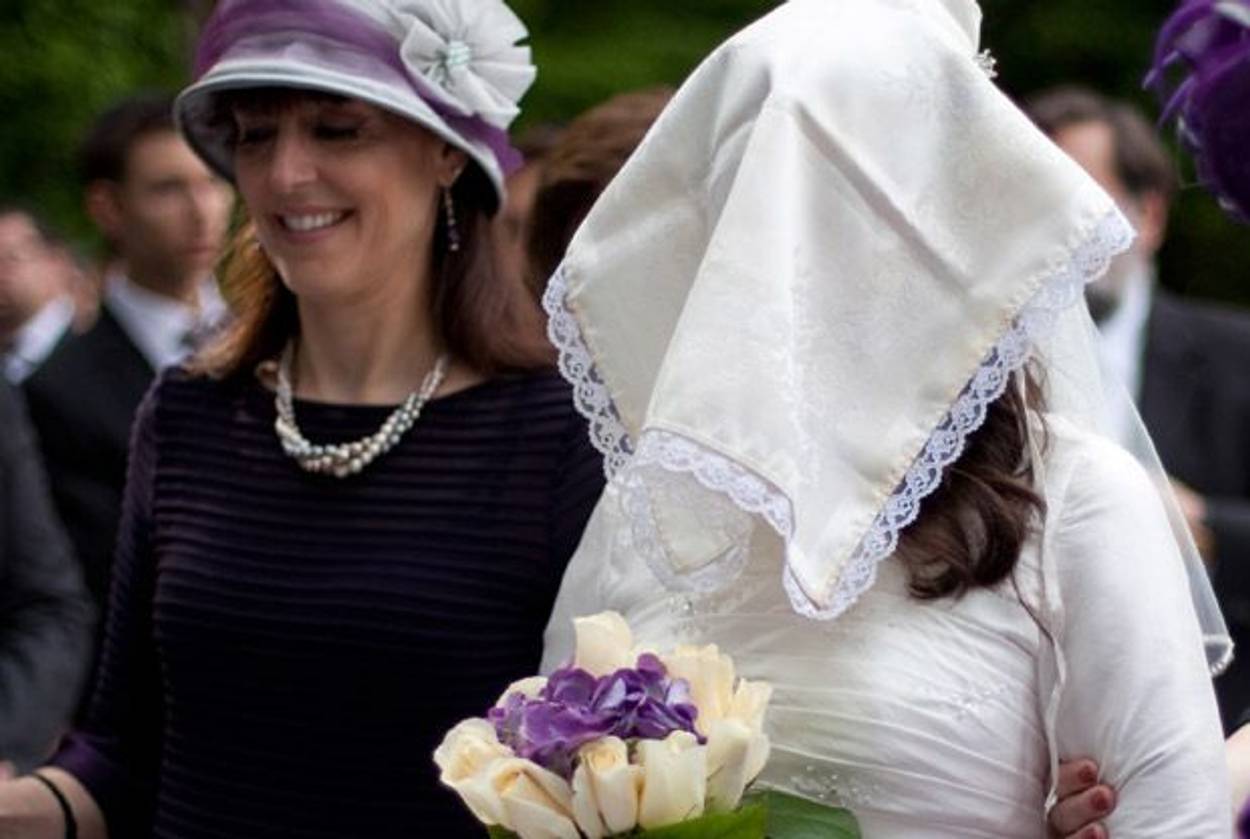
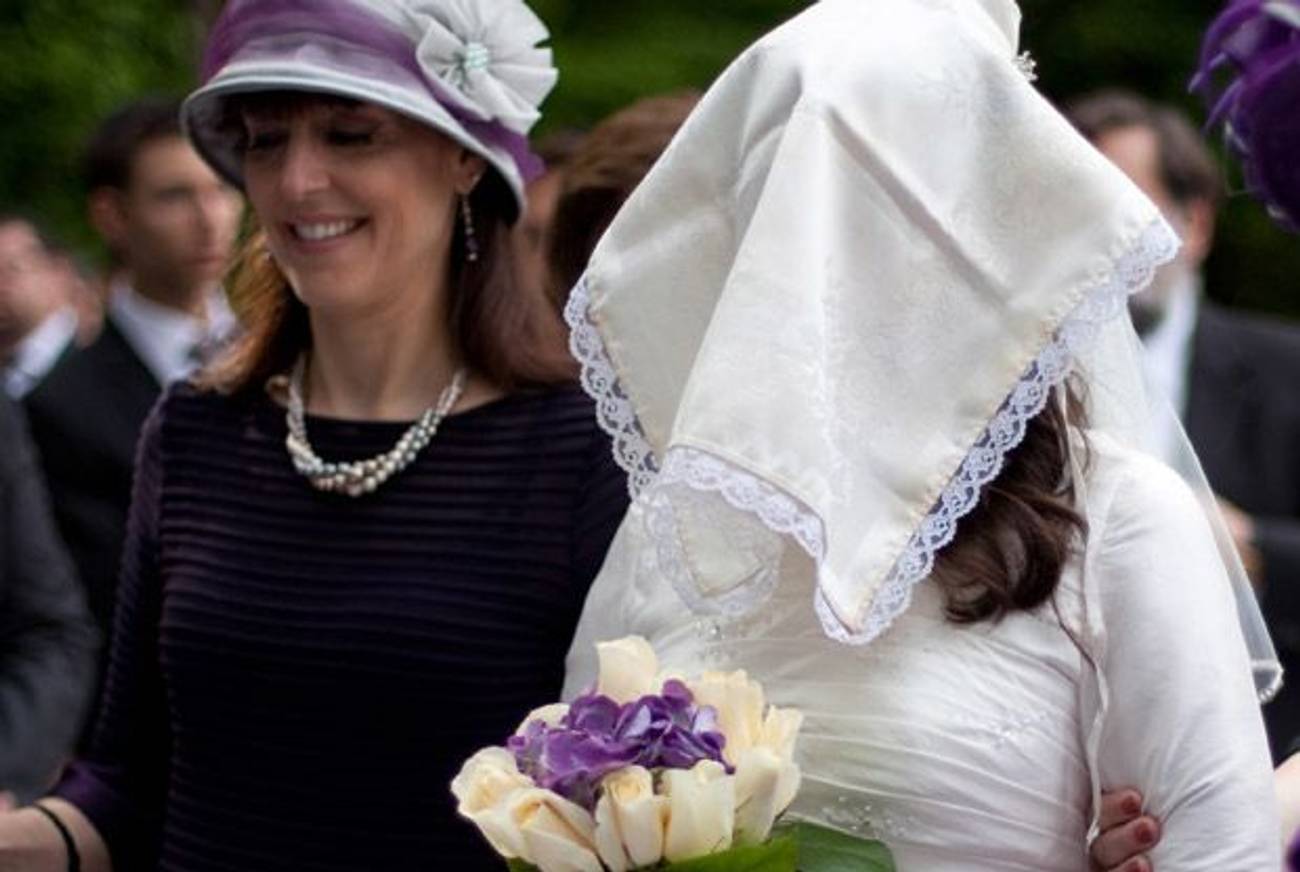
The author (left) at her daughter's wedding, walking with the veiled bride.No Eye Has Seen Photography
Last June, my daughter’s wedding announcement graced the pages of the New York Times. Emily, 20, and Michael, 21, were the youngest couple announced that week, and most likely for the entire year. Confession: I wasn’t thrilled.
This was not the milestone I had envisioned for my first-born during her sophomore year of college. But what do you do when you believe your child is making the wrong life decision? And if parenting is all about “letting go,” what happens when a mother is asked to do this earlier and faster than anticipated?
It’s taken a year, a challenging year, but I’ve finally come to accept the decisions Emily made. Our Jewish journeys have taken us on divergent paths, and I had to let go before I was ready. But now, as we celebrate Emily and Michael’s first anniversary, I think of this past year as just another step in my evolving relationship with my daughter and the beginning of a new stage of what being a mother means to me.
“I think I’m going to start dating, Mom,” Emily told me on the phone from college, when she was 19. “Is that OK with you?”
“Of course!” I said. “Just don’t rush into anything, if you know what I mean.”
What I meant was marriage.
Up until that point, Emily had never been on a date, kissed a boy, or even held hands. This choice reflected her beliefs as an Orthodox girl: Dating happens only when you are marriage-minded. I could see the advantages of this outlook on dating, but I had begun to wonder about its practicality. When it came to college students, I wondered if it was even healthy; I worried that it might unnecessarily push a young couple into early marriage, before they were truly ready. Many of Emily’s friends had started dating, and a few of them were already engaged. I feared that it might be contagious.
“You’re in a different place than a lot of your friends,” I reminded her. “So, don’t follow someone else’s timetable.”
“Have I ever, Mom?”
Right.
Emily entered the world with her own life plan. At age 4, she asked me to show her on the calendar when she would be a grown-up. When she was 7, she asked if she could skip being a teenager. At age 10, she drew pictures of her future life, which included writing a best-selling book and having 10 kids. She took the SAT at 12, and at 13 (using her Hebrew name, Leah), launched a national magazine for Jewish girls. She has been on the go ever since.
In Emily’s religious circle, dating meant letting the right people know that she was looking and being specific about what she was looking for. Emily wanted to date men who shared her life views, were ready to commit, and weren’t intimidated by an accomplished and ambitious woman with a mind for business (including the magazine she continued to run). Why, she would ask, waste his time or mine?
I thought back to my own dating experience. When I was 16, my parents allowed me to date only Orthodox boys, and in our tiny Midwestern community that gave me a choice of about five candidates. By the time I entered college in New York City, I was a disgruntled yeshiva graduate—sheltered, immature, and somewhat reckless. I dated indiscriminately, going out with any guy who could make me laugh, which led mainly to heartache and poor decisions (although I did have quite a few adventures). I could see how Emily’s choice to postpone dating thus far had eliminated distraction and romantic drama, allowing for a singular focus on developing her talents and female friendships.
In our family, the ultimate goal was to raise kids who loved being Jewish. My kids went to both public and day schools. They had friends and family members, Jewish and not, from all levels of observance. From an early age, Emily gravitated toward everything Jewish. She loved all the holidays. She loved reading Jewish books and visiting big Jewish communities. Over the years, our family grew in observance. Because our first community was so small, we relied on the services of the local Chabad Center. A few years at Camp Gan Israel proved inspirational for Emily, and she was gradually drawn toward the Chabad lifestyle, a path of Judaism that I, as a Modern Orthodox Jew, was on friendly terms with but did not embrace wholeheartedly.
“You wouldn’t believe how much background checking goes on before the first date,” I explained to a non-Orthodox friend of mine as we talked about Emily’s dating. “It’s like getting security clearance!”
“I guess that’s practical,” my friend replied. “But not very romantic.”
“That comes later,” I said.
“Later” came in just two months, when Emily called saying she had “met someone”—well, she hadn’t actually met him yet, rather, she had received first-hand accounts. Michael seemed to have everything on her checklist. As she filled me in on the details—recommendations, family background, schooling, career goals, religious outlook—I felt a twinge of excitement. I had to admit this pragmatic dating system offered an anxious parent a measure of comfort. I reminded Emily to take it slowly, to try to enjoy herself. No need to rush.
“I know, Mom.”
By the time Emily and Michael had their first date, they had skipped the preliminary, “where-are-you-from-what-do-you-do?” stage. They were ready to get down to business—and the question of chemistry. Emily called me after each date.
“I like him,” she told me after their second date.
“That’s a good start,” I replied.
She shared all the amazing things they had in common, dropping tidbits she’d know I would value, like stellar academic achievement and a happy childhood.
“You talked for five hours?” I asked after hearing about their date in Central Park.
“Well, yeah, what else should we do? Oh, and Mom, I want you to meet him!”
Michael passed the boyfriend test (although that is not what Emily wanted us to call him): He was articulate, polite, warm, and clearly crazy about our daughter. He sat at the kitchen table and graciously submitted to our lengthy interview, which my 17-year-old son would later call an interrogation. My 13-year-old said she’d be surprised if Michael ever came back. Were we really that bad? Not according to Emily’s report: “Michael loves you guys! He said he was so impressed by you both and could see why I turned out the way I did.”
Really?
Michael’s parents also seemed too good to be true. How could you not like a man who self-published a book on how to treat your wife like a queen and whose business is conflict-resolution? Michael’s mother was an international speaker and philanthropist. She told me how she had embraced her son’s decision to lead a religious life—he, too, had gravitated toward Orthodoxy in high school through his involvement with Chabad. “I raised my kids to follow their passions,” she said earnestly. “He’s a wonderful, mature, loving boy.”
I felt guilty for not sharing her enthusiasm and positive outlook toward the relationship. “It’s different with a son,” I told my husband. “And Michael is their youngest. They’ve had an empty nest for five years.”
Not long after the boyfriend test, Emily came home for the weekend. She was glowing. “Well,” she said, “Michael and I want to get engaged!”
Enter Steve Martin in Father of the Bride.
“What’s the rush?” her father asked, his ears turning red. “You’ve got college to finish!”
“I can do that and be married, too,” Emily assured us.
Married? The word lodged behind my ribcage. “Who said anything about marriage?” I asked desperately.
“Mom, did you think I was dating just for fun?”
And what would be so terrible about that? “How about to get some experience, to see who is out there—”
“And I found him!” Emily said. “How was I supposed to know it would happen that fast? It could have taken another five years.”
“You’re barely 20.”
“Yes, Mom, I know.”
We tried talking sense into her, at least what we thought made sense. You really haven’t known him long enough. How can you support yourselves? We can’t afford to make a wedding now. Don’t you want more time with your brother and sister? We got married at the sensible age of 26. You’re both too young! Every concern or objection her father and I raised, Emily countered with her practicality and natural optimism.
“Mom, I know this wasn’t on your timetable,” Emily said calmly. “I can appreciate how hard it must be for you.”
Oh, so it was my problem.
“OK,” I said, catching my breath and trying another tactic. “So, how about getting engaged, but waiting a year before getting married?” Or two.
“Mom, do you know how hard that would be?”
I stared at her. And then I got it. Emily and Michael were following the halachic dictum of no touching until they stood under the wedding canopy. How could I have forgotten? And what could I say to that?
“Besides,” she continued, “who wants to be in limbo? We want to start our life together. Sooner than later.”
My mouth went dry. “How soon?”
I wish I could say I was thrilled when Emily and Michael officially announced their engagement; everyone else seemed to be. Well-meaning friends offered comments like: “You’ll get to be a young grandmother,”or “Count your blessings, so-and-so is 30 and still looking.” None of this made me feel better. For one thing, it wouldn’t trouble me if Emily got married at 30. And becoming a bubbe—oy vey—was the last thing on my mind; I still had two teenagers at home. The truth is, I am a slow adapter and resistant to change; the idea of becoming a mother-in-law, much less a young grandmother, sent me into a tailspin. I wasn’t anxious to acquire a new set of relatives, either; I was pretty consumed with the ones I already had.
Before I could say “mother of the bride,” there I was toasting l’chaim, breaking a plate with Emily’s future mother-in-law, my home filled with smiling guests clapping and singing for the chossen and kallah. Amid all the mazel tovs, I couldn’t rid myself of the disappointment gnawing at my heart. I felt thrust into a role I wasn’t ready to play. And I didn’t want to share my daughter with a boy I barely knew. I wanted more time with her. Just her.
I feared the changes marriage would bring to our relationship. Emily and I not only shared a close bond, but we were also business partners at the magazine. Even while she was in college, we talked just about every day. Raising a kid who’s also a CEO is both exhilarating and exhausting. I had been with my daughter every step of the way on her entrepreneurial journey—accompanying her to media interviews, driving her to speaking engagements, editing magazine articles, helping with promotion, trouble-shooting, number crunching, and listening to her dreams and plans for inspiring Jewish girls to creativity and leadership. And she never stopped, never gave up, all through her teenage years. How would my future son-in-law fit into this dynamic?
But the decision had been made, and there seemed nothing left to do but surrender. I loved my daughter and wanted to make her happy, even if I wasn’t. So, I put aside my writing projects, parked my emotions, and threw myself into full-scale wedding-planning mode. The timetable seemed as crazy as the engagement itself: four months. “Don’t worry, Mom, I can help you,” Emily assured me. Of that, I had no doubt. I just wasn’t sure I would survive it.
Emily and I managed to avoid the dramatic conflicts one often hears about in wedding planning. Our differences centered around certain religious customs: how high the mechitza on the dance floor should be, what kind of music the band would play, and the wedding procession itself. During this stressful time, Michael’s parents offered incredible support. If there is a bashert for in-laws, they certainly fit the bill. They were in love with my daughter and in awe of her accomplishments. Michael’s mother’s positivity rivaled Emily’s. “Those two kids are going to do amazing things together. I just know it,” she gushed, no doubt sensing my trepidation. “Just embrace them. Think how blessed we all are.” Michael’s father assured my husband and me that we needn’t worry at all about Emily. She was in great hands. Having heard enough horrible in-law stories, my husband and I indeed felt blessed.
“Dr. Price is going to question your mental state when she hears the news,” I said to Emily, half-joking, en route to her yearly physical. The irony of accompanying my engaged daughter to the pediatrician just about did me in. As I sat in the waiting room, surrounded by moms with dozing infants, I remembered how this pediatrician had once reassured me that my precocious preschooler was a normal kid: “As long as Emily seems happy, knows how to play, and has friends, you have nothing to worry about, Mrs. Krieger.”
Now what would the doctor say?
Turns out, she was fine with it. Dr. Price just wanted to make sure Emily had actually met her fiancé.
“See, Mom? Not everyone thinks like you do,” Emily said on the drive home. “I’m not the typical 20-year-old.”
Tell me about it.
I figured that with the wedding a few weeks away, now would be a good time for The Talk. I asked her outright if she had discussed family planning with the doctor.
“Mom, can we not talk about that?”
I couldn’t let it go. I had wisdom on this matter. No matter how mature you may be, I told Emily, having a baby right away would jeopardize your studies and career: “You have no idea how all-consuming an infant is. Nobody does, until the day you bring one home.” I urged Emily, begged her, to postpone motherhood for a couple years at least.
She looked out the car window. “OK, Mom, I heard what you said, and I’ll take it into consideration. But, the decision, really, is between me and my husband.”
We drove home in silence, the word husband ringing in my ears.
The wedding unfolded without a glitch on a sunny, picture-perfect June day, with 200 friends, family members, and a fan club of girls. I danced the hora in a cloud of disbelief; the whole event seemed like an out-of-body experience.
The morning after, to my surprise, Emily’s friends had already posted chuppah photos on Facebook. I saw the Times wedding announcement. There was no denying it: I had a married daughter.
Michael and family members arrived later at our house for a brunch. When I saw my daughter in her new shiny sheitel, I just about lost it. Who was this young woman? I tried to be a gracious host, to act normal, until it was time for Emily and Michael to head to New York for their first sheva brachos and then move into their Brooklyn apartment. I fought back the tears, until their car pulled out of the driveway.
My sister hugged me. “It’ll be OK.”
But it wasn’t. The emotions I had put on hold arrived special delivery at 3:00 in the morning. I lay awake trying to get to the root of my anxiety. Did I really think she was too young for marriage? Was I worried that her dreams would be squelched? Did I think Michael was too frum?
Unable to fall back asleep, I got up and walked down the hallway to Emily’s room. I sat on her bed, the one her father had built for her, which I knew she’d probably never sleep in again. I looked at the plaques, awards, news clippings, fan letters, and bat mitzvah mementos decorating the walls. Emily’s beloved Jewish books filled one shelf, her childhood favorites on another. A pile of magazine samples sat on her desk. How long would I keep Emily’s room the same? Then I noticed a laundry basket filled with her clothes. Were those to be donated, folded, or was I supposed to wash them? I laughed. Some things never change.
As I sat in the stillness of her room, I realized that change was what I had been fighting all along. Change, the root of our fears. Until I learned to ride that wave, I’d be stuck on shore, pining for something out of reach.
That summer, during my wedding recovery phase, I met up with an old friend at Starbucks. When she asked me how I was doing, I told the truth: “I know I should be happy, and yet … I’m just not. I’m sad. Emily won’t be home at all this summer. I’ll miss our girl time, our family trips, the three kids staying up yakking half the night. Now when she visits, it will be with … him. They’ll probably stay in the guest room!”
My friend, a Jewish mom of three girls, squeezed my hand. “You’re right. Things are never going to be the same. But that doesn’t mean they won’t be good. Emily will still need you, just in different ways.”
I sipped my tea, blinking back tears.
And then my friend said something that took me by surprise. “You need to give yourself permission to grieve.”
“Grieve?” That sounded like an awful word to pair with a “wedding.”
“Yes. No matter how wonderful it is for her, you are experiencing a loss. Let yourself feel it. Mourn for it, and then you can move on.”
During the following months, my husband and I had more opportunities to get to know our son-in-law. We observed how he managed to inspire changes in Emily that we were never able to do, like eating lunch sitting down, not falling asleep with her laptop, and exercising. As she promised, Emily continued her studies at Yeshiva University while also growing her business and giving speaking engagements. Michael, with his youthful energy and head for business, joined her team by helping with technology and marketing. This surprising and welcome turn gave me some breathing room. My daughter now had someone else who would willingly listen to her business challenges, who would brainstorm with her, who would accompany her to conferences, someone who was totally devoted and not going to quit. My status as Emily’s number one fan now had a rival—except he wasn’t, he had become part of the family.
Now, as their first anniversary approaches, I’ve come to the conclusion that no matter when and how you do it, marriage is an act of faith—there is no formula or guarantee. I can think of couples I know, religious and secular, who followed different paths to the altar: marrying young, marrying old, long courtship, short engagement, living together, or remarrying—each ending in divorce. Surely, by midlife I have learned that no one path is right.
And yet, having heard so many stories of delayed adulthood, failure-to-launch kids, and aimless twenty-somethings, I know I should count my blessings. I have a responsible daughter with dreams and goals and a life plan. So, she launched herself earlier than the typical American teenager. Can’t I live with that? Emily found a wonderful guy; he just happened to show up a few years early. My job now is to work on embracing the changes her new life brings. To accept change is the beginning of letting go, which is something every parent must do—sooner or later.
Evelyn Krieger is the author of the young-adult novel One is Not a Lonely Number, named a 2011 Sydney Taylor Honor Book by the Association of Jewish Libraries.