Academic Transfer
In order to understand her identity, an Irish Catholic student at the University of Virginia had to follow her passion: a major in Jewish Studies
January 24, 2012

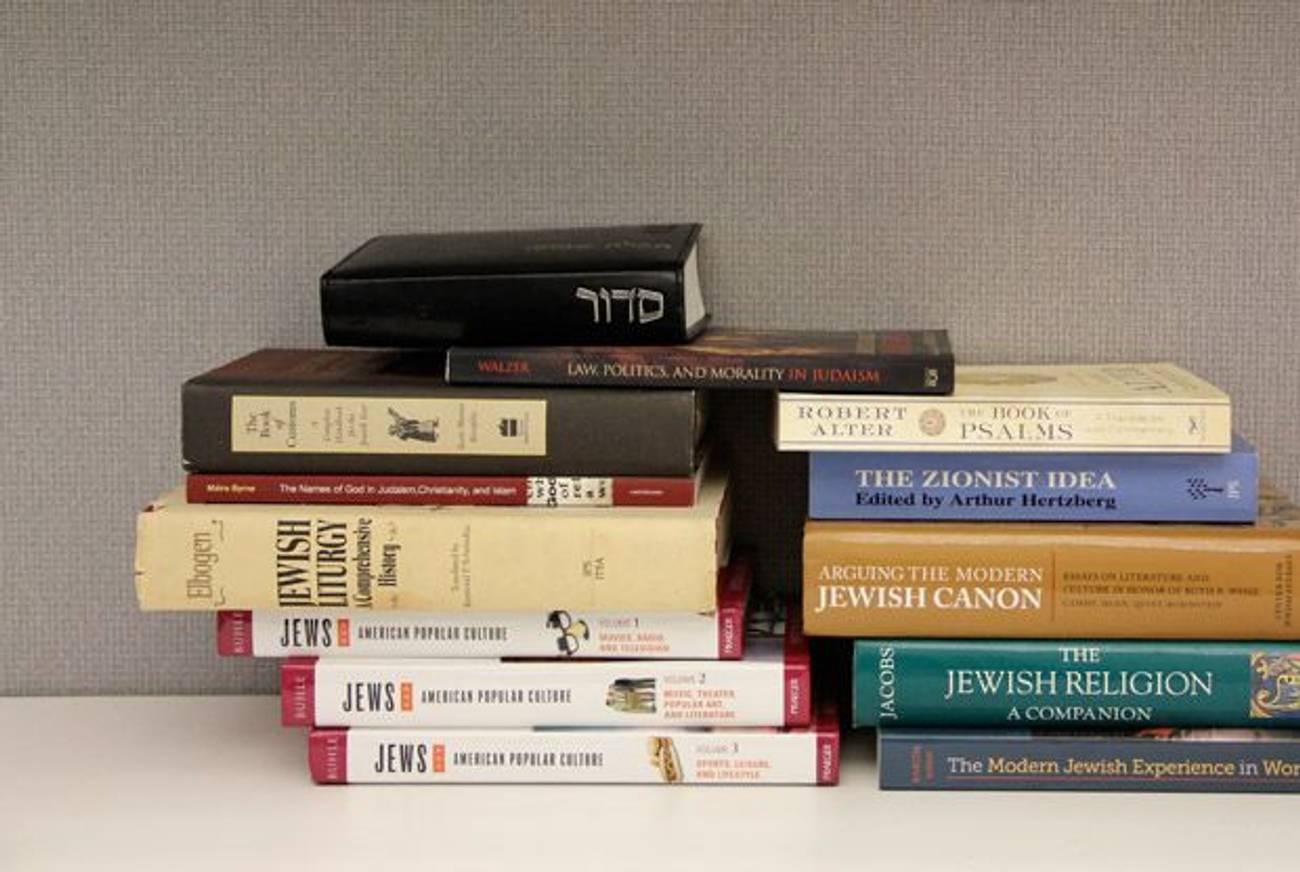
“You’re running away from who you are,” a family member warned me before I left for a spring break trip with my university’s Hillel. I couldn’t blame him: I am a blue-eyed, baptized Catholic, the product of a lifelong religious education set in classrooms with crucifixes hanging on the walls and statues of the Virgin Mary standing in the doorways. Most of my childhood classmates came, as I did, from large Catholic families with conspicuously Irish and Italian surnames. Despite my total immersion in all things Catholic throughout my upbringing, however, I always felt acutely estranged from both the Church’s religious precepts and Catholic culture overall. But on the cusp of that trip, I felt for the first time that, rather than escaping from an identity, I was actually starting to figure mine out.
A few years before, a totally unexpected encounter with the Jewish Studies department at University of Virginia turned into a consuming intellectual passion. Now, three years and many experiences with Jewish life later, I have found that Jewish Studies has become much more than simply an academic pursuit for me. In the strange, twisted, but amazing trip that has been my college experience, Judaism has provided me with the friends, mentors, values, and spiritual community that I didn’t even know I had been seeking. What started as an avowedly intellectual interest has influenced the entirety of my life.
I grew up in a very loving, very religious Irish Catholic family in the Philadelphia suburbs—the kind that flies a surprisingly tasteful flag featuring the scene of Jesus’s birth, illuminated by a spotlight, outside our front door during the Christmas holidays. During my childhood, my parents brought my three siblings and me to Mass every Sunday, where we squirmed and giggled our way through the weekly sermons. Cultural Catholicism pervaded our lives, from the elaborate religious rituals that we regularly observed to the social conservatism of our parents.
In ninth grade, I was enrolled in a strict, all-girls’ Catholic high school—a world of assigned lunch table seats and abstinence-only sex education. Rather than bulldogs or wildcats, we were, unfortunately, the Marians. Marians were required to observe all sorts of rules, the most undeniably humiliating one being the requirement to introduce formal dates to a welcoming line of benign but intimidating nuns.
We still had fun, of course. My friends and I invented imaginative games in our Latin class and threw the occasional breakfast tailgate at my parking spot before homeroom. We joked incessantly about our mandatory yearly assemblies with a local pro-life, chastity-promoting Catholic organization, from which we always received bright red stickers that asserted, “I’m Worth Waiting For!” But, though frustrated with Catholicism, by a large majority we identified with the politically and socially conservative views of our parents. I discussed with pleasure “building a wall” for the “illegals” and withholding taxes for the wealthy, and my government class contained one endearing but lonely liberal—a spike-collar-wearing Hillary Clinton devotee with multiple piercings and a pink streak in her hair.
When I started my first year at the University of Virginia, I felt ecstatic to finally experience freedom. Like so many of my peers’ college choices, my own decision to attend U.Va had been uninformed; I had no idea what I wanted to study or who I even was. My chance introduction to Judaism occurred when one of the first students I met, on one of my very first days at school, invited me to attend a Shabbat dinner at U.Va’s Hillel. Being a spacey 18-year-old with virtually no social inhibitions, I agreed.
At that time—before the Hillel’s new multimillion-dollar addition was completed—Shabbat dinners took place on long, crowded tables on old hardwood floors in two rooms featuring posters about Israel and ceiling-high bookcases filled with texts about Judaism. The warm lighting, the books, and the other students who seemed suspended in that hazy, magic time between the end of the school day and the weekend ahead—it all seemed so homey. I was utterly, inexplicably besotted. Of course, I was also utterly, comprehensively Catholic.
But, as I now realize, this new exposure to Judaism coincided with the emergence of some festering issues with Catholicism’s theological precepts. That fall, I enrolled in a course about the Hebrew Bible—during which it dawned on me that no one, including me, had to read the Bible as God’s Word. Still, I wasn’t sure what this meant for observance. During my Bible professor’s office hours, I would interrogate the petite, bewildered woman about her belief in God and Christianity. Repeatedly, she replied that she couldn’t share with me her own personal views, only the academic discourse.
The following semester I enrolled in a Jewish history course. I was astounded by the Jewish historical narrative and Jews’ contributions to intellectual and cultural life despite one horrendous instance of persecution after another. The American Jewish immigrant experience seemed particularly fascinating: Yiddish theater, Tin Pan Alley, you name it—for whatever reason, I was into it.
With the help of my obliging Jewish history professor, who took the time to respond to my theological queries during office hours with even more thought-provoking responses, I began to make peace with the religious teachings of my upbringing and explore new religious philosophies. And then he made an unexpected suggestion: that I consider majoring in Jewish Studies. Having no better ideas at the time, I decided to pursue it.
The next year, I became even more involved in Jewish life. I started going to Shabbat dinners every Friday night with my growing network of Jewish friends, several of whom I met in my quirky, close-knit beginners’ Hebrew class. One weeknight at Hillel, I was startled to find myself teaching a recent convert how to braid challah. I also took an incredible class about Jewish philosophy with a soft-spoken professor who explained the development of Jewish thought from Spinoza through post-Holocaust thinkers. From him, I learned for the first time about the compatibility between atheism and Jewish religious observance. Now, here was a philosophy that I could get behind! As a lifelong skeptic, I loved Judaism’s encouragement of theological inquiry, of questioning rather than knowing the answers. In addition, as I read more about Jewish thinkers who had existed on social and religious margins because of their Jewishness, I felt an odd affinity with them. In my (somewhat dramatic) perception, I was the ultimate Jew: a non-Christian, non-Jewish insider-outsider who perilously straddled the lines of membership in both communities. I didn’t fit anywhere.
Through Hillel, I also formed close friendships with several older, intellectual Jewish students, who began to influence my increasingly left-leaning views with their advocacy of typically liberal political causes and interest in tikkun olam.
One spring, I accompanied them to Miami for one of Hillel’s weeklong service trips—the group’s only non-Jew. I didn’t really know why I wanted to go on a specifically Jewish trip, but I’m glad I did. While in Miami, we spent time at the Jewish Federation there. As we sat in the Federation’s conference room, festooned with blue-and-white crepe decorations, we listened to speeches about Israel advocacy, social justice, and the 4,000-year-old Jewish legacy. Surprised at the fervor of these talks by wealthy and influential Jewish leaders who were mostly middle-aged men, I looked around at my group quizzically, but no one else even batted an eye. Despite my friendships with everyone in the group, I was suddenly aware that I lacked the exposure to the kinds of people and conversation that my Jewish friends had. No matter how much I learned in school, I could not replicate the actual lived experience of American Jews without having grown up as one.
I began to hate explaining that yes, I am a Jewish Studies major but, no, I am not actually Jewish. When my parents’ friends brought it up at dinner parties or during holidays when I went home for break, I tried to change the subject immediately or talk about my siblings’ lives instead. I think that many of these people from home suspect that I am using my academic life as an act of rebellion, the intellectual’s equivalent to selling drugs or getting a navel ring. (I would argue, though, that selling drugs seems a lot more profitable to me than majoring in Jewish Studies.) And all along, I kept vehemently claiming that the religion itself did not interest me.
During my third year in college, I enrolled in a class about Jewish ritual. I had to: It was a required course. Sitting in the back row with one of my equally disinterested friends, I felt only annoyance. I would have rather taken a class about Israel or Zionism, and here I was wasting time learning about Jewish weddings, bar mitzvahs, and the like.
As the class progressed, however, I had to admit that I liked the way our professor elucidated the connection between important life events and their physical recognition with rituals. Once, this professor assigned us a short paper with which we were to record our observations of an on-campus Jewish religious event. I took the assignment in a different direction by composing an affectionate portrayal of Jewish life as I had come to know it with a description of Hillel’s Yom Kippur services. I talked about my Hillel crew—my friend whose parents begged her to show up on Friday evenings and High Holidays in the hopes that she would defy the crushingly majority-Christian demographics of U.Va and one day meet a nice Jewish boy. I also talked about my token “intellectual” Jewish friends, the “eat-and-run” crowd of scruffy, Doonesbury lookalikes who showed up for High Holiday dinners and left conveniently before services. I went on and on, comparing the march of students to services from Hillel to that of kids on the way to a much revered but dreaded summer camp tradition. Once again, as a student of Jewish history and culture, I observed these Yom Kippur services from within the community but ultimately outside it.
I expected a C or C-minus with instructions to follow directions next time, but instead I received an A+, with a request to attend my professor’s office hours sometime. I began visiting her often; we talked about religion and identity in depth, and I began to consider the obvious benefits of participation in a spiritual community.
I admit that my situation is an odd one. Having traveled to Israel and completed most of my Jewish Studies course requirements, I am embarking on my last semester at U.Va and feeling very much a part of the Jewish community. I’ll be finishing an undergraduate thesis about the U.Va Jewish community, and I plan to apply to graduate school for Jewish Studies in a year or two. When in conversation with someone about Jewish life or Jewish traditions, I often accidentally say the word “us” or “we” when referring to the Jewish community. If I find a guy at U.Va inexplicably unattractive, I sometimes find myself explaining to my friends that he is, regrettably, way too goyish-looking. When Friday afternoons roll around, my friends—Jewish and non-Jewish—know to expect a probably bossy-sounding mass text message from me inviting them to Hillel that evening. Unlike most of my Jewish friends, however, I don’t receive any pressure to go there, or to fast on Yom Kippur, or to meet a nice Jewish boy.
And I have come to increasingly dislike Christmas—the buildup, the hype, the packed malls, and the materialism. (As Jewish holidays literally celebrate suffering, I think they would be a welcome and interesting change for me!) And I have made the decision, however reluctantly, to formally convert in the future. But, while this certainly sits toward the top of my to-do list post-graduation, I am not looking forward to the process. Conversion seems like a formality, a “box-checking,” to publicly legitimize the group affiliation that I felt very strongly and naturally from the beginning of my relationship with the Jewish community.
I do sometimes worry that some karmic Christian retribution will one day bite me in the tuchus. What if one day I have children and end up producing little self-hating Jews who bury themselves in Philip Roth and major in Christian Studies in college? What if they only support Israel so that Jesus has a place to land during the apocalypse? For now, though, I have enough on my hands with my own identity.
Anne Grant is a student at the University of Virginia.