Pregnant Pause
Pregnancies are fertile ground for superstition, especially for those who assume their traditions and lucky charms are based in Jewish law
February 07, 2012
Tablet Magazine
The name was obviously perfect as soon as it came out of my mouth, during a sleepy bedtime conversation with my husband about what we plan to call our son. I spent months struggling to imagine using any of the perfectly fine names on our original shortlist, but this one was everything we wanted: classic without being archaic, familiar without being common, striking in its full form without being awkward in the diminutive. It’s a name I can’t wait to share—which is why I was surprised to find myself on a windswept street corner a few weeks ago, admonishing my husband for putting it in a text message as I shivered in the cold January night.
“Don’t do that! Bad luck! Shhh!” I tapped out in a frenzy.
“Can’t help it!” he responded.
A clammy wave of fear and irritation washed through me. “But what about the Angel of Death?” I typed, before promptly erasing it. The Angel of Death? In stark black-and-white pixels, on a screen powered by electricity and chemicals and human ingenuity, it looked crazy. I shoved the phone into my bag and slid my gloves back on.
I used to live firmly in the observable world. When it came to my physical wellbeing, I trusted the power of medical technology to establish cause and effect. Twisted ankle? A quick X-ray shows whether anything is broken. Sore throat? A culture determines whether or not it’s strep, and antibiotics cure it. Tests identifying a cluster of pre-cancerous cells? There’s surgery to scrape them away, and close monitoring to trigger a repeat if they return. Things are, or they are not, and that’s that.
Pregnancy, I assumed, would work the same way. After all, it was a litmus test that confirmed it in the first place: two pink dashes on a plastic stick, easy as handing over $12 at the drugstore. A few weeks later, we heard a heartbeat, transmitted via sonogram, and a few weeks after that got our first visual confirmation via ultrasound that the bump in my belly housed an actual baby, who has two arms and two legs, 10 fingers and 10 toes, two little ears and a tiny button nose.
Then came the genetic tests, which I was startled to discover offer results in the form of percentages, rather than certainties. Our numbers were good, but if we wanted guarantees, we were told, we needed to do an amniocentesis—a test whose chances of hurting the baby were higher than the outside possibility that something was actually wrong. In other words, it was riskier to pursue a definite answer than to trust the statistics—a choice that, for us, was no choice at all. But that little seed of uncertainty took root in my mind and has been steadily watered by a cascade of “wait and sees” on everything from how big the baby will be to how labor will go. Now, with less than a month before delivery, it’s blossomed into the idea that the baby is like Schrödinger’s poor cat: simultaneously perfect and afflicted, not one or the other but both, until he emerges from the black box of my belly into the world, where we can see him for ourselves. Knowing a little bit turns out to be as good, or bad, as not knowing anything at all.
The fact that we live with the uncertainty for nine whole months—and that the evidence of the mystery is always right in front of me—is why, I’ve discovered, pregnancy is a particularly ripe condition for spawning superstition. “Whenever you have a situation where there’s a lot at stake, and you’ve done everything you possibly can to make sure there’s a happy outcome but there’s still a lot of uncertainty, it’s a perfect circumstance for superstitions to emerge,” Stuart Vyse, a professor at Connecticut College who specializes in the psychology of irrational beliefs, told me. “Establishing some kind of ritual or lucky thing you do makes you feel better, because it gives you the illusion of control.”
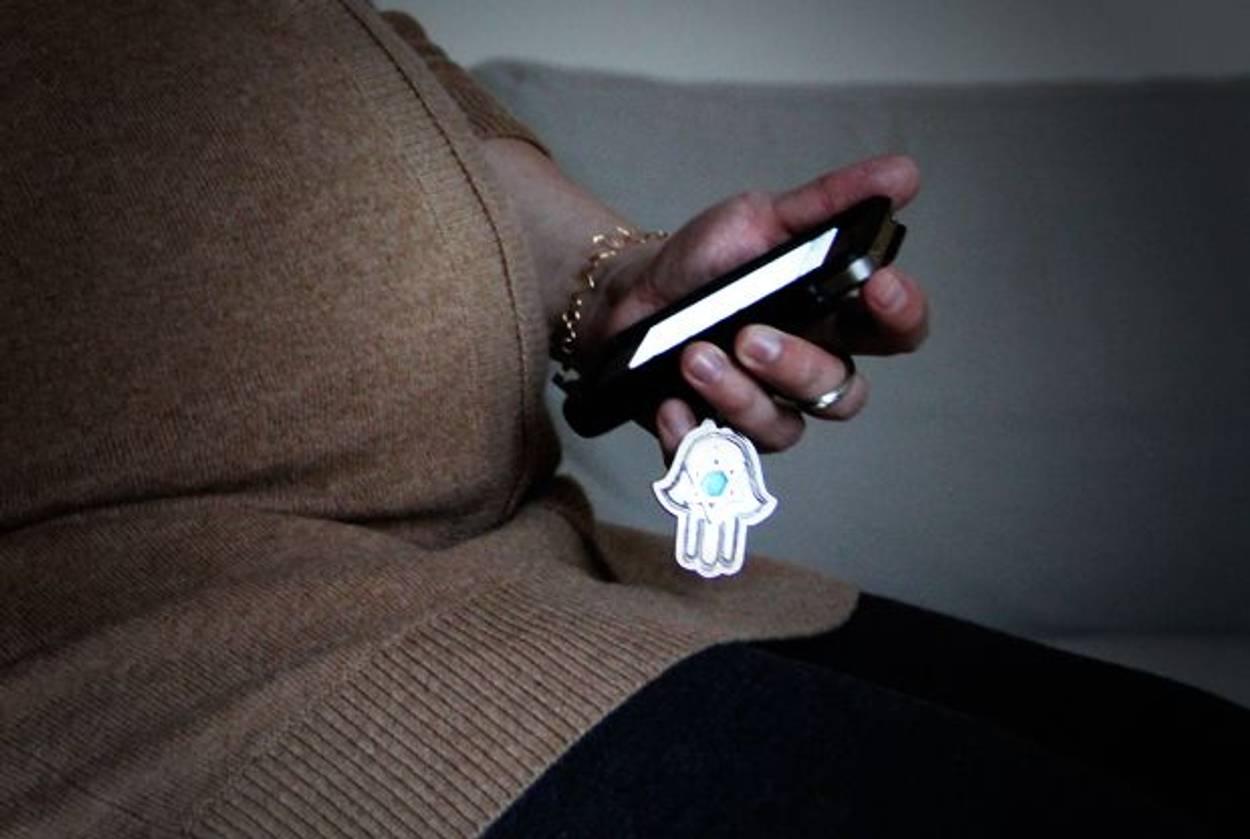
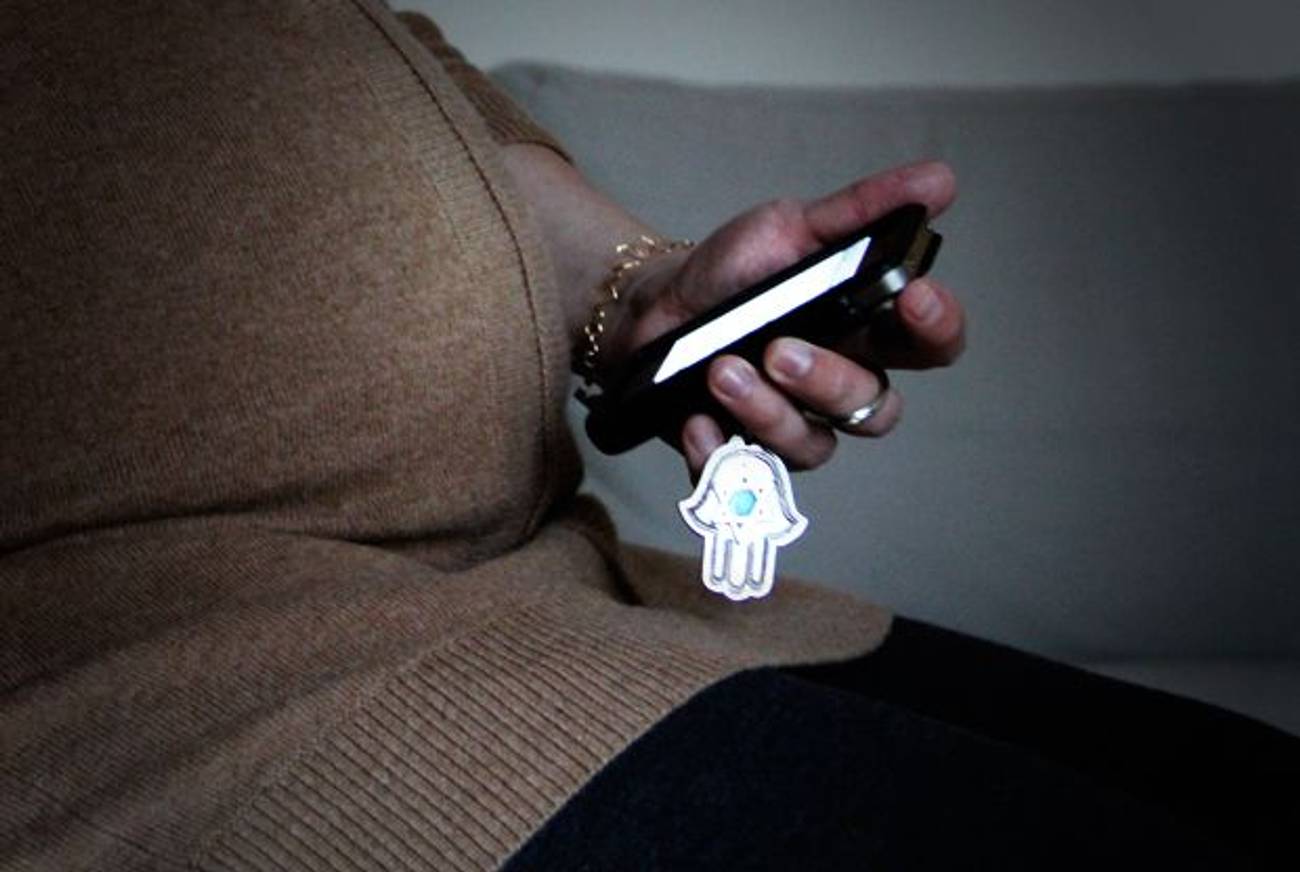
And Jews have spent centuries accumulating a vast catalog of practices surrounding pregnancy and childbirth: a trove of off-the-shelf totems to fit any anxiety that, for someone as determinedly secular as I am, has the added appeal of coming wrapped in echt Jewish authenticity. “You can trace the magic to the Babylonians, the ancient Greeks, you can see the common denominators,” said Michele Klein, an expert in Jewish birth folklore and customs. “But the Jews have a written heritage and have channeled it and processed it and turned it into a way to maintain Jewish identity, separate from other peoples.” So, expectant Jewish parents can rely on charms like the hamsah to ward off the evil eye or tie red strings around their wrists for good luck—or resort to time-honored tricks like not saying a baby’s name aloud before it is formally bestowed at the bris, eight days after birth, to avoid attracting notice from vindictive spirits.
Which is why, despite there being nothing in the Talmud about my omnipresent Angel of Death, it felt like a distinctly Jewish thing to fear. Along with the evil eye—ayin hara—it’s a concept that has become woven into the warp of Jewish observance, so much so that it can be thought of as “superhalachic.” (Another is the habit of wishing a pregnant woman “b’sha’ah tovah”—“in good time”—rather than a standard mazel tov.) “The overwhelming majority of these things are not legally or textually based,” said Rabbi Dr. Edward Reichman, who teaches Jewish medical ethics at Yeshiva University. Superstitious habits like not revealing a baby’s intended name before the bris, or not outfitting a nursery until a baby is born, dovetail with other legally sanctioned practices, like not planning a funeral until a person has died. “There is a belief that you don’t want to prophesize or look to the future in ways that are inappropriate,” Reichman told me. “There’s nothing in halacha about not calling a mohel before a baby’s born, but you don’t want to anticipate God’s work—so you wait.”
But how do you draw the line between what counts as superhalachic and what is just super weird? One person I spoke with mentioned, offhandedly, the idea that pregnant women shouldn’t step on cut toenails for fear of having a miscarriage—an idea that, according to Michele Klein, is tied to long-forgotten fears of witchcraft. “When I was pregnant, I loved the idea of biting the etrog,” Rabbi Mychal Springer, who directs the center for pastoral education at the Jewish Theological Seminary, told me, referring to the custom of eating the blossom end of the citron fruit to ensure an easy delivery. “Did I believe it would ease the pain of labor? No, but I didn’t need it to—it was about having something to take with me as a source of support.”
It doesn’t help that the main branches of Judaism offer little or no guidance. “Since customs and folklore are generally passed on orally in families, there are no innately Reform customs,” wrote Rachel Adler, a professor of modern Jewish thought at Hebrew Union College in Los Angeles, in response to my query about whether the Reform movement had made any effort to systematize or catalog any of the folk customs. But I was surprised to find just as little regard for them at the other end of the spectrum. “Superstition and old wives’ tales, people don’t get into that,” Shoshana Samuels, an expert in Jewish family law who consults for Orthodox synagogues across the country, said when I reached her by phone. “People are concerned with the ritual laws, with the women’s health side.”
Some people find the absence of official sanctions for superstitions freeing. “There are opportunities for creative thought,” said Amanda Bradley, a London mother who has set up a website devoted to helping Jewish parents find ways to grieve for miscarriages and stillbirths, including observing elements of the traditional shiva mourning ritual. But what looked like freedom to Bradley felt, to me, overwhelming—and threatened to drain even what few superstitions I had fixed on of their value. Then I remembered something Vyse had told me. “Superstitions are intuitive and based on the psychology of feeling good,” he said. “There are psychological incentives for people, even though they know intellectually that it doesn’t matter.”
So, I’m still not telling anyone what name we’ve picked for our son, and I’ve still got my husband using Go-Go—a nickname we came up with not long after I found out I was pregnant—when he talks about our prospective child. But it would be dishonest of me to pretend that I didn’t enjoy a flood of relief when I got an email from Reichman last weekend, reassuring me that we didn’t have anything to fear from saying our son’s name aloud. “It is not forbidden to announce the name of a baby before his bris,” Reichman wrote. “The boy only receives the full measure of his soul at the bris, and a person cannot be truly ‘named’ until attaining that completion.” Just like that, the shadowy fear seemed to pass, and I spent the rest of the night saying the magic words quietly to myself, with nothing to hold me back.
Allison Hoffman is a senior editor at Tablet Magazine. Her Twitter feed is @allisont_dc.