New Wave
French Jews making aliyah go from one conflict zone to another
June 08, 2010
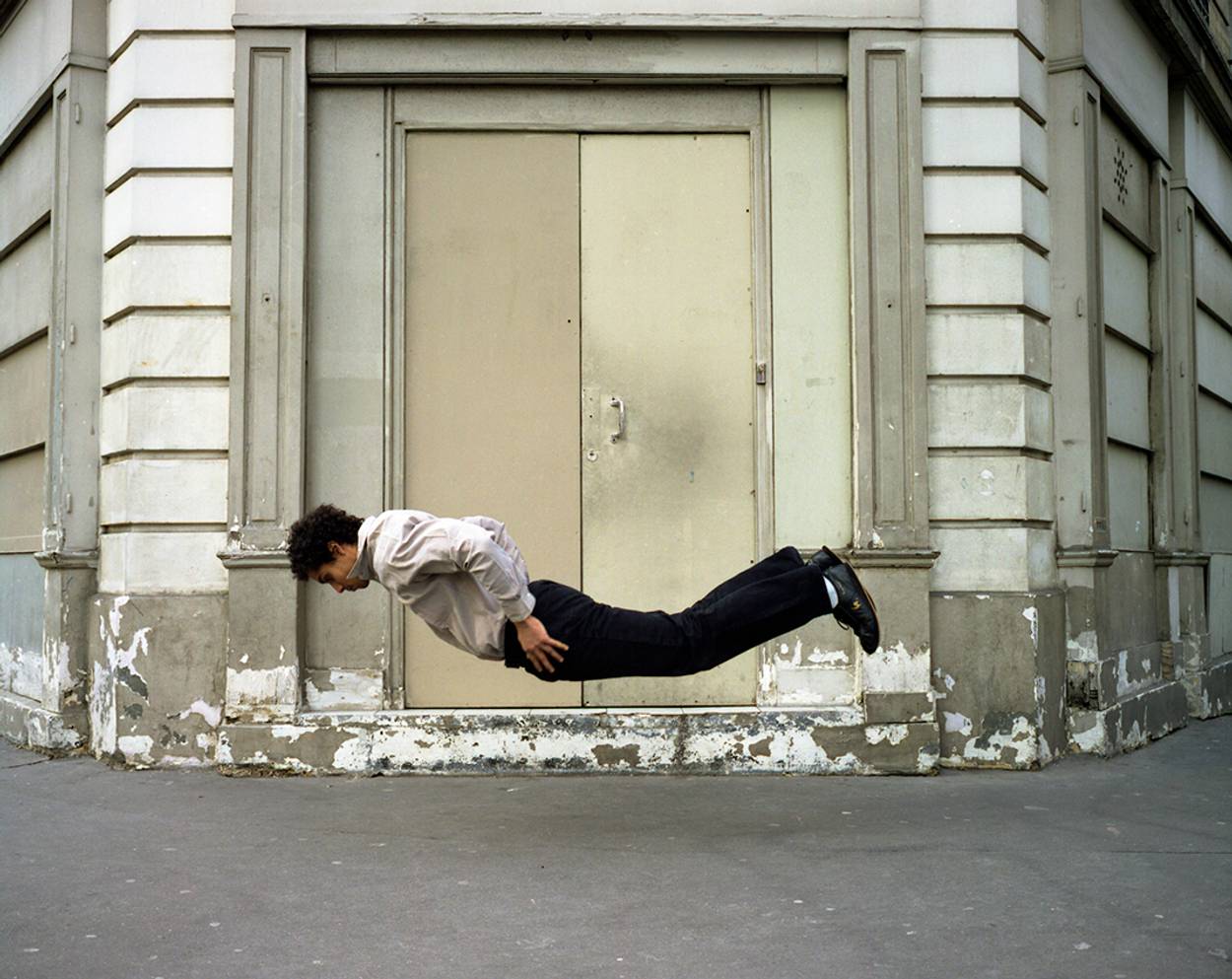
La Chute (The Fall), Paris, 2006Denis Darzacq/Agence VU

In a conference room at the Ramada Renaissance hotel on the western edge of Jerusalem, a group of 60 French Jews are about to become Israelis. They sit in softly cushioned metal-framed chairs set in two rows across the red-and-gold hotel carpeting. At the front of the room, delegates from the Jewish Agency stand before a dark blue table arranged with ID cards and a stack of heart-shaped pink chocolate boxes. A thin, dark-haired woman in a grey minidress holds a microphone and calls out the names of these new Israelis, serious-looking Orthodox families, retired couples on their way to the Francophone beach communities of Netanya and Ashdod, and twentysomethings headed for Tel Aviv. As they take their bounty, the new citizens pose for photos and thank their delegates, kissing them once on each cheek. Everyone stands for “Hatikva,” Israel’s national anthem. As she sings along, Nora De Pas, a girl I met yesterday, puts an arm around my shoulder, linking me to a chain of people who were strangers a week ago.
The Jewish Agency, eager to attract as many Jewish immigrants to Israel as possible, recently began organizing a monthly, all-expense-paid “Aliyah Tapis Rouge,” or “Aliyah on a Red Carpet”—group immigrations from France to Israel. As a non-practicing American Jew living temporarily in France from a family with no particular Zionist passion, I had never really considered going to Israel, and I wondered what the big deal was. Why would anyone want to leave a peaceful welfare state for a country in constant conflict? I never truly came to understand why these French Jews were abandoning everything they had ever known for a place they’d only loved on vacation, but a part of the agency pitch worked its way into that portion of my heart that yearns always to belong (and hates winter). But mostly it was February and it was cold, and I just wanted to get the hell out of Paris, where I had been staying in the apartment of an old friend who lives in Vincennes, a short walk from the last stop on the métro’s No. 1 line, traversing east-west across the city. Just a little farther out, the city is ringed by the sprawling Parisian banlieues—the depressingly indistinct postwar apartment structures, built in the 1950s and 1960s at the collapse of the French colonial empire, that served to accommodate the vast influx of working-class immigrants from the former colonies.
Last year the Jewish Agency counted 1,909 French olim, or people making aliyah, making up slightly more than 10 percent of the total number of immigrants for the year. The agency expects a similar number in 2010. French Jews have a history of making aliyah in times of conflict, whether out of solidarity with Israel or fear of the repercussions in France. Following the Six-Day War of 1967, the number of French olim spiked to 5,000, gradually leveling off to a relatively steady 1,000 a year before climbing back to 2,000 during the real-estate boom of the mid-1990s. Tensions between Jews and Muslims in France mounted to what many considered intolerable levels after the start of the Second Intifada in 2000. Having lived for centuries in the same French-colonized countries of North Africa, these Jews and Arabs became enemies in the poor suburbs of Paris, their identities muddled by a mix of lingering colonial resentments and solidarities with an Arab-Jewish conflict several countries away. The number of French Jews who emigrated to Israel peaked at 3,000 in 2005.
At the airport in Paris, I saw that the Jewish Agency had literalized the VIP: As I waited among a disorganized cluster of homebound Israelis, we looked on in envy at the 60 French olim who walked by on an actual red carpet. On the plane I awoke at 5:00 a.m. to the sound of a woman speaking above me as she waited to use the bathroom. Noticing the thick winter scarf draped across my eyes, she leaned over to the woman behind me, her voice tinged with alarm, and said (in French): “That’s not a burqa, is it?”
***
For many French Jews, the banlieues have come to signify hostility and danger. Although they don’t always say it, the Jews associate the suburbs with Muslims, and they associate Muslims with anti-Semitism. While France does not gather ethnicity statistics, official estimates indicate that the country is home to Europe’s largest population of both Jews and Muslims, at approximately 600,000 and 6 million, respectively. In places like Sarcelles and Créteil, where large populations of Jews and Muslims both live, Jews have been shaken by recent incidents like the highly publicized kidnapping and murder of 23-year-old Ilan Halimi in 2006. Halimi, who was Jewish and worked as a cell-phone salesman in Paris, was lured to Bagneux, a suburb south of Paris, by a group of young African immigrants calling themselves the Barbarians. Initially demanding a ransom of 450,000 euros (about $540,000), the Barbarians held Halimi for three weeks, brutally torturing him. He was found naked and handcuffed in the woods near Bagneux, beaten and burned, and he died on his way to the hospital.
“We know very well it was just because he was Jewish,” Précylia Azau tells me over coffee one Sunday morning at the McCafé cart on the third floor of the Créteil Soleil Regional Commercial Center. Précylia has just moved back to France from Israel. She is thin and petite, her dark features and brown eyes reflecting her Sephardic heritage. She has a large smile that shows a wide gap between her two front teeth, and when she speaks French it is with an accent I assume to be Israeli. “When I find myself all alone in the street I get scared,” she says. “I feel safer in Israel than in France in spite of the bombs.”
Précylia epitomizes the unique ties linking French Jews to Israel. Twelve years ago, Précylia’s parents—both born and raised in France to Algerian parents—decided to move to Israel. Now 24, she has come back to live in her grandmother’s Créteil apartment as she recovers from a breakup with her boyfriend of seven years. Although she misses everything about Israel and says her visit is only temporary, she has begun working at a Jewish preschool and mentions the possibility of enrolling in college here. Through her smile I see a deep melancholy resting in the droop of her dark eyes.
Précylia respects the strict dress code of the Chabad Lubavitch movement she joined in Israel but still manages to look fashionable in a thin wool v-neck sweater and knee-length denim skirt. If I saw her on the street, I wouldn’t have any idea she was Jewish. Even so, she is certain people recognize her as an Israeli, and she says she’s more afraid taking the subway in Paris than she was volunteering as a nurse in Gaza during the war in 2009.
Although her precautions strike me as extreme, at first Précylia’s comments about French society reveal the permeating sense of tension I have always felt but can never quite put my finger on. “People here are cold,” she says. “They’re not lively. They’re dreary.” I ask her if she thinks people in France are anti-Semitic. “Arabs are, that’s for sure,” she says, and I stop nodding along. “I hate Arabs, because I’ve lost people I know because of them.” As she says this, I notice for the first time that she is still very young, even though we are nearly the same age.
When we leave the mall around noon, Précylia and I walk to her grandmother’s tiny kosher bakery a half-mile away. Précylia walks behind the counter and hands me a paper bag with two chocolate croissants. Heading back toward the metro I pass through the mall parking garage, which is garish and ugly, with beams and archways painted in bright pastel purples and oranges. Looking at Créteil spread out before me, I can’t discern any particular order to the streets below. The buildings look plopped down at random. Some have podlike protruding balconies fashioned in that jaunty 1960s mod way that surely must have seemed then to be a harbinger of some utopic future. If I lived here I would spend my entire life dreaming of somewhere else.
The banlieues of Paris are far from the headquarters of the French newspaper Le Monde Diplomatique, where the historian and journalist Dominique Vidal sits at his desk beneath a towering stack of books and papers. Vidal is organized and compact in appearance, his curly salt-and-pepper hair cut short and his beard neatly trimmed. In addition to obscure works by Karl Marx and Emmanuel Levinas, the books on Vidal’s desk reveal a lifelong passion for the Middle East. Along a crowded bookshelf that takes up a wall of his office hangs a small pennant embroidered with the word “Palestine.”
Vidal speaks quickly and amiably, enumerating points from a mental outline like a university professor at a conference. “Firstly, what’s happening in France is a bit contrary to the general trend,” he says when I ask why the number of French olim has increased in the last decade. “But even if there is an augmentation of aliyot from France, relative to the 600,000 or 700,000 Jews in France, the number of Jews who leave is very, very small.” Vidal explains that North African Jews—who have only been in France since the collapse of colonialism—are the most likely to emigrate. “For them the second exodus isn’t a big deal,” Vidal says. “It’s a lot harder to get a family who has been in France for multiple generations to leave.”
Still, recent hostilities in France have put a spotlight on French Jews as a population in need of saving, and in 2004 then-Israeli Prime Minister Ariel Sharon made news by urging all French Jews to seek immediate refuge in Israel. But Vidal more or less dismisses the idea that Jews are leaving France because of anti-Semitism or interethnic aggressions. “It’s infinitely more nuanced than that,” he says, while admitting that since 2000 there has been a considerable rise in anti-Jewish acts in France. But if anti-Semitism has been on the rise, Vidal says the real problem is that France has become more racist in general. He points to a set of studies showing that when asked if they were ready to elect a Jewish president, 90 percent of French respondents said yes, while only 36 percent said they could imagine electing a Muslim. In another 2008 government study, 65 percent agreed that “certain behaviors justify racist reactions.”
Vidal, who has organized 50 community discussions in various Parisian suburbs, takes issue with the idea that Arabs are uniquely responsible for anti-Jewish acts. “For example,” he challenges, smiling with the enthusiasm of a teacher quizzing a student, “what percentage of young Arabs and blacks do you think are responsible for anti-Semitic acts?” He waits a few seconds as I try to reconcile the stereotypes and plausibilities of a culture I know mostly from afar. “Thirty percent,” he offers, finally growing impatient. “The other two-thirds are white-whites, as we say. Among those two-thirds there are a lot of members of the extreme right. And there aren’t a lot of Africans in the extreme right.”
For Vidal the aggression bubbling up in France is heated by a social and economic crisis that has left thousands out of work. In 2008, unemployment in the suburbs was 17 percent, more than double the national average, and according to Vidal up to 50 percent of the Arab population is unemployed. While he believes that mass anti-Semitism has waned in the general French populace, anti-Arab racism soldiers on. “Objectively, it’s much better to be Jewish than Arab,” he says.
But among French Jews, nearly any criticism of Israel is met by accusations of anti-Semitism that poison the discourse and cripple the fight against real anti-Semitism, Vidal says. “After all, Israel is young. We have to admit that this society makes mistakes,” he says, turning a common apology into a barb. The level of hostility his own critiques have inspired has appalled Vidal, whose views have occasionally won him the label of anti-Semite. “My father was at Auschwitz, and my mother was hidden,” he says with deliberate control, no longer smiling. “If it weren’t so serious, it would be grotesque.”
An hour and a half after landing at Ben Gurion airport in Tel Aviv I am nursing a paper cup of instant cappuccino in a windowless room of some distant unknown airport terminal. Maryse and Gérard—a retired couple from Paris—sit with me at a small round table in an open dining area, sipping the free coffee and orange juice. As Maryse snacks halfheartedly on miniature glazed cinnamon rolls, Gérard slips into an empty room along the back wall to chant his morning prayers. At the airport in Paris last night, Gérard was wearing a black duckbilled cap, which he took off on the airplane to reveal the blue-and-purple crocheted yarmulke he wears now. I never see him put the cap back on.
Across the room fellow passengers drowse amidst their belongings along a phalanx of plush faux-leather orange armchairs. Banners hanging from the walls display the words “Welcome Home” in multiple languages, and from a ceiling-mounted TV an infomercial from the Ministry of Immigrant Absorption plays on an infinite loop, promising to help at “every step of the way.” As their names are called out, Maryse and Gérard disappear into adjoining numbered offices where they fill out the paperwork that will effect a silent transformation they have been planning for more than 40 years. When they board a charter bus tomorrow afternoon for their new apartment in Ashdod, they will be Israelis.
Maryse has been waiting for this moment since she was a young woman in Paris in the 1960s. With aspirations to join a kibbutz, she began attending a Jewish community group, where she met Gérard. In 1970 they were married. They were both born in North Africa, she in Tunisia, he in Algeria. Looking after Gérard as he walks off for his third or fourth refill of coffee Maryse smiles a wry grin. “Mr. Coffee,” she says, and begins to chuckle, her crystal blue eyes flashing mischievously. I notice that the two of them are wearing matching denim jackets. A gold-colored cane rests lightly against Maryse’s dark pants, occasionally sliding to the floor. She looks more exhausted than relieved.
As we pile onto a shuttle bus, Nora and some of the other young people in the group—known by everyone as “the kids”—pluck kumquats from a tree outside the terminal. Fluffy clouds hang high overhead and the air is warm and moist. The bus takes us to baggage claim, where everyone’s luggage sits in a pile by the carousel. A girl named Priscilla wheels a loaded cart out of the airport, holding her sedated cat in a travel carrier by her side. Her hair is pulled neatly back into a French braid, and she looks a bit like Audrey Hepburn. Because members of her family concealed their identities during World War II, Priscilla cannot prove she’s Jewish, and she has spent the last three years converting to Judaism in order to make aliyah. As she wheels a cart through the terminal’s automatic doors, she turns to Nora. “There you go, we’re Israelis,” she says, and they both laugh.
But that’s not quite true yet. Leaving the airport, we board a bus that takes us over rolling green hills to the Jerusalem Ramada. I am so tired I can hardly take in any of what I’m seeing. At the hotel, we sample plates of fruit and Israeli salads from a buffet table in the dining room. After breakfast, I help Maryse and Gérard carry their luggage up to their room before heading to a conference room where they will sign yet more papers.
From a seat at the back of the room, I watch a man named Michael sit down at a table across from a harried group of anonymous Jewish Agency delegates. His dark hair is slicked back under a black velvet yarmulke, and he wears jeans and a tight grey thermal shirt. When he is done he hurries back down the aisle, stopping briefly to tap me on the shoulder. “It’s very moving to sign that you are really Jewish,” he says with a smile and rushes out of the conference room.
As the ceremony ends, everyone goes up to their rooms to nap. I step outside, basking in the smell of unknown flowers. I wonder if Michael feels any different now, lying up in his hotel room. If Israel will fill the spiritual hole around which Maryse and Gérard have organized their entire lives. If Précylia will ever move back here. There is a palpable freshness to the air, and I start to feel lightheaded. Having nowhere else to go, I walk into the Old City.
As I return from my walk I spot Michael again in the hotel lobby. He’s standing alone near the elevator bank, waiting for a bus to arrive for a scheduled tour of Old Jerusalem. Whenever I see Michael, he is alone. When his wife and children moved to Israel a year ago, he stayed behind in Paris, working construction jobs to save up money for the trip. “Ever since I was a little kid, I dreamed of moving here,” he says. “When I was 13, I came and volunteered for three months in Jericho.”
Michael speaks of Israel with all the enthusiasm of a convert, dismissing the concerns other olim have raised about the lack of the social and financial support systems they’re used to in France. “We come here for a better quality of life, we don’t come here for money,” he says. “We’ve become too materialistic in France. We’ve become a welfare country.”
Michael was raised in the suburbs of Paris in what he calls a poor family, and he says he knows a lot of Jews who are leaving France because of the worsening situation there. “That wasn’t the case 20 or 30 years ago,” he says. “My best friends were Arabs. We loved each other like brothers.” When he runs into them now, his childhood friends are still friendly, but their children bristle. “The problem is that the Israeli conflict has been exported to France,” he says. French Jews and Arabs have come to see each other as Palestinians and Israelis, and heightened tensions in Israel lead to spikes of violence in France. Although he makes a point of acknowledging his appreciation for France’s rich culture and history, when I ask him if there is a solution to the situation there, he says there is only one: “To leave.”
In the Paris office of the Jewish Agency, Laurent Chimouni taps a stack of business cards against his desk and gazes at a giant photo of Tel Aviv on the wall behind me. The same crisply rendered aerial cityscape hangs in the waiting room amid a series of photos of salt-white beaches and hypnotic blue seas stretching out of frame. Outside Chimouni’s office, the grey Parisian sky pelts a thin mist of icy rain onto the streets below.
Chimouni, who made aliyah from France 20 years ago, grew up in Toulon, across the Mediterranean from Israel. Now he is on a two-year mission as an “aliyah delegate” for the Jewish Agency in Paris. Earlier in the week, I attended an information session he hosted for Jews thinking of making aliyah, passing through the Jewish Agency’s bunkerlike door security and joining a dozen or so prospective olim in a conference room lined with fake palms and little Israeli flags. As I entered, a representative from a private Israeli high school got up to advertise its French-style curriculum to a room full of middle-aged and elderly people. “Do any of you have high school-age children?” he asked eagerly. No hands went up.
Chimouni is small and stocky, with rich brown eyes and a Mediterranean complexion, and he speaks with the eagerness of a salesman. He assures me low attendance is normal for the winter months and insists that a surge in olim is inevitable in France. In the summer, the airports are filled with them, up to 200 on a flight, he says, and 80 percent young families. The decision to make aliyah is less urgent in France than in more hostile countries like those of the former Soviet Union (which together sent 6,818 Jews to Israel in 2009), but French Jews also face what Chimouni calls “push factors.” “Our position isn’t as good here as it used to be,” he says. “When they are afraid for their children, it’s no longer a matter of choice.”
France has an established Jewish population predating the French Revolution. In 1791 it was the first European country to grant its Jewish population citizenship. But at this point the majority of French Jews come from North Africa, where they had lived for centuries, arriving there with the destruction of the Second Temple in Jerusalem in 70 A.D. and again after expulsion from Spain in 1492. Before World War II, the Jews represented a significant population in the colonies of North Africa—about 140,000 in Algeria; 105,000 in Tunisia; and 225,000 in Morocco. In North Africa today, only a tiny fraction remains. As the French colonial period collapsed in the 1950s and 1960s, these Sephardic Jews found themselves in increasingly uneasy territory, especially in Tunisia and Algeria. In Algeria, the French had granted Jews French citizenship in 1870, giving them a distinct advantage over their Muslim counterparts and further eroding relations between the two populations. Educated in French-Jewish schools in their North African homelands and fluent in French, many Jews saw France as an obvious destination.
While the vast majority of Moroccan Jews went directly to Israel, about half of departing Tunisian Jews and nearly all of the Algerian Jews moved to France. But they didn’t always find the secular republican paradise they had been promised. Algerian Jews in particular were disdained more for their presumed connection to the colonizers—derisively referred to as pieds noirs, or “black feet”—than for their religious affiliations. Now hitting retirement age, many of these Jews look to Israel.
“Israel is the ideal,” Rony Taieb tells me from his kosher butcher shop on the avenue de Flandre in Paris’s lively 19th arrondissement. “People have become disappointed in their other ideal—France.”
Now 39, Rony was born in Israel, and he says he has never gotten over the shock of leaving the sunshine. When he was 3, his family, originally from Tunisia, moved to Paris, and his father started the butcher shop Rony now runs with his two employees. As he stands in the doorway smoking a cigarette, Rony’s wife, Léa, calls to tell him a real-estate agent will be by to visit the shop later in the week. Rony and his family are already registered with the Jewish Agency, and he hopes to sell the shop by this summer so that he and Léa and their five children can move to Ashdod in time for the beginning of the school year.
Rony wears a white apron over a fleece vest and plaid shirt. He talks mostly in proverbs and idioms, and when he laughs his voice cracks into a rough smoker’s hack. He does not describe himself as religious—while he and his family have Shabbat dinner together every Friday, they don’t go to synagogue, and he vehemently refuses to send his children to religious schools—but he believes that the Messiah is on his way and predicts a huge migration of Jews from all around the world to Israel. An oil painting hanging on the wall of his shop shows an emotional Moses flying through the air, stone tablets in hand and long grey hair flowing in the wind.
Although he has no plans for work when he gets to Israel and his knowledge of Hebrew is rusty and outdated, Rony bears no sign of anxiety about the hardships he will face. “They say that life is less difficult when you’re in the sun,” he says, and I ask him if he plans to start up another butcher shop when he gets to Ashdod. “Not right away. I’m going to draw out in the garden under the sun. I like to draw.” When I ask if he is afraid for his 17-year-old son, Ruben, who will have to serve in the Israeli army, he tells me that he too served in the army, moving back to Israel as a young man just to finish his military service. “I owed it to my country,” he says.
Rony’s wife Léa shares his idealism—they both mention the same metaphor of a salmon returning to its source—but she speaks more of practical matters than prophecy. Sitting on her maroon-cushioned couch a few days later, she tells me that once she and Rony have sold the butcher shop, they will take a trip to Israel to find an apartment. When they finally move they will spend the first several months in Jewish Agency language schools, called ulpans, where students study Hebrew for five hours a day every day for five months. “It’s our job to integrate,” she says. “The olim from France are the least appreciated because we’re like spoiled children.”
Léa is short and pretty, with long dark brown hair. Rony and Léa’s apartment is small, with red-tinted walls and heavy wooden furniture from Morocco, where Léa’s family is from. As we talk I hear Sarah and Abigaël, her 4-year-old twin daughters, playing in their room down the hall. With curly brown hair and mischievous little grins, they look just like their father. When they bound into the living room they present us with crayon drawings, wearing part or all of entirely new outfits every time. “Israel needs us,” Léa says, explaining the feared demographic crisis posed by a growing Arab population. “In 20 years, there will be more Arabs than Israelis.”
When Rivka and Rachel, their two oldest daughters, get home from school, Léa heads into the kitchen and whips up a batch of crêpes. The girls quiz me on American pop culture, asking if I’ve heard of various teen celebrities and if I watch TV shows like Hannah Montana. Rachel, who is almost 12, tells me that her favorite Jonas brother is Nick, and 10-year-old Rivka is horrified. “Oh no, I like Kevin!” she says emphatically.
Rivka and Rachel are excited to go to Israel, where they will be with their grandfather, Léa’s father, and their Israeli cousins. They’re not worried about learning the language or making new friends, although Rivka says she will be sad to leave behind her French friends. They tell me that they have lots of non-Jewish friends at school and even some Arab friends. Rachel says she’s never been bothered by anyone because she’s Jewish. “I have,” Rivka chimes in, excited by the attention we give her. “Someone called me a ‘dirty Jew’ once. And not only that, he was my boyfriend!”
As I finish up my crêpe, Léa leads me into a side closet and pulls out a lime-green suitcase that she opens on the living room floor. She laughs as she unhinges the latches. “Not even my husband knows about this.” Inside she has packed various items for their future home in Israel—clothes and toys and cartoon wall decorations for the twins’ bedroom. “Israel is like a mother—no one will worry about us like our own country,” she says. “Here it’s like we’re staying with our mother-in-law. Even if she is very sweet, she will never care for us like our mother.”
In the elevator down to the courtyard outside their apartment, what I long to tell Léa and her children is that it is going to be hard, so hard they can’t even imagine. That no matter how much they want to integrate, they are going to miss things they never even knew they liked about France—daytime talk shows, political cynicism, the ability to make jokes. That Rivka’s friends aren’t going to write her as much as she wants them to, and vice versa. That someday they are going to wonder what they are doing there and what it means to be a person, and that being in Israel is not going to add up to a sum so much greater than it would in France. But I have not yet been to Israel, and I have no idea what it is like there, and so I cannot help but wonder if perhaps it is the one purchase in the world that matches up to its sales pitch.
At dinner at the Jerusalem Ramada, I sit with “the kids” at a long rectangular table in a corner of the dining hall. Across from me, Daniel-from-Barcelona—who traveled with our group because there is no Jewish Agency branch in Spain—peers longingly at a table of South Americans who have just arrived this afternoon. Daniel-from-Barcelona is the real-life version of the European from my teenage foreign-exchange fantasies. Eva, who sits next to me, asks Daniel what kind of girl he likes, then points to me. I blush. Looking at Eva, Daniel-from-Barcelona says it’s too bad I’m going back to America. Eva asks when I’m going to make aliyah. They both stare deep into my eyes. I laugh and get up for another dinner roll.
After dinner, Nora and I walk up the spiral staircase to the hotel lobby and make our way to a lounge on the second floor across from the Internet room. The nightly Muslim call to prayer sounds as we sit down next to the bay windows over the Ramada parking lot. Nora wears billowing bohemian pants that inhale and collapse as she sits down. Her eyes are huge, communicating a bulging intelligence that bubbles up in a fidgety kind of energy. She speaks English faster than I can write.
The first time Nora came to Israel, she was 13 and hated it. “I expected a lot,” she says, imagining Israel as the paradise of diaspora hype. Instead she found the people cold and unwelcoming and couldn’t wait to leave. But when she returned for Passover three years ago, she discovered a different Israel among the young people on her kibbutz. “This new generation around our age is really different. They were born in this state, their parents were born in this state. They don’t have this fear of uncertainty. They are not scared.”
As we talk, Nora looks down at her phone distractedly, awaiting a call from a friend about a possible apartment opportunity. At 24, she moved to Israel without a job or a place to live, but listening to the command in her voice, it seems clear that she will land on her feet. She wants to use her degree in theater to import French drama to Israel’s francophone community. Her goals are lofty, but she’s clear-headed about her prospects. “I know it’s going to be complicated,” she says.
Nora wasn’t raised in a religious family and doesn’t share the idealism of many of her fellow olim. Before coming to Israel, she debated moving to England but was discouraged by the economic situation there. She recognizes that Israel isn’t perfect and thinks it’s important to offer a critical perspective. I wonder if this isn’t just the guarded optimism of a younger generation, another kind of idealism.
Nora pauses to take a call from her uncle, who lives in Israel and plans to attend the ceremony tomorrow afternoon. “I don’t like Paris,” she says after she hangs up. “I prefer this war to the other one, because no one reacts there, no one.” More than any particular form of racism or anti-Semitism, she says French society has grown cold to its own brutality. She’s seen people collapse on the metro and intervened when no one else would. She’s watched transit authority officers turn their eyes from dangerous subway fights. After witnessing a violent attack in a Paris park, she and her friends called out to a police officer down the street. The officer told them they were out of her district and put in a call for help before continuing on her patrol. “It’s the law of the streets—they’ve given up there.”
***
After the Jewish Agency delegates have distributed the new Israeli IDs, everyone hangs around to hug and take photos. Eventually, they migrate to an adjoining room, where the hotel staff has heaped their luggage into a pile. Back in the lobby, people mill about, waiting for buses to arrive and distribute them across the country. The first to go are the kids, all but one of whom are headed for Tel Aviv. They depart as a lively group, already planning a party as they load their suitcases into a large white van. I return to the lobby to sit with Maryse and Gérard.
When they leave, I’ll take a city bus back into Jerusalem. I’ll let street vendors lure me into overpriced jewelry shops with the promise of free coffee and mint tea. I’ll visit three of the holiest sites in the world—the Wailing Wall, the Dome of the Rock, and the Church of the Holy Sepulchre—all in one day. I’ll make strange new friends in dingy youth hostel kitchens. My backpack will be searched more times than I can count. I’ll see the separation fence and listen to the life stories of Arab bakers who no longer bother to hope for peace. And I’ll finally walk the beaches of Tel Aviv, as crisp and salty-white as in those photos.
Watching the last of the buses disappear, I know I should be excited by all of this. But I am standing alone in an empty hotel parking lot, and my mind fills with questions I can’t answer. What exactly are these people running away from and what do they hope to find here? A part of me thinks they are crazy for trying this. A part of me thinks they are just plain wrong. Because I know that somewhere between 10 and 30 percent of French olim ultimately return to France, I am sure that at least one of these families will move back. The thought of such upheaval makes me queasy. And yet I feel a fondness for them I could not have anticipated. I envy their hope. I want them to succeed.
As I re-lace my tennis shoes and tighten the straps on my backpack, I watch the clouds pull apart, freeing up broad patches of blue. Mostly I’m thinking that I can’t wait to get back to America, to the place where I grew up and where all of my family lives. A place that I love and hate simultaneously and feel perfectly at ease saying so. It is the only place I have ever called home, which is to say that it is not so much a country as a feeling of comfort and belonging. I feel lucky to have such a place, and I have no idea what I would do without it.
Ryann Liebenthal is a freelance writer and assistant editor at Harper’s Magazine.