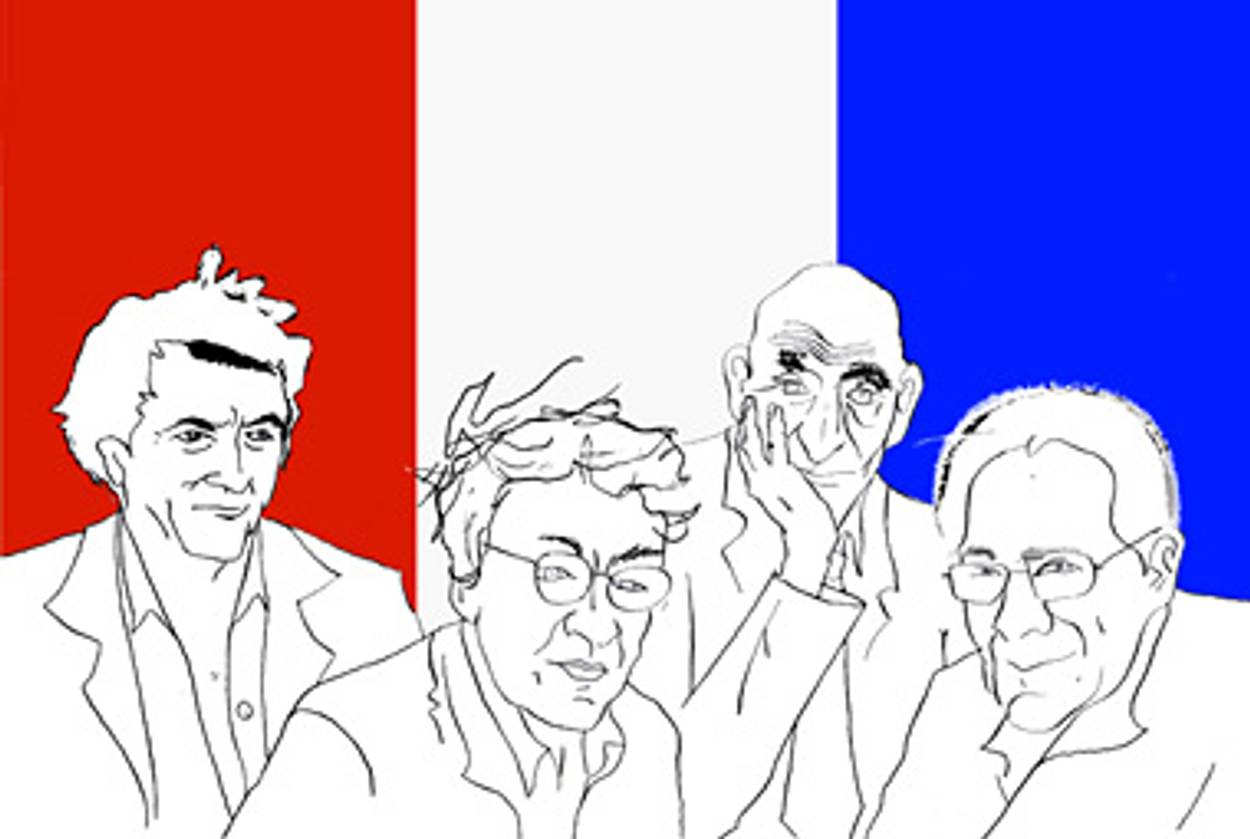
When L’Antisémitisme Partout, a purple-covered pamphlet, fell kicking and screaming from the printing press earlier this year, the French media took notice. The book’s authors, Eric Hazan and Alain Badiou, are prominent intellectuals. Hazan is an influential publisher, while Badiou, a philosopher, has become, since the deaths of Pierre Bourdieu and Claude Lévi-Strauss, an elder statesman among French intellectuals, a staid and gray-haired gentleman whose muted cardigan sweaters hardly reflect his fiery Marxist politics and penchant for outrageous formulations.
One of those provocations was in the title he and Hazan chose for their small book. In 60 pages, they argued that the only place anti-Semitism is partout, everywhere, in France is in the feverish imaginations of a coterie of mostly Jewish intellectuals ranging from Bernard-Henri Lévy to Alain Finkielkraut. The traditional anti-Semitism that pulsed through French politics and literature prior to World War II, they noted, was now little more than a “ghostly residue.”
As for the much-discussed rise in anti-Semitic activity among French Arab youths, Badiou and Hazan were equally dismissive. They allowed that since 2001 hate crimes aimed at French Jews have increased. Moreover, they acknowledged that the criminals were frequently beurs—the slang term for French youths of North African origin. But, the writers warned, the media, influenced by a loose association of Jewish intellectuals, have dramatically distorted the numbers and nature of these acts. This “opération de stigmatisation” aimed at young French Muslims, the authors argued, was at the heart of a massive public relations campaign led by these intellectuals. Whether the Arabs live in the decaying suburbs of Paris or the devastated villages of the West Bank, Badiou and Hazan claimed, they have all been transformed by these Jewish intellectuals into a single barbarian horde, against which the West is pitted.
The small book lit up the blogosphere and led to a widely watched televised debate in March among Badiou, Hazan, and Finkielkraut on the popular television show Ce Soir ou Jamais (Tonight or Never). Within minutes, however, it became clear that a calm and candid conversation was not to be. The participants quickly fell to finger-jabbing accusations and insults—all of it in impeccable French sprinkled with literary and philosophical references. It was as if Jerry Springer had choreographed a session of the Académie Française. While the guests did not leap for one another’s throats, the evening nevertheless ended as it started: with each side persuaded that the other simply refused to listen to reason.
It was a watershed moment. More than a century after French Jews, in the crucible of the Dreyfus Affair, had forged the concept of the public intellectual, which had inspired intellectuals all over the world and helped shape some of the 20th century’s most sweeping ideas, French Jewish thinkers, through their quibbling about Islam and Israel, were now destroying that very cultural tradition. If the intellectual, as a cultural figure, becomes an artifact of the past, intellectuals, many of them Jewish, will have only themselves to blame.
Providing the kindling that helped inflame the battle raging over L’Antisemitisme Partout are several slow but dramatic changes in the French political climate. Once a nation whose language was the lingua franca of diplomats and artists, whose cultural heritage and revolutionary history belonged to the world, France is now besieged by the economic and demographic forces of globalization. Particularly dramatic has been the growth of its Muslim population. While estimates of size vary from 5 to 6 million, France’s Muslim population is by far the largest within the European Union.
The sheer size of its Muslim population coupled with the erosion of its borders has made France’s national identity the subject of much debate. Oddly, it’s a debate in which Jews figure prominently. Speaking in 1789, Count Stanislas de Clermont-Tonnerre famously declared the after the French Revolution, “Jews should be granted everything as individuals and denied everything as a nation.” This led to an understanding of French republicanism as a tradition that safeguarded individual rights so long as citizens uphold its values and endorse its emblems. But where does the recent legislation prohibiting Muslim immigrants from wearing traditional religious garbs that cover the face, for example, fall under this logic? Should the republic punish those who refuse to adhere to its symbols? Or tolerate those who, in the name of freedom, reject some of the republic’s central tenets? These are huge questions; the answers may mold not only France but Europe as well, as every nation on the continent is currently struggling with similar conundrums.
These are not new questions. They’ve been asked, mainly by intellectuals, for a very long time, shaping what scholars call les guerres franco-françaises, the series of internecine political and ideological battles in France that first burst into flames in the late 18th century and whose embers glow even today. The war has pitted two ideological camps against one another: the forces of the Enlightenment, committed to the rational, secular and universal ideals of the French Revolution, versus those of the Counter-Enlightenment, wedded to an instinctual, religious, and particularist conception of France.
The Revolution made an offer to French Jews that they could hardly refuse: liberty, equality, and fraternity. In the eyes of many, it was as if God, in collaboration with the French Republic, had slipped them a world-historical trifecta. From scorned and shamed scapegoats, the Jews were transformed, literally overnight, into patriots blessed with all the rights and duties of citizenship. With the passage into law of Jewish emancipation in 1791, how could one not conclude that the coming of the Messiah and the coming of the Revolution were one and the same? France had become our Palestine, declared one Jewish witness, and France’s mountains now our Mount Zion.
But it was no less a defining moment for enemies of the Revolution, who emphasized an organic and historical conception of the nation against the prevailing rational and universal claims on the nation’s behalf. Perhaps inevitably, Jews found themselves in the middle of these furious claims and counterclaims over France’s true vocation. For the conservative thinker Maurice Barrès, the Jew and the intellectual, given their rationalist and cosmopolitan character, were equally alien—indeed, they were, in his phrase, “uprooted” and foreign to the “soil and dead” that constitute the true France. When other reactionary thinkers, like Charles Maurras, Louis Ferdinand Céline, and Robert Brasillach, attacked the Republic, they also attacked the place French Jewry had within it. While these intellectuals did not share the same political or aesthetic ideals, they all agreed that the Jew would always remain a Jew—the embodiment, in Maurras’ notorious phrase, of “l’anti-France”—and thus serve as the foil against which the true France could be defined.
These anti-Republican—and anti-Jewish—voices were gaining ground, but in 1927 republican intellectuals struck back. That year the French (and Jewish) intellectual Julien Benda published La Trahison des Clercs. The pamphlet, usually translated as The Betrayal of the Intellectuals, was a rappel à l’ordre for the band of intellectuals. A veteran of the Dreyfus Affair, Benda reminded his peers that truth is the one and only ideal of their vocation. Not the sloppy and sentimental truths of tenderhearted souls, but the austere and universal truths of scientists.
Benda insisted he was not a moralist but instead a rationalist for whom the accusations leveled against Dreyfus were toxic not because they endangered a Jew but because they endangered truth. Zola had already trumpeted this credo in J’Accuse, the article that turned une affaire into l’Affaire. The anti-Semitism that helped send Dreyfus to Devil’s Island scarcely crops up in Zola’s accusation; at most it is a sideshow to the sorry affair. What is at center stage, instead, is the assault on truth. But with the confidence of a rationalist rather than the fervor of a moralist, Zola declares that “truth is on the march, and nothing will stop it.”
Continue reading: Vichy and its legacy. Or view as a single page.
Thirty years later, Benda worried that his fellow intellectuals, wittingly or not, had undermined their noble mandate with all too worldly ideological attachments to socialism or nationalism. One could not be both a true intellectual, argued Benda, and what Sartre would eventually identify as an engaged intellectual. The “clerics” of his day willingly “abased the values of knowledge before the values of action.” Of course one could be engaged—in fact, at times, as during the Dreyfus Affair, one had to be engaged. Yet, Benda claimed, such instances of political engagement had to follow rather than precede the disinterested and dispassionate analysis of a particular question or policy. The conflation of these approaches was catastrophic, shaping an age, Benda decried, distinguished by “the intellectual organization of political hatreds.”
Thus, the concept of the public intellectual—committed and engaged—was born. But Benda himself would not live up to his own principles for long: One war later, he was unable to resist the siren call of worldly ideologies, becoming a fellow traveler of the Communist Party and apologist for the crimes of Stalin’s Soviet Union. From the defender of Zola’s legacy, Benda had become a participant in Moscow’s show trials. This betrayal suggests the ease with which intellectuals blurred or simply ignored the line between Truth and truth. Too often, the historian Tony Judt observed, the French intelligentsia acted in history rather than in the light of history and acted out of a sense of conviction rather than a sense of responsibility. It’s a tradition that continues still.
During the early days of Vichy, the official in charge of Jewish Affairs, Xavier Vallat, lectured an SS officer who had questioned his anti-Semitic credentials. “I have been an anti-Semite longer than you,” he blurted. “What’s more, I am old enough to be your father!” Vallat, who oversaw the implementation of Vichy’s anti-Semitic legislation and aryanization of Jewish property, was right on both scores: He was already reading Maurras when his interlocutor was still in diapers.
Yet this dismal story points to a French paradox: The same country that gave us the likes of Vallat also gave us Léon Blum, the leader of the Socialist Party who became prime minister in 1936, leading Vallat to mourn that his “old Gallo-Roman country will be governed by a Jew.” And Blum was not alone; nearly a half-dozen Jewish prime ministers have governed France in modern times, from Blum to René Mayer, Pierre Mendès-France, Michel Debré, and Laurent Fabius.
But this Jewish prominence carried a high price: Their alliance with the Republic thrust the Jews, as the historian Pierre Birnbaum noted, “into the very heart of the guerres franco-françaises.” The more assimilated they became, the more prominent in the realms of politics and culture, the more central Jews became to the conspiratorial fantasies and rhetoric of anti-Semites.
Had it not been for France’s defeat by Nazi Germany in 1940 and the creation of the authoritarian French State—better known as Vichy and hailed by Maurras as a “divine surprise”—anti-Semitism may well have remained a respectable ideology in France. The anti-Semitic legislation imposed by Marshal Pétain’s regime in 1940 and 1941—without the slightest of nudges from the Nazis—raised few eyebrows in occupied France. Most of the nation, of course, was still reeling from defeat and occupation and scrambling to meet their material needs. Yet the “vivid French tradition of anti-Semitism,” in the words of historians Michael Marrus and Robert Paxton, had seeped into the political mainstream and greatly eased Vichy’s task. During the rafles, or round-ups, of the summer of 1942, French gendarmes, under the aegis of Vichy authorities, gathered more than 27,000 Jews, nearly all of whom were deported to Auschwitz. In August alone, 4,000 Jewish children, taken from their parents, were shipped east from Drancy, a grim suburb of Paris, on French trains run by French engineers and guarded by French gendarmes. By the time the Allies liberated France two years later, nearly 75,000 Jews, both foreign and native-born, had been delivered to Auschwitz; about 2,500 survived. What didn’t survive, though, was the understanding French Jews, in particular intellectuals, had of their place in the nation.
A quarter of a century ago, the French historian Henry Rousso hauled France into a therapist’s office, pulled out his notepad, and began to ask very personal questions. The result was The Vichy Syndrome, a book that, like Robert Paxton’s Vichy France, was not only a dazzling work of history but also a historical event in its own right. Both books grabbed France by its collective collar and demanded that it return to and reconsider its recent past.
According to Rousso’s diagnosis, this particular syndrome surged into French culture and politics in the early 1970s. Until then, France had known a kind of collective amnesia concerning the four years under Vichy and the Germans—a forgetfulness encouraged by Charles de Gaulle, who had, for reasons of postwar unity, peddled the image of a France with 40 million résistants. This portrayal was as fictitious as the earlier image of a France with 40 million pétainists, but never mind: It was precisely what the French, emerging from the shock of the occupation, needed.
The student rebellion of 1968 first breached the wall of silence that had been built around Vichy. It also launched the careers of the so-called “nouveaux philosophes.” Many of these young firebrands, ranging from Finkielkraut and Bernard-Henri Lévy to André Glucksmann and Pascal Bruckner, were Jewish. They eagerly pummeled figures of paternal authority—Sartre was no more spared than de Gaulle—and ridiculed the myths they had inherited, be it the “singing tomorrows” of communism or the glowing yesterdays of Gaullism. Ultimately, the only thing truly new about these philosophers was their use of the electronic media: The shine of Lévy’s mane of hair became better known in France than the substance of his thought.
This was hardly surprising, as the contents of Lévy’s shampoo were far richer than the contents of his writing. In particular, his book The French Ideology, which spied a specifically French brand of totalitarianism under every nook and cranny in French history, was especially silly. Yet all of this was irrelevant. What did count, in Rousso’s phrase, was the shattering of the mirror in which France had looked at itself for more than 20 years. Walking gingerly among the shards, French Jewry, in particular, began to piece together a new self-image. This work of reassessment had, in fact, already begun in 1967, with the Six-Day War. The existential threat posed to Israel in that war, followed by its stunning victory, galvanized a community that had always insisted on its thorough Frenchness. There then followed the one-two blow delivered by Charles de Gaulle: his decision to impose a military embargo on the entire Middle East, followed by his public reflection that the Jews were an “elite people, sure of themselves and domineering.” In retrospect, the general’s remark seems less a provocation than an observation many Jews have themselves made. Moreover, de Gaulle’s warning to David Ben Gurion on the eve of the Six-Day War—“You will create a Palestinian nationalism, and you will never get rid of it”—proved tragically prescient.
But this is now, while then was then. Even Raymond Aron, the era’s most perceptive and least impulsive thinker, was shocked by de Gaulle’s observation. Among the first Frenchmen to rally to de Gaulle’s call to join him in London in 1940, Aron knew anti-Semitism was utterly alien to the general’s worldview. Nevertheless, as Aron recalled in his memoirs, when he heard de Gaulle’s remark, “a burst of Jewishness exploded within my French consciousness.” Until his death in 1983, Aron wrestled with this tension; for a time he considered naming his memoirs Souvenirs d’un Juif Français. Ultimately, Aron fell back on Mémoires, a simple title that barely disguised his complex and unresolved inner conflict.
Continue reading: No adults left in the room. Or view as a single page.
Nevertheless, in 1967, Aron sensed that French anti-Semitism, dormant since 1944, had been reawakened. De Gaulle’s remarks, Aron declared, “open a new chapter in Jewish history and perhaps anti-Semitism. Everything is now possible. … Of course there is no question of persecution or scorn, but instead of distrust and careful observation.” A long rumba line of historical and cultural events then began to jiggle across France, swaying in time to Aron’s words. In 1969, there appeared Marcel Ophüls’ documentary film The Sorrow and the Pity, which chronicled the ambient anti-Semitism of France under the Germans and Vichy; in 1971, President Georges Pompidou pardoned Paul Touvier, a member of the notorious Milice, the fascist militia created by Vichy, who had been found guilty of murdering resistance fighters and French Jews; in 1973, Paxton’s seminal history Vichy France appeared in France, revealing that it was not the Nazis but French authorities who willed into existence the regime’s anti-Semitic policies. Distrust and careful observation were the orders of the day.
By the 1980s France was frantically bailing out the ship of state as the bilge from its recent past kept leaking into its present. French Jews, in particular, watched with growing unease as one leak after another burst through the straining hull. The arrests and trials of the Vichy officials René Bousquet and Maurice Papon, the extradition and trial of Klaus Barbie, the notoriety of negationist writers like Robert Faurisson and rise of the anti-Semitic demagogue Jean-Marie Le Pen all formed a vortex from which issued, in Rousso’s phrase, “the rebirth of Jewish memory.”
But whose Jewish memory would that be? It was with the publication of his essay Le Juif Imaginaire in 1980 that Alain Finkielkraut captured the dilemma of Jewish identity in postwar France with the same acuity, if not the same feverishness, that Philip Roth did for American Jewry with Portnoy’s Complaint. Finkielkraut’s discovery was as simple as it was sobering: French Jews could no more be Jewish by going through the rituals of traditional Judaism, much less identifying with the appalling fate of their parents’ generation, than an American tourist could become truly French by sitting at the Café Flore, smoking a Gauloise and listening to Juliette Greco. The Final Solution, Finkielkraut seemed to suggest, had created an unbridgeable chasm between the Yiddishkeit that flourished in Europe prior to Hitler and the ashes that were left for Finkielkraut’s own postwar generation. Put simply, it was impossible for French Jews to really be Jewish.
Yet, Finkielkraut confessed, none of this had stopped him from pretending to be a Jew. Born into a secular Jewish family in 1949, Finkielkraut received “the most beautiful gift a post-genocide child could be given”—namely, a prêt-à-porter tragedy, Auschwitz, he had never experienced, but in which he could claim the starring role. This entirely unearned role not only gave him enormous social capital, but it also kept him “away from Jewish culture more than social pressure or any obligation to assimilate.” What need did he and his peers have to study or practice Judaism, or indeed know the first thing about it? History had given them a free ride, but one that transformed them into Luftmenschen, or impractical intellectuals, subjected to a kind of cultural weightlessness.
If history comes the first time as tragedy and the second time as farce, the third time is as a reality show. The young Finkielkraut, with his great mass of hair tumbling over arched and bushy eyebrows, launched himself onto the stage of self-dramatization. First came the revolt of 1968, when he acted out the traditional rites of revolution with his fellow students on the streets of Paris. When Danny “the Red” Cohn-Bendit was prevented from re-entering France in May of that year, Finkielkraut was among the thousands shouting in unison, “We are all German Jews,” a reference to the authorities’ refusal to admit Cohn-Bendit claiming he was a German national and a rabble-rouser. Finkielkraut felt uneasy, but not over the outrageous comparison; instead, he was annoyed that the goyim were trespassing on his personal territory. Who was the real Jew here, anyway, he wondered? Were we all truly German Jews? The answer then hit him: None of us was. “Get out of here,” he told himself: “We were all imaginary Jews.”
That Finkielkraut has been the most vocal and eloquent critic of Badiou and Hazan’s book is as predictable as it is ironic. In the three decades that separate the success of Le Juif Imaginaire from the debate over L’Antisémitisme Partout, Finkielkraut has, in a series of combative and perceptive books, viewed politics and culture through the prism of Jewish concerns. In The Future of a Negation to Remembering in Vain, The Defeat of the Mind, and In the Name of Humanity, he has weighed in on the historical confusion created by Holocaust denial and revisionism, the moral confusion engendered by the trials of Maurice Papon and Klaus Barbie for crimes against humanity, and the cultural and political fog created by the Western world’s policies of multiculturalism.
But Finkielkraut, L’Antisémitisme Partout argued, was guilty of doing to the Muslims what has once been done to the Jews, transforming the mostly Muslim youths of France’s blighted and blasted suburbs into an irreducibly foreign element in France, portraying them as a violent rabble who, when not whistling derisively during renditions of the Marseillaise, spend their time terrorizing French Jews. Hazan and Badiou argued that to call 2002, a year that saw a spike in hate crimes, “the year of crystal,” as Finkielkraut bluntly put it, alluding to Kristallnacht, is much more than bad history: It is a form of hate crime directed at an entire people.
Badiou and Hazan did not for a minute deny the existence of hate crimes—“we do not take any such act lightly,” they wrote—but they observed nonetheless that certain cases were exaggerated by the media. They insisted that anti-Semites—the sort who were commonplace in France from the Dreyfus Affair to Vichy—are a nearly extinct species, “a mere handful of fanatics.” The phenomenon now rising from the decaying tenements that ring France’s cities, they argued, had less to do with anti-Semitism and more to do with suspicion and hostility aimed at Israel. Seeing their own predicament in that of their fellow Arabs in the West Bank and Gaza, France’s beurs, Hazan and Badiou wrote, “conflate Israel’s anti-Palestinian repression and a misleading impression of French Jews.” This sentiment, they claimed, represents a “politique mal politisée”—in other words, using awkward or violent gestures to give voice to legitimate grievances and expressing a justified impatience with the Republic’s failure to live up to its values. Those who, like Finkielkraut, criticized the beurs, Hazan and Badiou stated, were the “new inquisitors” who used the memory of anti-Semitism in France to deflect any and all legitimate criticism of Israel’s policies in the occupied territories.
Finkielkraut is hardly new to such attacks. Since 2002, he has been engaged in a series of verbal clashes on the subject of the entwined destinies of the Republic and its Jewish and Muslim communities. The tension between the two communities has led Finkielkraut to make some unequivocal statements, such as calling wearing the Islamic veil a “terrorist act.” In 2007, two of Finkielkraut’s most reasonable interlocutors, the historian Michel Winock and the philosopher Paul Thibaud (who also happens to be a former president of Amitié Judéo-Chrétienne de France, a prominent interfaith association of Christians and Jews), went on Finkielkraut’s radio show to try and save their host from himself. It was for naught: When Winock observed that Finkielkraut’s remarks left him with the “impression that all of France was submerged by anti-Semitic sentiment,” Finkielkraut had no better reply than, “It’s in the air.” In turn, Thibaud insisted the question of anti-Semitism “must be placed between parentheses so as to distinguish it from the question of Israel’s policies.” It was a well-meaning but hollow wish: Parentheses clearly make for a weak levee against the great swells of emotion that have marked this affair. Just as they had once fought against the ways they themselves were perceived, many Jewish French intellectuals are now self-appointed defenders of the Republic against what they perceive as a dangerous foreign element, Islam and its adherents.
Just three years after the publication of Finkielkraut’s Le Juif Imaginaire, that most conflicted of French Jews, Raymond Aron, testified in court on behalf of Bertrand de Jouvenel. The elderly political theorist was suing the Israeli historian Ze’ev Sternhell for libel: In his book Ni droite, ni gauche, Sternhell had accused Jouvenel of “fascist” sympathies during the 1930s and the Occupation. In his testimony, Aron emphasized Jouvenel’s “bonne volonté,” or good will. But he also warned against simplifying the events of 1940 to 1944. He reminded the court that in the wake of France’s defeat, even men of good will were mistaken about Vichy. His own decision to go to London, he observed, was largely due to the accident of being born Jewish. As Aron stepped out the courthouse, he collapsed on the stairs and died, the victim of a heart attack.
With Aron’s death, France lost one of its few remaining adults in the rumpus room of intellectuals. It is precisely his kind of voice that is missing from the current debate over the place of Muslims and Jews in republican France. This is a pity: Despite their frequent moments of solipsism and silliness, fecklessness and flimflam, French intellectuals nevertheless represent an extraordinary tradition in French history. Twenty years ago, Tony Judt announced that the intellectual as hero was a “dying genre.” If the intellectual, as a breed, isn’t dead already, it may well be that this latest ruckus will finish him. It remains to be seen what this means for the future of the entity with which the intellectual has so closely been associated: the Republic.
Robert Zaretsky is professor of history in the Honors College at the University of Houston and the author, most recently, of Albert Camus: Elements of a Life.