In the fall of 2002, Nathan Lewin, a Washington litigator and one of the country’s leading advocates for Jewish causes, needed a plaintiff. Congress had just passed a foreign-aid bill requiring the government to permit American citizens born in Jerusalem to record their place of birth on their passports as “Israel”—a change from longstanding policy that recorded only the city name. Though he signed it, President George W. Bush issued a signing statement asserting that he would take the passport clause as merely advisory, and would therefore ignore it, because Congress has no authority to make foreign policy. For Lewin, it was an irresistible invitation. “We wanted to have our one test case,” he told me last week. “We wanted just one plaintiff who met the standard of a lawsuit.”
Luckily, Lewin’s new law partner—his daughter, Alyza, with whom he had founded an independent practice, Lewin & Lewin, a few months earlier—knew the perfect candidate. Her childhood friend Naomi Siegman, a pediatrician, was living in Jerusalem with her husband, Ari Zivotofsky. And in October 2002, a month after Bush signed the new law, their youngest son, Menachem, was born at Shaare Zedek, the oldest Jewish hospital in Jerusalem. “I’ve known Naomi my whole life,” Alyza Lewin said. “So, when she had the baby, I called her and said, ‘Go ask.’ And that’s how we got our test baby.”
On Monday, the boy, now 9 years old and only beginning to understand that his name is attached to a potentially landmark case, will be in Washington to watch Nathan Lewin argue on his behalf before the U.S. Supreme Court. It will be Lewin’s 28th appearance before the justices in the 50 years since he was admitted to the bar—a career in which he’s successfully argued for everything from the government’s use of informants in its case against Jimmy Hoffa to Chabad’s right to put up a menorah in front of Pittsburgh’s City Hall. “Nat is an absolutely off-the-charts brilliant lawyer,” said Alan Dershowitz, who has been friends with Lewin since the early 1960s, when both were young attorneys in Washington—Dershowitz as a clerk for Judge David Bazelon, chief of the U.S. Court of Appeals in the District of Columbia, and Lewin as a young hotshot in the Department of Justice.
In the four decades since he left the government, Lewin, an Orthodox Jew, has had some hotshot clients. In the 1980s, he gained notice as a lawyer for the actress Jodie Foster when she was called to testify against her stalker, John Hinckley Jr., after his assassination attempt against President Ronald Reagan. Later, Lewin represented Edwin Meese, Reagan’s attorney general, and kept him out of court in the wake of the Iran-Contra affair.
But it is Lewin’s work for Jewish causes that will likely be his lasting legacy. His first client in private practice was a Holocaust survivor who was concerned about jeopardizing his U.S. citizenship if he were drafted into military service while visiting Israel; Lewin subsequently defended members of the Kahanist Jewish Defense League. In recent years he has argued for the right of the Satmar Hasidim to have their own public school district in the Catskills enclave of Kiryas Joel, and he has represented Sholom Rubashkin, the former official of Agriprocessors, the now-shuttered Postville, Iowa, kosher meatpacking plant, in appealing the 27-year sentence he is serving for fraud.
Even friends like Dershowitz question whether all of Lewin’s Jewish cases have been good for the Jews. “The difference between us is that he spends most of his time representing the Orthodox community,” Dershowitz told me. “So, we have differences on issues like the menorah, or aid to schools, and we both have our opinions on what is best for the Jewish community, as a whole.” But on the Zivotofsky case, Dershowitz said, “we totally agree.” A review of the amicus briefs submitted in Zivotofsky v. Clinton, including one filed by a broad coalition that includes B’nai B’rith, the Anti-Defamation League, the Jewish Council for Public Affairs, the American Israel Public Affairs Committee, and all three branches of Judaism, suggests that the preponderance of the organized American Jewish community is also on Lewin’s side.
Yet from Lewin’s perspective, the Israel aspect is the least interesting thing about the case. “This case is much more limited in a Jewish context,” he told me. “But it’s much broader in the separation of powers context.” The court’s decision will only apply to the 50,000 or so U.S. passport holders born in Jerusalem since 1948. But the precedent it sets will determine whether Congress has the authority to pass laws concerning foreign affairs that have binding power over the president.
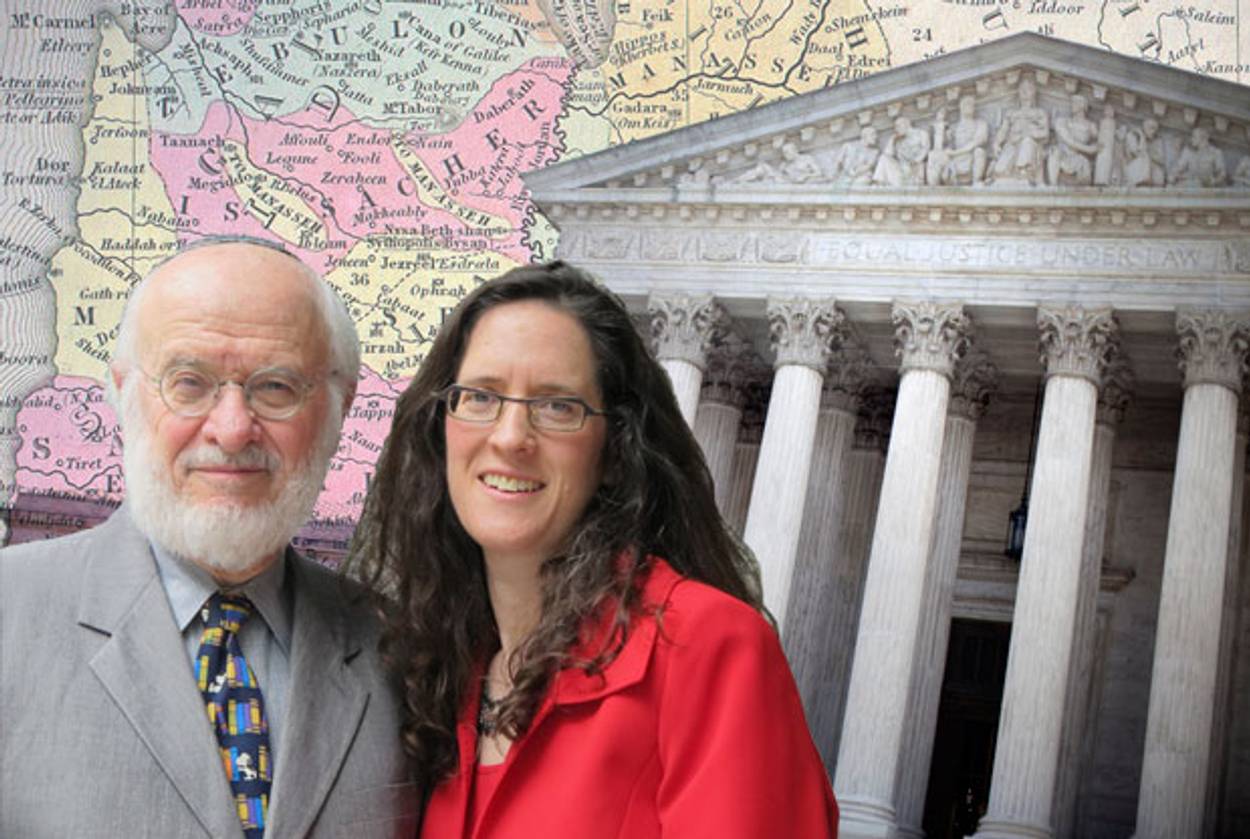
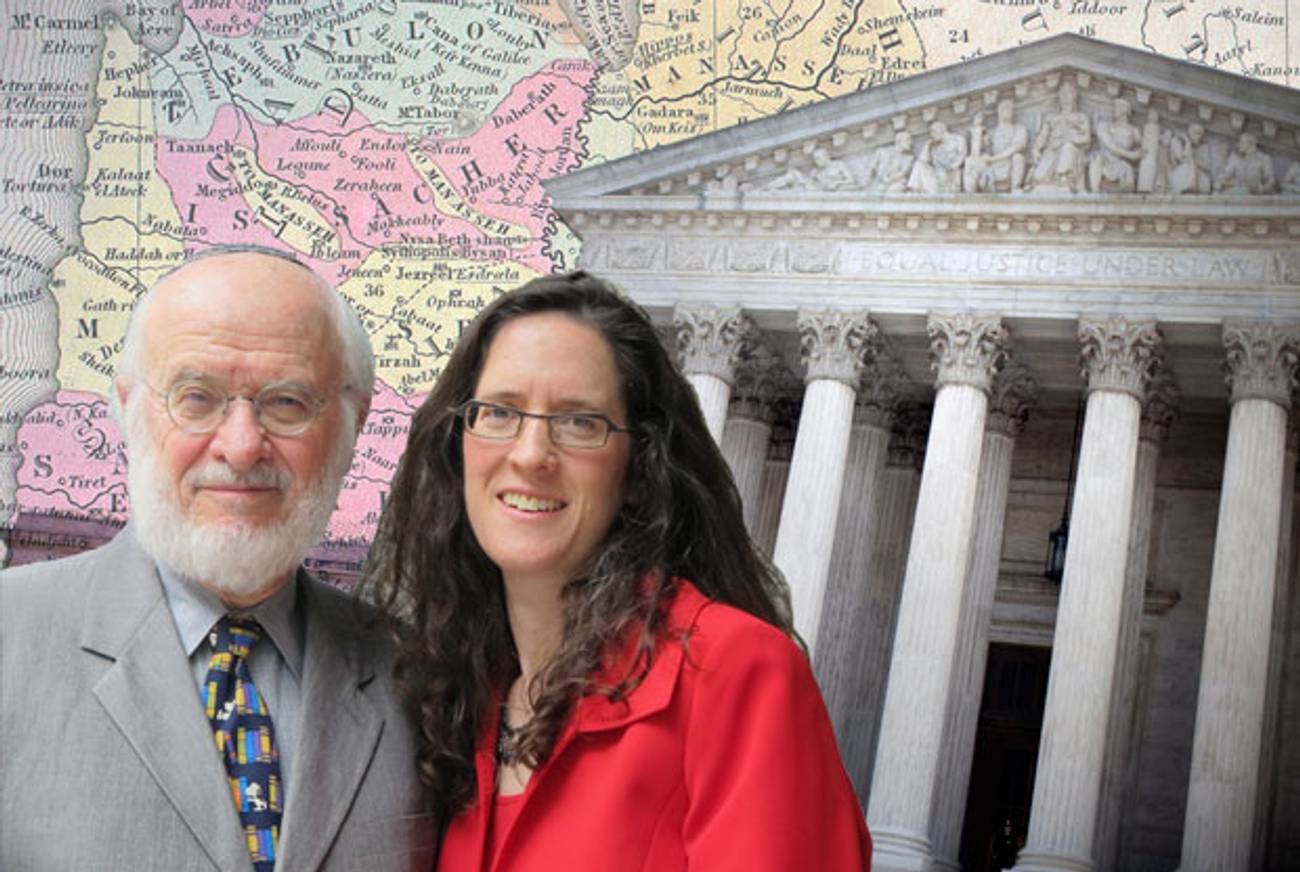
At 75, Lewin has a gravelly voice, a close-cropped white beard and, behind round glasses, the twinkly eyes of a favorite uncle. He talks with his hands, often tapping the table in front of him for effect, and favors a green knit kippah and whimsical ties—Snoopy sometimes, graphic flowers the day we met at Lewin & Lewin’s modest offices in downtown Washington. The conference room there is haphazardly decorated with framed courtroom sketches, black-and-white Adrian Bonfils photographs of Jerusalem from the late 1800s, and an antique Amsterdam map labeled “Iudea et Terra Sancta.” Another wall holds a version of the Lawyer’s Prayer, in Hebrew and English, with a citation from Deuteronomy: “Justice and only justice thou shalt pursue.”
Originally, Lewin expected a relatively quiet pursuit. “If you’d asked me when I was at Harvard Law School would I be a criminal defense lawyer,” Lewin said, “I’d have said you were crazy.” Born in Lodz, Poland, in 1936, he fled east with his parents and arrived in the United States via Japan. In New York, he enrolled at Yeshiva University High School, where he was valedictorian. Lewin went on to earn an undergraduate degree at Yeshiva before heading to Harvard Law, where he graduated alongside Supreme Court Justice Antonin Scalia, former Sen. Paul Sarbanes of Maryland, and former Massachusetts Gov. Michael Dukakis—the last Democratic presidential nominee Lewin is sure he voted for, though he remains a registered Democrat. “It was the least I could do for a classmate,” he explained. Scalia, he added, is a personal friend from their days on the Law Review, but the justice doesn’t do any favors for former classmates appearing before his bench. “In fact,” Lewin said, “in the first case in the District of Columbia District Court in which I drew him, he not only rejected my argument, but went out of his way to mention another argument I could have used, and explained why he would have rejected that, too.”
After Harvard, Lewin clerked on the Supreme Court, for Justice John Harlan. He initially promised his wife, Rikki, they could return to New York after his clerkship was over, but instead Lewin went to work for the Justice Department, under Robert Kennedy, and Rikki Lewin eventually became a photo editor at the Washington Jewish Week. Lewin fell in love with the courtroom while he worked on the government’s case against union leader Jimmy Hoffa, and after Hoffa’s first trial ended in Tennessee, Lewin went to work in the Solicitor General’s office, which represents the government before the Supreme Court, under Archibald Cox and, later, Thurgood Marshall. Lewin’s first argument before the Supreme Court was a tax case; he won it but describes it as “a nightmare.” By 1966, he had learned enough to successfully present the government’s argument for using informants to make its case against Hoffa—one of the most-watched cases of the era.
When we met, the case Lewin was most interested in discussing wasn’t the looming Zivotofsky proceeding, but his decade-old fight to win compensation for victims of terrorism from U.S.-based charities found to provide financial support to terrorist groups. The case was filed on behalf of Stanley and Joyce Boim, Americans whose son, David, was killed at a West Bank bus stop in 1996 by Hamas terrorists. The timing turned out to be propitious. “Our first argument was scheduled for Sept. 24, 2001, in Chicago,” Lewin recounted. “And it became apparent after September 11th that this would not just be a case about the Boims and Palestinian-backed terrorism.” Lewin eventually won a $156 million judgment against the Quranic Literacy Institute and the American Muslim Society on the grounds that they had, through a third group, helped underwrite Hamas terrorism.
“I don’t think there’s any Jewish issue that doesn’t have my father’s fingerprints on it,” Alyza Lewin told me. She sat next to her father, their similarities showing in their mannerisms—talking in quick, confident bursts, leaning forward to make points—more than their looks: Alyza is lanky where her father is burly; she wore sensible Washington pearls and a gray pantsuit rather than echoing her father’s fondness for colorful shirts. A mother of four in her mid-forties, Alyza Lewin went to Princeton and then NYU Law School and then worked at the white-shoe firm Wilmer Hale in Washington before joining her father in practice, first at his former firm, Miller Cassidy Larroca and Lewin, and then in their new enterprise. (Her younger sister, Na’ama, followed their mother into photography.) “I grew up hearing my father talk about the cases he had, and people told me I had a warped view of the legal profession, because my father had a disproportionate number of interesting cases,” she said. “So, it was important to me to establish myself as a lawyer in my own right.”
Nathan Lewin described Alyza as his managing partner—“a master at dealing with clients, negotiating settlements”—whereas his role is to be the courtroom pugilist. (To demonstrate, he punched the empty air in front of him.) Their relationship is obviously close, and their father-daughter shtick is well-practiced: When Nathan Lewin recounted his daughter’s announcement that she’d followed his advice to take college courses she was interested in by signing up for a bartending course, she rolled her eyes and exclaimed, “There was no class in bartending!” It was, she said, a workshop offered by an eating club, which she took in order to graduate from ordering virgin piña coladas to more sophisticated drinks on dates. As she explained, her father grinned.
Alyza Lewin said that when she told her friends she planned to go into practice with her father, they warned her that he would second-guess her work. She said, a little ruefully, that he’d been reviewing her papers since she was in high school. She is clearly proud to work in his shadow, specifically mentioning her father’s work as AIPAC’s counsel during the government’s investigation of Steve Rosen, the group’s former foreign-policy director, who was indicted in 2005 on charges of violating the Espionage Act. (The charges were dropped in 2009.) “He is the go-to in Washington,” Alyza Lewin said. “He had to advise AIPAC to let these employees go for conduct, without telling them why, and there is no other lawyer in the Jewish community who has that standing.” AIPAC’s general counsel, Phil Friedman, concurred, saying in an emailed statement: “Nat Lewin is a person of integrity with a deep knowledge of the law and an exceptional sense of fairness and decency.”
“My goal,” Alyza Lewin explained, “was to create a vehicle for my father to practice law the way he wants to.” Her father quickly interjected, “We complement each other, not just with an ‘I’ but with an ‘E.’ ”
Allison Hoffman is a senior editor at Tablet Magazine. Her Twitter feed is @allisont_dc.