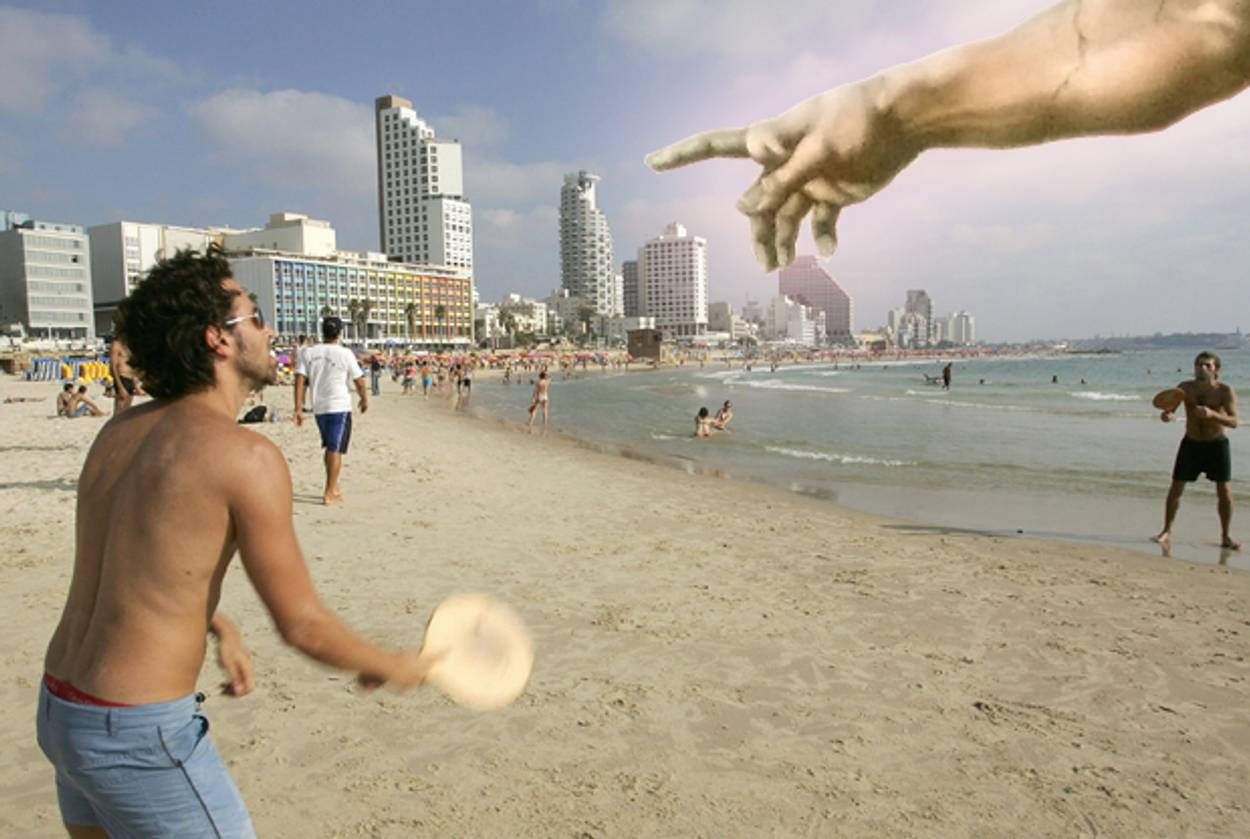
The Jewish people, it turns out, are on very good terms with God. Eighty percent of Jewish Israelis say they are believers, and 70 percent agree with the proposition that Jews are the Chosen People, according to a survey released in Israel last week.
Conducted by the Israel Democracy Institute’s Guttman Center for Surveys and the Avi Chai Foundation, the survey, which analyzed the responses of 2,800 Israelis, confirmed the truths I held to be self-evident when I grew up in Israel not too long ago. (Avi Chai is affiliated with the Keren Keshet Foundation, which created Nextbook Inc., Tablet Magazine’s publisher.) Back then—after the arrival of McDonald’s but before the second Intifada—it felt like a given that if you were Jewish you most likely had some sort of relationship with God, regardless of your level of observance. Except for a few pesky atheists, my friends and I all defined ourselves as secular even as we fasted on Yom Kippur, took much pleasure in the way the streets cleared up on Friday afternoons, and directed our prayers—about girls we wished would notice us or older brothers we wished would make it home safely from the front—to God.
Not much has changed, according to this new survey. Yet when the findings were released, many of my colleagues on the Israeli left took to the op-ed pages to register their shock and lament the demise of modern Israel. The survey, went the common cri de coeur, was a sure sign of the impending apocalypse, which would finally turn the Jewish state into an intolerant theocracy.
Writing in Haaretz, journalist Uri Misgav argued that the findings reflected a “depressing ideological situation.” The disturbing thing “about those who believe in the theory of the Chosen People,” he wrote, “is the fear that they are not particularly smart,” perceiving the world on “an infantile theological level” that surely should have been vanquished by reason and modernity.
In the same paper, columnist Gideon Levy sounded even grimmer. “You have to give it to the pollsters,” he wrote. “They let the cat out of the bag. … Israeli society isn’t secular, it isn’t liberal, and it isn’t enlightened.”
It’s easy for me to understand Misgav and Levy. Like them, I consider myself a proud member of the battered and decimated tribe known as the Israeli left. Like them, I look with horror as brutes of all stripes—from hill-dwelling Jewish terrorists to Avigdor Lieberman and his comrades in Knesset—trample democracy’s core values. But in their disdain for and fear of religion, Misgav, Levy, and the lion’s share of the Israeli left fail to understand not only their past but also, more troubling, their future. Unless the Israeli left learns how to stop fearing and start loving—or at least understanding—religion, its chances of advancing a popular agenda are slim.
It’s tempting for secular, educated adults to see religion as the flickering remnant of a primitive fire that once guided mankind—a fire no longer necessary now that we have the quiet heat of science, technology, and rational thought. And it’s easy to look at an idea like divine election as nothing more than pure chauvinism. I used to entertain these notions. But two years ago, together with my friend and teacher Todd Gitlin, I decided to grapple with these ideas by writing a book.
What I learned startled me. Far from a simple call to exceptionalism, chosenness is a devilishly complex idea. At the height of the biblical drama, at the moment a collection of disparate tribes are made into a solid nation, God appears to the Israelites at Mount Sinai and bequeaths to them their status as his chosen sons and daughters. “And ye shall be unto me a kingdom of priests,” God says, “and a holy nation.” Why the Israelites? What does it mean to be chosen? Are the children of the chosen also chosen in perpetuity? God never tells.
The result is a never-ending quest, over the course of millennia, to solve this divine riddle. To have been chosen means spending a lifetime wondering about what it means to have been chosen. Some possible answers to this question align neatly with the Israeli left’s worst fears: Much of the settler movement is powered by an understanding of chosenness as a divine mandate to occupy land, even when others are living on it.
But there are other approaches to chosenness, which see it not as a prize but as unique burden—a challenge to prove worthy of our historical designation. It is this approach, I believe, that uniquely obligates the Jewish people to protect the meek, feed the hungry, and defend the innocent. Rather than give this interpretation of chosenness serious consideration, however, the Israeli left dismisses it as irrelevant. That dismissal is a particular tragedy for left-wing Zionists, since the question of chosenness is the central issue of Zionism.
While the overwhelming majority of Israelis identify themselves as Zionists, most lack a nuanced understanding of the movement’s history and nature. Had Zionism been just another 19th-century nationalist movement, it would have been relegated to the museums and the archives once it had achieved its goal of establishing the Jewish state. After all, a century and a half after Italy’s unification, no Italian would think of defining herself as a Garibaldist. That Israelis still fly Zionism’s flag suggests that the movement is not simply nationalistic.
Having survived for millennia as other nations crumbled, assimilated, or were vanquished, the Jewish people owe much of their resilience to the belief in the idea of chosenness and its earthly manifestation, the return to the promised land. But modernity posed a challenge greater than any before. The Emancipation offered Jews a devastating release from the weight of history: Trade in eternity for today, it cooed. Give up your dreams of redemption for citizenship and the right to vote. It was a deal many Jews were only too glad to take. And yet even as they assimilated, the Jewish faith—and the Jewish people’s yearning for the land of Israel—persisted. And so when Zionism came along, it was the perfect vessel for these unshakable sentiments.
To its adherents and opponents alike, Zionism insisted it was strictly a political movement charged with founding a Jewish homeland and freeing the Jewish people from generations of subservience and persecution. The truth was that a different spirit animated it from the start. In a candid conversation with an early biographer, Theodor Herzl, Zionism’s father, confessed a dream he’d had as 12-year-old boy—a dream, Herzl said, that had sparked his interest in what would become his life’s work. “The Messiah took me in his arms and carried me off on wings of heaven. On one of the iridescent clouds we met Moses. … The Messiah called out to Moses, ‘For this child I have prayed!’ To me he said, ‘Go and announce to the Jews that I shall soon come and perform great and wondrous deeds for my people and all mankind.’ ” The dream terrified Herzl, and he never spoke of it until shortly before his death.
But the truth was that the feeling behind Herzl’s religious-tinged dream was one many of Zionism’s early luminaries shared. The state’s first president, secular scientist Chaim Weizmann, for example, recalled in his memoirs that the Balfour Declaration sounded to him like “the steps of the Messiah.” Such religious fervor, whether conscious or not, united radical Marxists and stern Halachists in common cause. Zionism’s core thrust was a return to Zion—but that notion is impossible to understand outside of its biblical context. Whatever its political interests and accomplishments, Zionism was never satisfied with mere earthly affairs. It still isn’t.
In denying Zionism its religious essence, the Israeli left is proving to be inept not only at understanding the past but also at planning for the future. Increasingly, it is governed by a humanist ethos that sees the occupation and the horrific acts committed to preserve it as an affront to universalist values. But there is a very strong argument to be made that the occupation is also an absolute violation of Judaism’s core tenets, and it’s an argument that those 70 percent of Israelis who believe in chosenness should hear. The problem is that there’s no one to make it; for the Israeli left, religion is anathema.
It’s a shame. When the U.S. civil rights movement fought against seemingly insurmountable odds, it was wise enough to allow universalists like Bayard Rustin and Christians like Ralph Abernathy to coexist and saw no contradiction between speaking the language of reason and the language of faith. If the Israeli left is ever again to become a significant shaper of Israel’s course, it should be thrilled with the recent survey. Seventy percent of Israelis already believe that they were chosen by God. All they need now is someone to tell them what it is that they might have been chosen for.
Liel Leibovitz is a senior writer for Tablet Magazine and a host of the Unorthodox podcast.