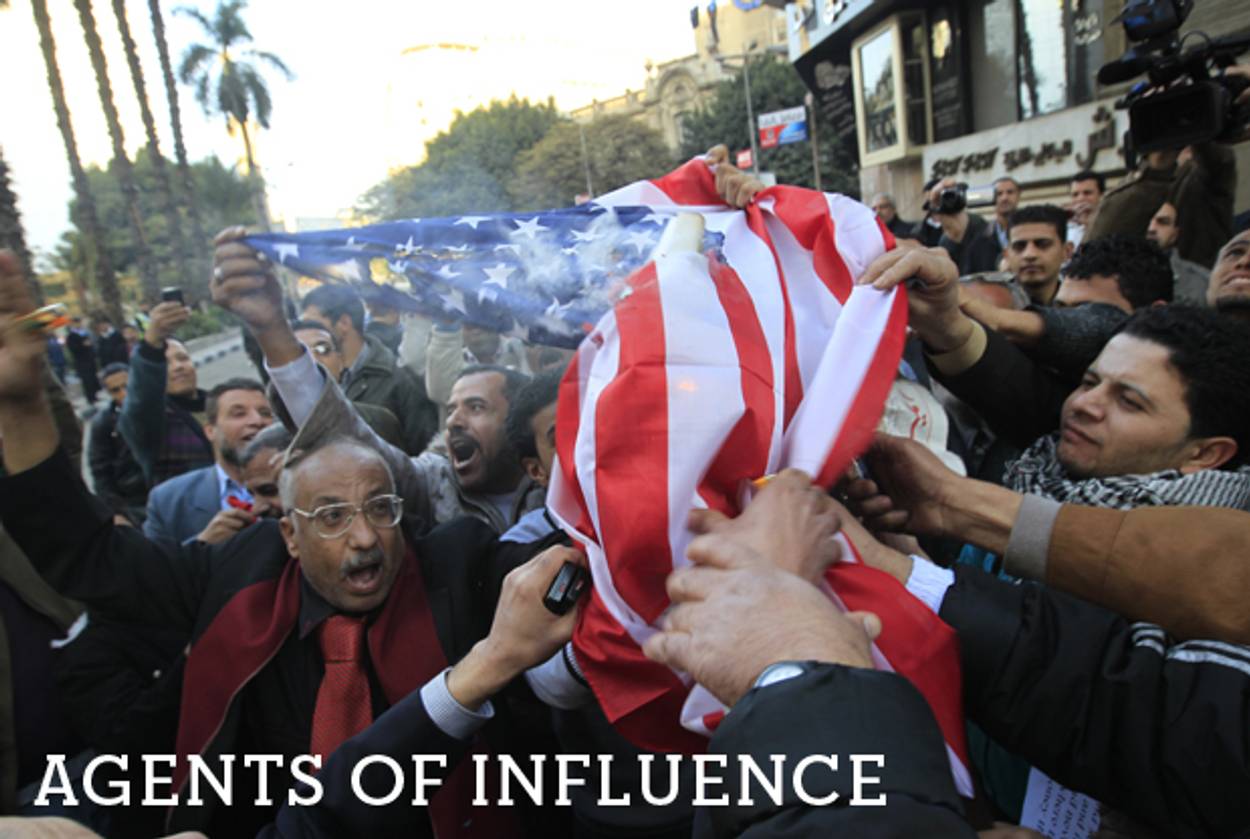
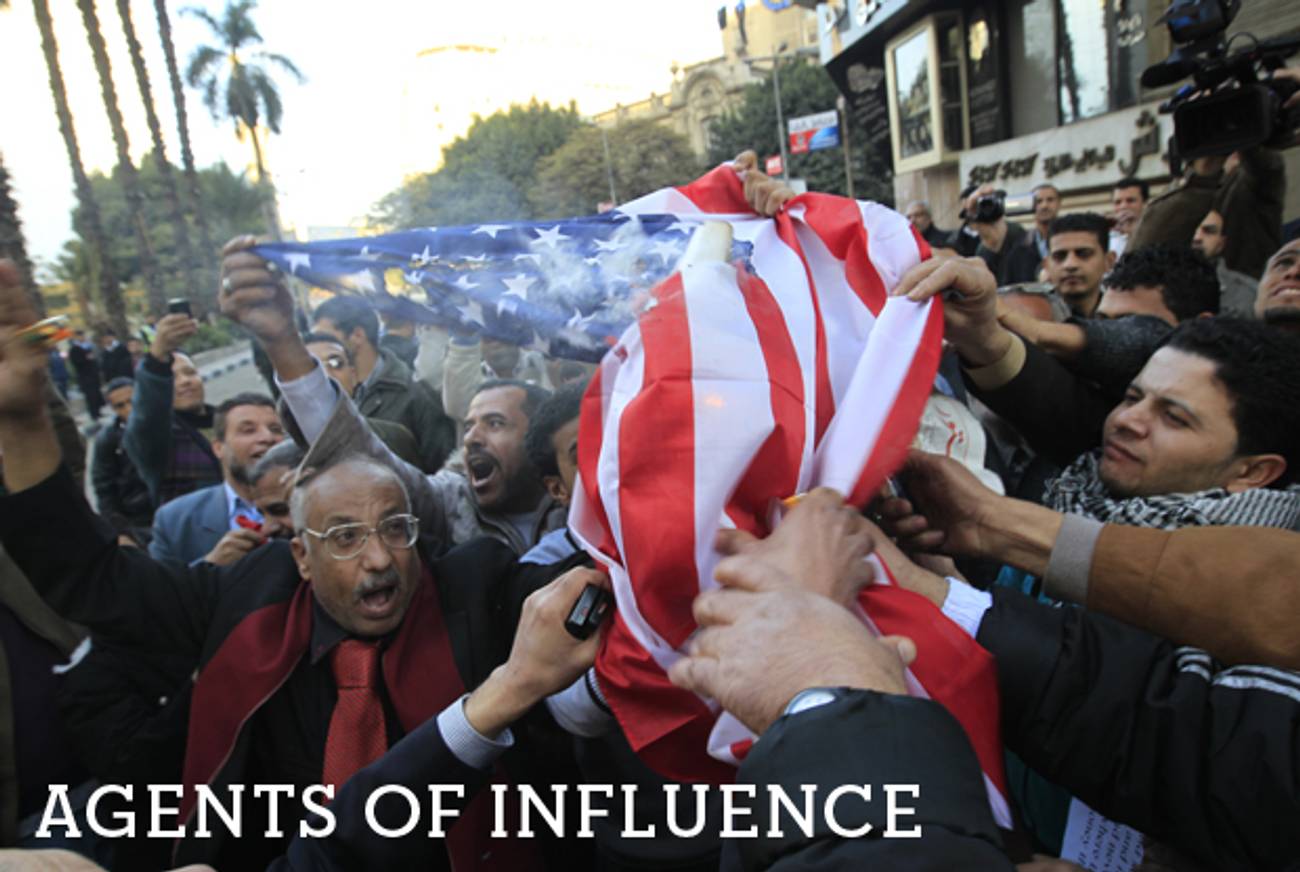
Since last month, 19 Americans working with pro-democracy nonprofit organizations have been under investigation for trumped-up charges of operating without proper registration. On Monday, the Egyptian government announced that these Americans would actually stand trial. The threat of a show trial with a large group of U.S. citizens has brought Washington and Cairo into the sort of direct conflict that would have been unimaginable under former Egyptian President Hosni Mubarak.
One of the U.S. organizations that’s been targeted, the International Republican Institute, released a statement on Sunday arguing that these arrests represent a “politically motivated effort to squash Egypt’s growing civil society, orchestrated through the courts, in part by Mubarak-era holdovers.” Perhaps the organization, headed by Sam LaHood, son of U.S. Transportation Secretary Ray LaHood and one of the Americans set to be prosecuted, put out this statement to give the Supreme Council of the Armed Forces a chance to blame the incident on Egypt’s bogeyman.
But the truth is that this crisis has nothing to do with civil society or the work that American pro-democracy groups do in the new Egypt. Had American hikers been available for kidnapping, they’d have served just as well as LaHood and the 18 others. No, this is simple extortion—and the Egyptian government expects to be paid.
Republican presidential candidate Newt Gingrich has already dubbed this the “Obama Hostage Crisis.” He’s not too far off. What Ayatollah Khomeini said about the 1979 Iranian hostage crisis applies equally well here: America cannot do a damn thing.
By blaming the situation on “Mubarak-era holdovers,” the International Republican Institute seems to be suggesting that this incident does not really reflect the new Egypt. Instead, it must be the old regime that is responsible for threatening Americans. Only Mubarak’s cronies could want to hold back Egyptian democracy.
The reality is rather different. A December Gallup poll showed that 71 percent of Egyptians oppose U.S. economic aid of any sort, and that 74 percent oppose “direct U.S. aid to Egyptian civil society organizations.” While this doesn’t mean the majority of Egyptians support threatening American democracy activists with prison time, such behavior on the part of the country’s ruling authorities certainly reflects popular opinion—and that’s to say nothing of the Muslim Brotherhood and the Salafists, who combined won more than two-thirds of parliament in recent elections. Given their history of resistance to the West and their perception of the United States as an imperial power, it’s safe to assume that these groups aren’t much interested in U.S. involvement in Egypt’s new political arena.
It’s worth noting how these December poll numbers track in parallel to last March’s constitutional referendum. That vote gave the Egyptian electorate a choice: Either vote on a few amendments to the 1971 constitution and push ahead to elections, or write a new constitution, a process that would delay elections. The army and the Islamists favored the first, while the revolutionaries who brought down Mubarak opted for the second, since it would give them a chance to organize coherent political entities capable of winning seats in parliament. Ultimately, three-quarters of the voters sided with the army and the Islamists. Only one quarter voted with the revolutionaries—presumably the same quarter of Egypt’s population that polled in favor of continued U.S. aid to civil society, support that gave rise to the revolution itself.
The most curious question is this: If so many Egyptians are against U.S. aid money to Egyptian civil society, how did organizations like the International Republican Institute and its counterpart, the National Democratic Institute, manage to do their work for so long? If they are charged with operating without a license, but had been working in Egypt regardless for many years before the arrests, how did they get away with it? Because Hosni Mubarak let them.
The man who now lies in a hospital bed in Sharm el-Sheikh under house arrest and is typically blamed for everything that has gone wrong in Egypt over the last 30 years is the same man who was at the helm as Egyptian civil society grew. The revolutionaries who toppled the Egyptian president arose under him. The middle-class, ostensibly liberal-minded, and Western-oriented demonstrators who protested in favor of democracy were drawn from the nonprofit organizations, independent media outlets, and private-sector enterprises that had all come about under Mubarak.
These weren’t real reforms, runs the argument against Mubarak. He didn’t go nearly far enough. It’s true. Forty percent of Egypt’s population still lives on less than $2 a day, and Mubarak’s security services were still torturing and murdering innocent Egyptians, like Khaled Said, whose June 2010 death helped inspire the January revolution.
The tragedy is that the choice the revolution revealed was never between dictatorship and democracy. Rather it was between a pro-American ruler who kept his country out of war and allowed moderate, halting reforms, and whatever order would follow Mubarak. Because the transition into the post-Mubarak era was not managed, neither by Mubarak nor the White House, the post-Mubarak order is effectively a repudiation of everything that Mubarak stood for.
Mubarak was obviously not a democrat but the head of an authoritarian military regime who was satisfied keeping Egypt stable, or, as his critics say, static. But the Americans, and to a lesser extent the Europeans, pumped in all sorts of money to promote Egyptian civil society. If Mubarak wanted military aid, he had to tolerate pro-democracy money—for human-rights initiatives and voter-registration drives, among other programs—as well. You can argue that he had no choice, but it is now obvious that he did: Like the current ruling authorities, he could have leveled trumped-up charges against American democracy activists in order to leverage Egypt’s economic and political position.
As Washington policymakers understand, the Egyptian hostage crisis does not merely touch on the fate of 19 Americans. Secretary of State Hillary Clinton, as well as lawmakers like Republican Sen. John McCain and Democratic Sen. Carl Levin, has warned that the $1.3 billion Egypt receives annually from the U.S. in military aid might be in jeopardy. However, it’s highly unlikely that Washington will forfeit the only instrument it has to influence Egypt’s political order.
Perhaps some U.S. officials think that with the Egyptian economy in such bad shape—declining tourism receipts, flight of capital, dwindling hard currency reserves, and lack of foreign direct investment—this might be a good time to pump U.S. aid money directly into the pockets of regular Egyptians. After all, why should we fund a military caste that kidnaps the sons of American Cabinet secretaries and will likely use its expensive U.S.-made weapons against its own people, as it did against Coptic Christians in October, or against American allies, like Israel? Instead of the $250 million scheduled this year for economic aid, we should give the whole package, more than $1.5 billion, to the Egyptian people.
It’s doubtful we could get money past the military. And even if we did, who knows that it wouldn’t set the stage for civil war. The army could play on the various divisions already at work in Egyptian society—Muslims vs. Christians, Muslim Brotherhood vs. Salafis, as well as the competing security services already at each other’s throats—to create conflicts that would require Egyptian military intervention backed up by U.S. support and money to restore the peace, such as it is.
But there is already a real wedge between the Egyptian people and its army: The former has said it doesn’t want U.S. aid while the latter needs it. In fact, the Egyptian army is so desperate for American money that it wants more of it, which is why it is going to put 19 Americans on trial. From the perspective of Cairo’s current ruling clique, at approximately $2 billion a year, Mubarak sold Egypt for way too little over the past 30 years, and now, given Egypt’s economic bind, it needs as much as it can possibly squeeze out of the White House. A visiting Egyptian military delegation canceled its meetings with U.S. policymakers on Monday to make explicit to Washington that Egypt has the much stronger bargaining position.
Here’s how things are likely to shake out: Most of the money will continue to flow to the military because that is the only instrument Washington has in the post-Mubarak Egypt to affect Cairo’s political system. Moreover, as U.S. policymakers know, U.S. military aid means that Washington has a more or less accurate accounting of the Egyptian army’s budget and that it will not seek to buy the majority of its arms elsewhere, like Russia.
Therefore, given the explicit anti-U.S. nature of Egypt’s population, the choice before our policymakers is whether or not to fund an army that is ruling a state hostile to our national interests, where domestic dynamics may drive it to war with Israel. The other option is to let someone else equip that same army, over which we will therefore have no control at all. At least opting for the first means that those 19 American citizens will be released by the regime sooner rather than later.
Lee Smith is the author of The Consequences of Syria.