Until a year ago, Tahani Soliman, a 37-year-old Israeli Arab, says she didn’t feel any strong connection to Upper Nazareth, the Central Galilee town where she lives with her husband and two children. Soliman describes the predominantly Jewish suburb of about 40,000, which looks out over the ancient Arab city of Nazareth, as serving as little more than a “hotel” for her family. “There’s no school here for the kids, no after-school activities,” so her son and daughter, 16 and 12, respectively, spend their days in Nazareth, just to the southwest. That’s also where she and her husband, Ratb, operate the print business and school-supplies shop they own. They return home each evening to Upper Nazareth to sleep.
But on March 30, 2011, Soliman had an experience that made her feel she had something at stake in her bedroom community. Every year on March 30, Israel’s Arab citizens and Palestinians commemorate the anniversary of the 1976 protests that resulted in the killing of six Arab citizens by Israeli security forces in the nearby Galilee town of Sakhnin. The original demonstrations—the central event in what was called “Land Day”—were intended to express anger over the state’s expropriation of Arab-owned lands in the region, and they continue to be a vehicle for Arabs’ general frustration over their treatment by the state.
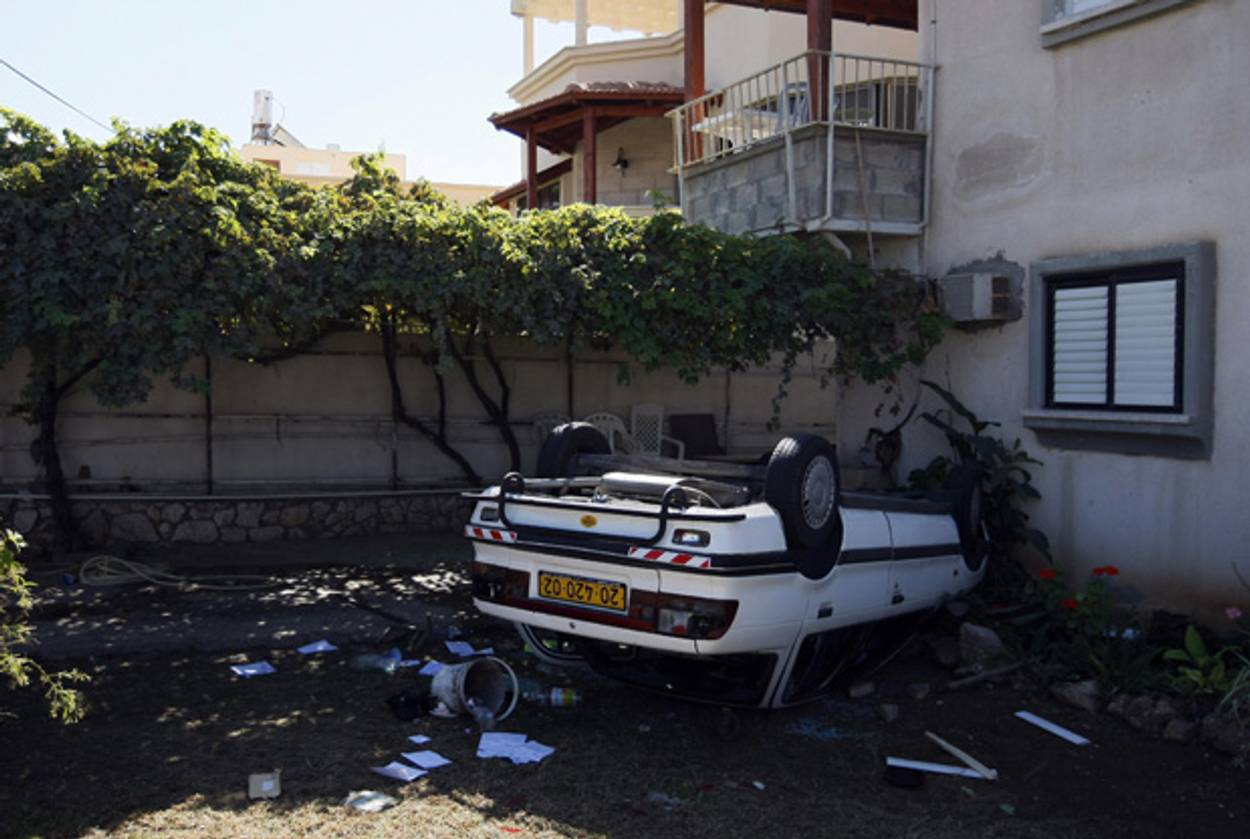
Soliman, who is active in the Arab-Jewish socialist party Hadash, decided to join fellow party members at their 2011 Land Day demonstration. “I had a black-and-white kaffiyeh I wanted to wear”—an article of clothing that she wouldn’t wear publicly in Upper Nazareth, where she says that her family doesn’t speak Arabic in their grocery store for fear of drawing unwanted attention. Because the checkered scarf was damp, she hung it outside to dry. The next thing she knew, “stones were being thrown at my house from all directions.” Nothing was broken, and no one was hurt, but Soliman told me she saw the teenagers who threw the stones, and heard them call out “Death to Arabs.”
Tahani Soliman and her family are among an estimated 7,000 Arabs—the equivalent of about 18 percent of the population—living in Upper Nazareth. I spoke with her about what it’s like to be an Arab in a predominantly Jewish town. Although she initially described it as placid and uneventful, once she told me about the kaffiyeh incident, she began to recall other acts of anti-Arab racism.
There was, for example, the time “someone sprayed the words ‘Kahane was right’ on my neighbors’ house,” a reference to the late American-born rabbi Meir Kahane, who advocated for the expulsion of Arab citizens from the state. “It’s a very lovely house,” she added.
“We didn’t make a big deal about these things,” she said. “The police came, and the slogan was erased, and forgotten.” That was then. Today, Soliman is part of a newly formed group of Arab women in Upper Nazareth who have organized to pressure local government to give them their due.
In the Jewish state, Jews and Arabs generally live separately. Even in so-called mixed cities like Haifa, Akko, Jaffa, Lod, Ramle, and Jerusalem—whose heterogeneous populations predate statehood—there are Arab neighborhoods and Jewish ones. It’s unusual to find members of the two communities living on the same block, let alone in the same apartment building.
Most people seem to like it this way. Even for those who consider themselves liberals, their ideal is more often “separate but equal” than equal and integrated. But in recent years, things have been changing, if only because conditions in Arab municipalities are anything but equal to those in Jewish towns.
Prof. Aziz Haidar discovered just to what extent several years ago, when he and his colleagues at the Jerusalem Van Leer Institute began mapping the Arab citizenry of Israel. They started with the raw population statistics compiled by the Central Bureau of Statistics, but when they added up the numbers of Arabs living in all the country’s Arab municipalities and in its mixed cities, “we discovered that there were 60,000 missing,” he said. That is, that the sum they arrived at was 60,000 less than the total number of Israelis classified in their identity cards as Arabs—in 2010, some 1.5 million. “It turned out,” Haidar said, “that they were living in Jewish cities. That was a big surprise.”
Haidar, an Arab born in the Western Galilee town of Majd al-Krum, has become an expert on the phenomenon of Arab internal migration. It’s far more common than most Jewish Israelis are aware of, with significant Arab presence in the “Jewish” towns of Carmiel, Nahariyya, Tzfat, Hadera, Afula, Kfar Sava, Tel Aviv, Netanya, and Givatayim, in addition to Upper Nazareth.
The most basic reason Arabs leave their traditional homes for bigger Jewish cities, Haidar said, is an inability to find affordable housing. In other cases, they move because of a job, something that is becoming more common as Arab young people get university degrees and are unable to find appropriate work in their rural hometowns. The best example of this is the Negev city of Be’er Sheva, where Arabs, both from the Galilee and from the surrounding Bedouin communities, have resettled in the thousands, many of them after attaining degrees at Ben-Gurion University.
Then there is the “quality of life” calculation. Many Arab towns lack community services and infrastructure that are standard in Jewish towns: paved roads and sidewalks, parks and gardens, community centers, as well as banks and police stations. Arab municipal governments are poorly funded and often dysfunctional, if not corrupt and nepotistic.
Haidar said that the prospect of urban anonymity—the ability to live in a place “where you’re able to sit in a café and read the newspaper without anyone recognizing you”—is also a major draw for people who have grown up in communities where your every action is known and scrutinized by your neighbors, many of whom are also members of your clan. For women who don’t want to be saddled with the restrictions of a traditional lifestyle, this can be particularly alluring.
When Soliman and her husband, Ratb Gommed, crossed the city line from Arab Nazareth to Upper Nazareth four years ago, they weren’t looking to make a political statement. They would have preferred to remain in Nazareth, Soliman said, but “we wanted privacy, and there were no villas [detached houses] or [semidetached] cottages in Nazareth.” Now, they are looking to move into a larger residence, a private house, but Tahani says she’s no longer interested in returning to Nazareth: “I live in Upper Nazareth,” she explained. “It’s ours too. It’s not a ‘Jewish’ city.”
That last remark isn’t just rhetorical: Soliman explained that her family owned agricultural land in the pre-state village of Jabl Sikh, now the site of the middle-class Upper Nazareth neighborhood of Har Yona. In an ironic twist, Har Yona is where the Soliman-Gommeds’ house is situated.
Upper Nazareth was established by the government of David Ben-Gurion in 1957 to serve as an anchor for Jewish settlement in the Galilee. Bringing more Jews to this verdant and historically rich part of the country has always been a national priority. Upper Nazareth and Ma’alot (on the northern border) were founded in the 1950s, and Carmiel, to the west, a decade later, together with a whole network of gated hilltop communities called mitzpim (lookouts) that accept only Jews as members. Nevertheless, the Galilee remains about 70 percent Arab.
In nearly 64 years of statehood, some 700 communities have been established in Israel, and all but a small handful of them were intended for Jews only. The land for those 700 towns and villages came in large part from the roughly 350 Arab communities that were abandoned during the War of Independence, in 1948-1949, when some 700,000 of the more than 800,000 Arabs living in Mandatory Palestine became refugees.
Today, the 150,000 Arabs who remained in Israel and became citizens have multiplied tenfold to some 1.5 million and constitute 20 percent of the population. Yet the proportion of land owned by Arabs has dropped from over 80 percent to under 5 percent during the same period. So, even if there weren’t middle-class Arabs who aspired to live in predominantly Jewish towns, the shortage of land and housing in all-Arab communities leaves some with little choice.
Unlike most phenomena having to do with Arabs and Jews in Israel, the trend of Arab migration has largely taken place under the radar, grabbing headlines only when public figures decide to use the trend to stoke populist fear. In 2010, for example, the chief rabbi of Tzfat issued an open letter to the 30,000 Jews of that northern city instructing them not to rent space in their homes to Arabs. (Tzfat hosts a small college where more than half of the students are Arab; some rent rooms from local residents.) His letter was signed by 18 other local rabbis.
That same year, Oren Milstein, the deputy mayor of Carmiel, was fired by the mayor in the wake of a campaign he initiated to encourage Jewish residents not to sell the homes to Arabs. Milstein had even set up an organization to which locals were encouraged to report anonymously on neighbors who were selling or renting to Arabs.
Shimon Gafsou, the mayor of Upper Nazareth, has also been outspoken about the need he sees to maintain his city’s Jewish character by attracting more Jewish residents. “I am building a neighborhood for Haredim only,” he told me over the phone, and he anticipates drawing 3,000 families, “with lots of children.”
I asked Gafsou he wasn’t concerned about attracting a population group that typically has high unemployment rates, and that, by nature of its highly restrictive way of life, often drives other populations out and property values down. He responded that the ultra-Orthodox he’s building for are a “quality” population of “working religious.”
Gafsou emphasized that Arabs have a legal right to live in his city and acknowledged that when they move there, it’s often because the state has historically “made mistakes, and they couldn’t develop in their own towns.” But tolerating the presence of individual Arab citizens is not the same as recognizing that they have collective needs, and Gafsou minced no words in declaring that “there won’t be an Arabic-language school” in Upper Nazareth so long as he is mayor. “Someone who wants to study in Arabic can go to study in Nazareth,” he said, which is exactly what most of the children from Arab families do, including Soliman’s.
At the same time, Gafsou said that Arabs are welcome to study in Jewish schools: “They don’t have to put a kippah on their head.” But Israel has always had separate schools for Jews and Arabs—not to mention Jewish children from secular and observant backgrounds—and the law mandates that if a certain minimum number of residents demand a particular type of school, the state has to accommodate them. There are already at least three Arabic-language public kindergartens in Upper Nazareth, but so far no primary schools.
City council member Shukri Awawdi says that a primary school for Arab children is a priority for his constituency and that “we’ll apply to the High Court of Justice if we need to. It’s not acceptable that I pay property tax and we don’t have schools. Our parents have become like taxi drivers, driving their kids every day to school and to after-school activities [in Nazareth], when it a basic right to study where you live.”
I asked Gafsou about the huge Israeli flag I saw hanging from a flagpole in the middle of a traffic circle in the Har Yona neighborhood, which is home to many of the city’s Arab families. It might not qualify for the Guinness Book of World Records, but it’s certainly one of the biggest flags I’ve ever seen, and I wondered aloud whether he thought that the people who hung the flag there were really trying to make Arabs feel welcome.
“I put up the flag,” Gafsou told me proudly. “It’s a Jewish town, and people who want to live here have to understand that it will always be Jewish.”
“Did you see the flag?” asked Fidaa Tabuny Abu Dbai, a longtime feminist activist who is leading the group of Arab women, including Soliman, that’s working to force the city to open an Arab grade school. “I think it’s a sign of insecurity. They have a feeling they’re losing control.” She compares Upper Nazareth to cosmopolitan Haifa. “Haifa is 11 percent Arab, but it feels like a mixed city. Upper Nazareth is 18 percent Arab, but it’s a Jewish town. Its streets are named for Jews, its cultural life is Jewish. You don’t feel it’s a place where Arabs live next to Jews.”
If most Arabs migrate to Jewish towns seeking a better life, they may well begin to think of their presence in political terms if they encounter hostility once there. Abu Dbai told me that she had previously invested her political energies in other people’s causes and that it is only within the last year or two that she began thinking that the Arabs of Upper Nazareth—where she has lived for a decade—could organize to press for their rights. “We started having conversations, why don’t we have a school? We always said, ‘We’ll live here a while and then we’ll go back.’ But there’s nowhere to go back to.” Abu Dbai said she was instigated by smaller things, too. “When you go down with your girls to the playground,” and the other kids ostracize them, or worse, that can strengthen a family’s resolve to stand its ground.
Consider Zenat and Issam Kadry, a couple I met in Carmiel, the growing middle-class city of 40,000 that was established in the heart of the Arab Galilee in 1964. The pair moved here from the nearby village of Nahef in 1998. Today Issam owns an electrical contracting business with some 30 employees in Carmiel. The family lives in a lovely apartment built along the side of a hill on the city’s northern edge, looking out on the northern Galilee and Lebanon. But since the birth of their twins three years ago, Zenat and Issam have been looking for a bigger place.
Issam is self-assured, and even when is describing a case of petty racism, he seems more amused than irritated. He says, for example, that he has encountered real-estate agents who, when they hear that the Kadry family already lives in Carmiel, have responded by saying, “That’s already better. You won’t upset the balance.” Another agent, he recalls, an Arab woman, instructed him: “Don’t speak loud. I’ll find you something but don’t make a big deal.”
Zenat, 37, for her part, is angered by the way she and her family have been received in Carmiel. She has sent all five of her children to Hebrew-language pre-schools in Carmiel. It’s important to her that they be proficient in Hebrew. Over the years, however, very few Jewish children have been permitted by their parents to visit her kids at home. She’s also a charter member of a Jewish-Arab group that has formed in the town to organize for equal rights for all residents—and one of the first goals of the group is to have the city open up a bilingual Arab-Jewish kindergarten. (Both this group and the group of Arab women in Upper Nazareth are receiving assistance from Shatil, an organization that helps build civil society in Israel.)
At the same time, however, she said that she does not view herself as an Israeli: “I am completely Palestinian,” she told me. Yet she wouldn’t consider leaving Carmiel because “this is my land.” I asked her what she meant by that. Was she referring to the land on which the city was built, because it was expropriated from a number of Arab villages in the area? “My land is all of Palestine,” she responded. Later, when we talked about their search for a new house, she made a point of declaring that when they sell the house in which I’m visiting them, she will consider selling “to Arabs only.” Issam said that she doesn’t mean it; Zenat insisted she was serious—and both were smiling, as if this wasn’t the first time they’d had this argument.
Like this article? Sign up for our Daily Digest to get Tablet Magazine’s new content in your inbox each morning.
David B. Green is an editor at Haaretz English Edition, and writes its “This Day in Jewish History” column.